


Serotype distribution and antimicrobial resistance of human Salmonella enterica in Bangui, Central African Republic, from 2004 to 2013
- PMID: 31790418
- PMCID: PMC6907862
- DOI: 10.1371/journal.pntd.0007917
Serotype distribution and antimicrobial resistance of human Salmonella enterica in Bangui, Central African Republic, from 2004 to 2013
Abstract
Background: Limited epidemiological and antimicrobial resistance data are available on Salmonella enterica from sub-Saharan Africa. We determine the prevalence of resistance to antibiotics in isolates in the Central African Republic (CAR) between 2004 and 2013 and the genetic basis for resistance to third-generation cephalosporin (C3G).
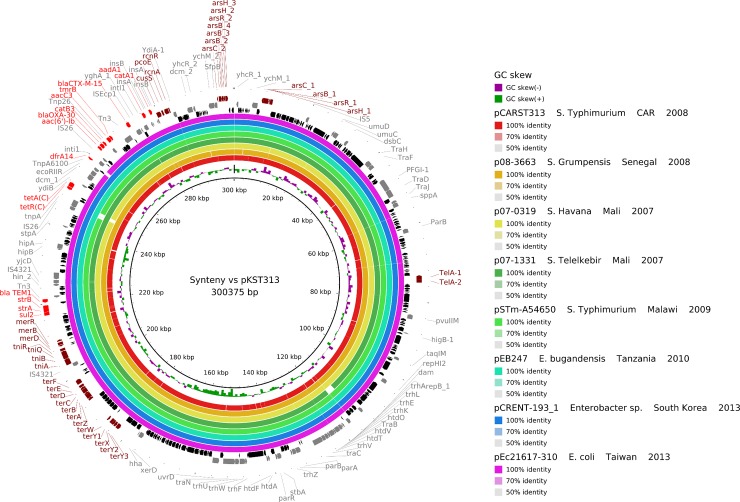
Methodology/principal findings: A total of 582 non-duplicate human clinical isolates were collected. The most common serotype was Typhimurium (n = 180, 31% of the isolates). A randomly selected subset of S. Typhimurium isolates were subtyped by clustered regularly interspaced short palindromic repeat polymorphism (CRISPOL) typing. All but one invasive isolate tested (66/68, 96%) were associated with sequence type 313. Overall, the rates of resistance were high to traditional first-line drugs (18-40%) but low to many other antimicrobials, including fluoroquinolones (one resistant isolate) and C3G (only one ESBL-producing isolate). The extended-spectrum beta-lactamase (ESBL)-producing isolate and three additional ESBL isolates from West Africa were studied by whole genome sequencing. The blaCTX-M-15 gene and the majority of antimicrobial resistance genes found in the ESBL isolate were present in a large conjugative IncHI2 plasmid highly similar (> 99% nucleotide identity) to ESBL-carrying plasmids found in Kenya (S. Typhimurium ST313) and also in West Africa (serotypes Grumpensis, Havana, Telelkebir and Typhimurium).
Conclusions/significance: Although the prevalence of ESBL-producing Salmonella isolates was low in CAR, we found that a single IncHI2 plasmid-carrying blaCTX-M-15 was widespread among Salmonella serotypes from sub-Saharan Africa, which is of concern.
Conflict of interest statement
The authors have declared that no competing interests exist.
Figures
References
-
- Harrois D, Breurec S, Seck A, Delaune A, Le Hello S, Pardos de la Gandara M, et al. Prevalence and characterization of extended-spectrum beta-lactamase-producing clinical Salmonella enterica isolates in Dakar, Senegal, from 1999 to 2009. Clin Microbiol Infect. 2014;20:O109–16. 10.1111/1469-0691.12339 . - DOI - PubMed
-
- Breurec S, Vanel N, Bata P, Chartier L, Farra A, Favennec L, et al. Etiology and epidemiology of diarrhea in hospitalized children from low income country: a matched case-control study in Central African Republic. PLoS Negl Trop Dis. 2016;10:e0004283 10.1371/journal.pntd.0004283 . - DOI - PMC - PubMed
-
- Rafai C, Frank T, Manirakiza A, Gaudeuille A, Mbecko JR, Nghario L, et al. Dissemination of IncF-type plasmids in multiresistant CTX-M-15-producing Enterobacteriaceae isolates from surgical-site infections in Bangui, Central African Republic. BMC Microbiol. 2015;15:15 10.1186/s12866-015-0348-1 . - DOI - PMC - PubMed
Publication types
MeSH terms
Substances
LinkOut - more resources
Full Text Sources
Medical
