Observational Study
. 2019 Dec 2;23(1):389.
doi: 10.1186/s13054-019-2668-2.

Ultrasound-based clinical profiles for predicting the risk of intradialytic hypotension in critically ill patients on intermittent dialysis: a prospective observational study

Affiliations
Observational Study

Ultrasound-based clinical profiles for predicting the risk of intradialytic hypotension in critically ill patients on intermittent dialysis: a prospective observational study

Rogerio da Hora Passos et al. Crit Care. .

Abstract

Background: Intradialytic hypotension, a complication of intermittent hemodialysis, decreases the efficacy of dialysis and increases long-term mortality. This study was aimed to determine whether different predialysis ultrasound cardiopulmonary profiles could predict intradialytic hypotension.

Methods: This prospective observational single-center study was performed in 248 critically ill patients with acute kidney injury undergoing intermittent hemodialysis. Immediately before hemodialysis, vena cava collapsibility was measured by vena cava ultrasound and pulmonary congestion by lung ultrasound. Factors predicting intradialytic hypotension were identified by multiple logistic regression analysis.

Results: Intradialytic hypotension was observed in 31.9% (n = 79) of the patients, interruption of dialysis because of intradialytic hypotension occurred in 6.8% (n = 31) of the sessions, and overall 28-day mortality was 20.1% (n = 50). Patients were classified in four ultrasound profiles: (A) 108 with B lines > 14 and vena cava collapsibility > 11.5 mm m-2, (B) 38 with B lines < 14 and vena cava collapsibility ≤ 11.5 mm m-2, (C) 36 with B lines > 14 and vena cava collapsibility Di ≤ 11.5 mm m-2, and (D) 66 with B lines < 14 and vena cava collapsibility > 11.5 mm m-2. There was an increased risk of intradialytic hypotension in patients receiving norepinephrine (odds ratios = 15, p = 0.001) and with profiles B (odds ratios = 12, p = 0.001) and C (odds ratios = 17, p = 0.001).

Conclusion: In critically ill patients on intermittent hemodialysis, the absence of hypervolemia as assessed by lung and vena cava ultrasound predisposes to intradialytic hypotension and suggests alternative techniques of hemodialysis to provide better hemodynamic stability.

Keywords: Acute kidney injury; Critically ill patients; Dialysis; Hypotension; Profiles; Ultrasound.


Conflict of interest statement

The authors declare that they have no competing interests.

Figures
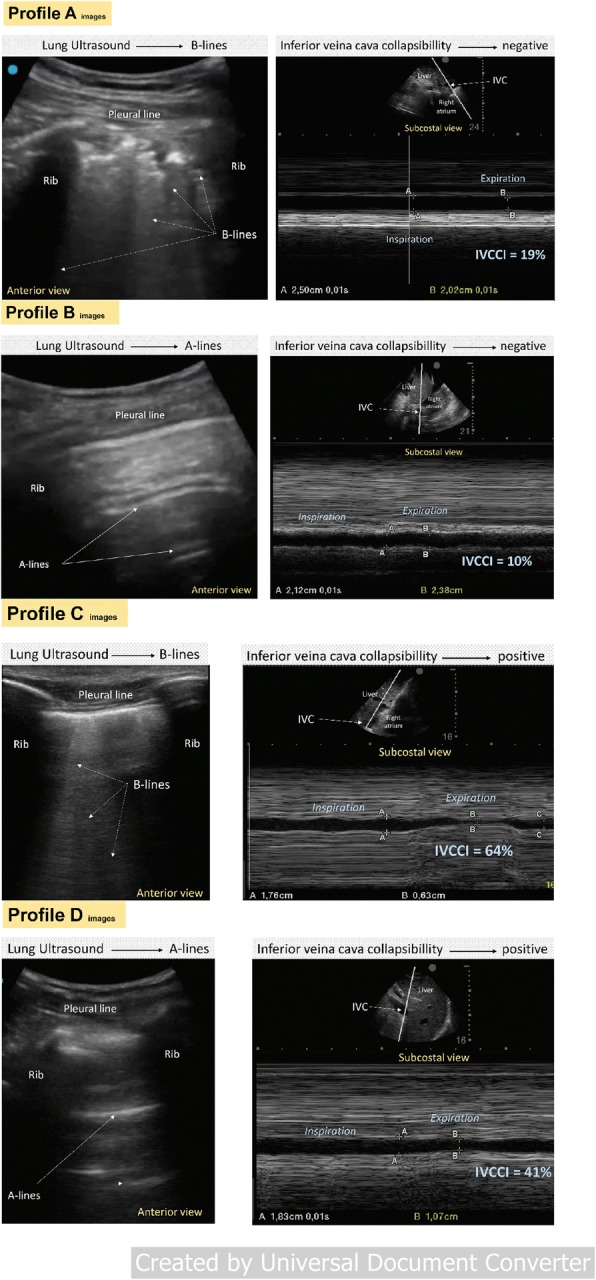
Fig. 1
Fig. 1
Vena cava and lung ultrasound profiles. (Profile A) 66-year-old patient admitted to the intensive care unit for community-acquired pneumonia with acute kidney injury KDIGO 3 requiring hemodialysis. The patient had a positive fluid balance of 6.5 L and did not receive vasoactive support. In the right upper anterior thoracic region, multiple coalescent B lines issued from justapleural consolidations typical of bronchopneumonia are visible. As shown in the corresponding video file (Additional files 1, 2, 3, and 4), lung sliding is nearly abolished caused by inflammation/infection of pleural layers. The vena cava appears well filled and does not show any significant collapsibility with respiratory movements. (Profile B) 28-year-old patient admitted to the intensive care unit for a urinary tract infection, and acute kidney injury KDIGO 3 requiring dialysis was diagnosed. The patient had a positive fluid balance of 2.5 L, and he was on vasoactive support. In the right upper anterior thoracic region, predominant A lines are visible. As shown in the corresponding video file (Additional files 1, 2, 3, and 4), lung sliding is normal. The vena cava appears filled and shows not significant collapsibility with respiratory movements. (Profile C) 53-year-old patient admitted to the intensive care unit for an alcoholic acute pancreatitis. AKI (KDIGO) 2 was diagnosed, and intermittent dialysis was initiated. The patient had a positive fluid balance of 8.5 L, and he was on vasoactive support. In the right upper anterior thoracic region, white lines from the pleural line to the bottom (B–lines–comets) are visible. As shown in the corresponding video file (Additional files 1, 2, 3 and 4), lung sliding is normal. The vena cava appears collapsed with respiratory movements. (Profile D) 73-year-old patient admitted to the intensive care unit for an acute mesenteric ischemia treated by an extended right hemicolectomy. The patient developed AKI KDIGO 3, and intermittent dialysis was started. The patient had a positive fluid balance of 5.5 L and did not receive vasoactive support. In the right upper anterior thoracic region, horizontal lines (A lines) are visible. As shown in the corresponding video file (Additional files 1, 2, 3, and 4), lung sliding is normal. The vena cava appears collapsed with respiratory movements

References

    1. Claure-Del Granado R, Mehta RL. Fluid overload in the ICU: evaluation and management. BMC Nephrol. 2016;17:109. doi: 10.1186/s12882-016-0323-6. - DOI - PMC - PubMed
    1. Schortgen F, Soubrier N, Delclaux C, Thuong M, Girou E, Brun-Buisson C, et al. Hemodynamic tolerance of intermittent hemodialysis in critically ill patients: usefulness of practice guidelines. Am J Respir Crit Care Med. 2000;162:197–202. doi: 10.1164/ajrccm.162.1.9907098. - DOI - PubMed
    1. Doshi M, Murray PT. Approach to intradialytic hypotension in intensive care unit patients with acute renal failure. Artif Organs. 2003;27:772–780. doi: 10.1046/j.1525-1594.2003.07291.x. - DOI - PubMed
    1. Torino C, Gargani L, Sicari R, Letachowicz K, Ekart R, Fliser D, et al. The agreement between auscultation and lung ultrasound in hemodialysis patients: the LUST study. Clin J Am Soc Nephrol CJASN. 2016;11:2005–2011. doi: 10.2215/CJN.03890416. - DOI - PMC - PubMed
    1. Ross DW, Abbasi MM, Jhaveri KD, Sachdeva M, Miller I, Barnett R, et al. Lung ultrasonography in end-stage renal disease: moving from evidence to practice-a narrative review. Clin Kidney J. 2018;11:172–178. doi: 10.1093/ckj/sfx107. - DOI - PMC - PubMed

Publication types
