


Comprehensive assessment of side effects associated with a single dose of ketamine in treatment-resistant depression
- PMID: 31791675
- PMCID: PMC8457026
- DOI: 10.1016/j.jad.2019.11.028
Comprehensive assessment of side effects associated with a single dose of ketamine in treatment-resistant depression
Abstract
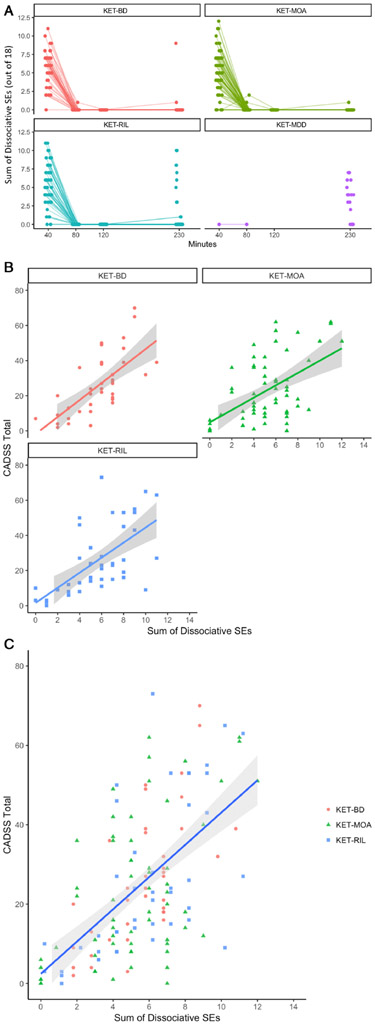
Background: Concerns about ketamine for treating depression include abuse potential and the occurrence of psychotomimetic effects. This study sought to comprehensively assess side effects (SEs) associated with a single subanesthetic-dose intravenous ketamine infusion. A secondary aim was to examine the relationship between Clinician-Administered Dissociative States Scale (CADSS) scores and dissociative symptoms reported on a comprehensive, clinician-administered SE questionnaire.
Methods: Data from 188 participants were pooled from four placebo-controlled, crossover ketamine trials and one open-label study (n = 163 with either treatment-resistant major depressive disorder or bipolar disorder and 25 healthy controls). SEs were actively solicited in a standardized fashion and monitored over the time-course of each study. Statistical analyses assessed the effect of drug (ketamine, placebo) on SEs and measured the relationship between CADSS total score and SEs contemporaneously endorsed during structured interviews.
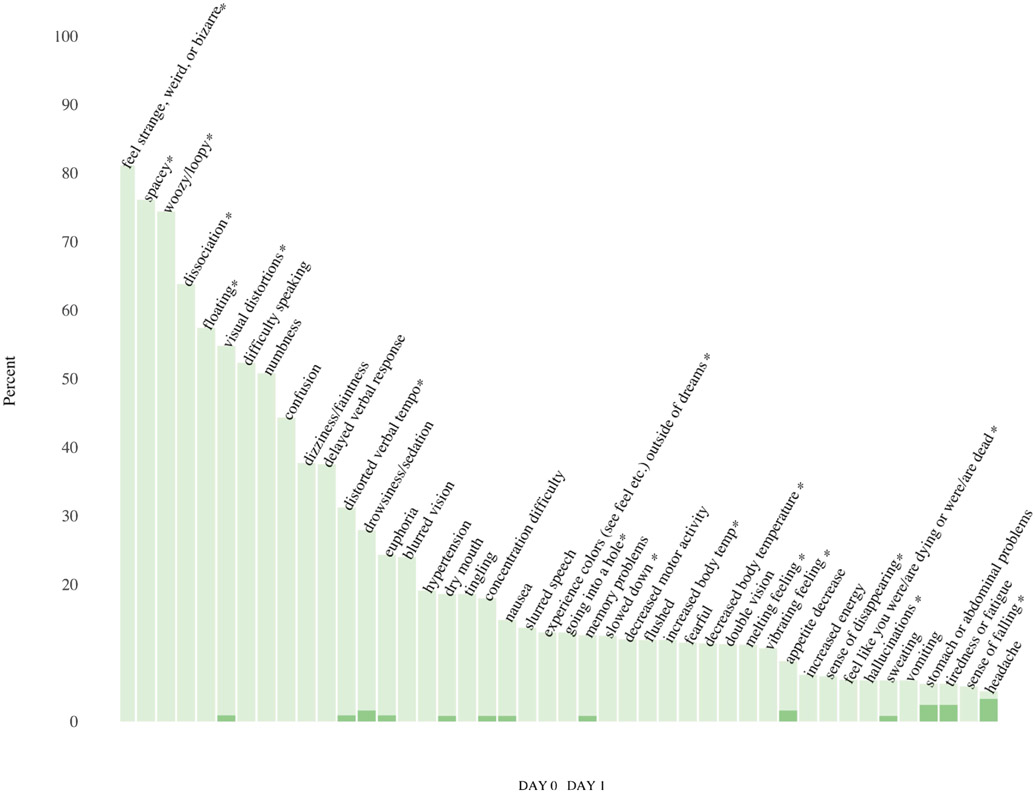
Results: Forty-four of 120 SEs occurred in at least 5% of participants over all trials. Thirty-three of these 44 SEs were significantly associated with active drug administration (versus placebo). The most common SE was feeling strange/weird/loopy. Most SEs peaked within an hour of ketamine administration and resolved completely by two hours post-infusion. No serious drug-related adverse events or increased ketamine craving/abuse post-administration were observed. A positive correlation was found between dissociative SEs and total CADSS score.
Limitations: The post-hoc nature of the analysis; the limited generalizability of a single subanesthetic-dose ketamine infusion; and the lack of formal measures to assess ketamine's cognitive, urological, or addictive potential.
Conclusions: No long-lasting significant SEs occurred over the approximately three-month follow-up period.
Trial registration: ClinicalTrials.gov NCT00088699.
Keywords: Adverse events; Dissociative; Ketamine; Major depressive disorder; Side effects.
Copyright © 2019. Published by Elsevier B.V.
Conflict of interest statement
Declaration of Competing Interest Dr. Zarate is listed as a co-inventor on a patent for the use of ketamine in major depression and suicidal ideation; as a co-inventor on a patent for the use of (2R,6R)-hydroxynorketamine, (S)-dehydronorketamine, and other stereoisomeric dehydro and hydroxylated metabolites of (R,S)-ketamine metabolites in the treatment of depression and neuropathic pain; and as a co-inventor on a patent application for the use of (2R,6R)-hydroxynorketamine and (2S,6S)-hydroxynorketamine in the treatment of depression, anxiety, anhedonia, suicidal ideation, and post-traumatic stress disorders. He has assigned his patent rights to the U.S. government but will share a percentage of any royalties that may be received by the government. Dr. Kraus received travel support from Roche and AOP Orphan. All other authors have no conflict of interest to disclose, financial or otherwise.
Figures
References
-
- aan het Rot M, Collins KA, Murrough JW, Perez AM, Reich DL, Charney DS, Mathew SJ, 2010. Safety and efficacy of repeated-dose intravenous ketamine for treatment-resistant depression. Biol Psychiatry 67,139–145. - PubMed
-
- American Psychiatric Association., 2013. Diagnostic and statistical manual for mental disorders, Fifth edition ed. American Psychiatric Publishing, Washington, DC, pp. 291 – 307.
-
- Benjamini Y, Yekutieli D, 2001. The control of the false discovery rate in multiple testing under dependency. Ann Statist 29, 1165–1188.
-
- Bonnet U, 2015. Long-term ketamine self-injections in major depressive disorder: focus on tolerance in ketamine's antidepressant response and the development of ketamine addiction. J Psychoactive Drugs 47, 276–285. - PubMed
Publication types
MeSH terms
Substances
Associated data
Grants and funding
LinkOut - more resources
Full Text Sources
Medical
