. 2019 Dec 2;9(1):18085.
doi: 10.1038/s41598-019-53988-4.

Genetics of cognitive trajectory in Brazilians: 15 years of follow-up from the Bambuí-Epigen Cohort Study of Aging

Affiliations

Genetics of cognitive trajectory in Brazilians: 15 years of follow-up from the Bambuí-Epigen Cohort Study of Aging

Mateus H Gouveia et al. Sci Rep. .

Abstract

Age-related cognitive decline (ACD) is the gradual process of decreasing of cognitive function over age. Most genetic risk factors for ACD have been identified in European populations and there are no reports in admixed Latin American individuals. We performed admixture mapping, genome-wide association analysis (GWAS), and fine-mapping to examine genetic factors associated with 15-year cognitive trajectory in 1,407 Brazilian older adults, comprising 14,956 Mini-Mental State Examination measures. Participants were enrolled as part of the Bambuí-Epigen Cohort Study of Aging. Our admixture mapping analysis identified a genomic region (3p24.2) in which increased Native American ancestry was significantly associated with faster ACD. Fine-mapping of this region identified a single nucleotide polymorphism (SNP) rs142380904 (β = -0.044, SE = 0.01, p = 7.5 × 10⁻⁵) associated with ACD. In addition, our GWAS identified 24 associated SNPs, most in genes previously reported to influence cognitive function. The top six associated SNPs accounted for 18.5% of the ACD variance in our data. Furthermore, our longitudinal study replicated previous GWAS hits for cognitive decline and Alzheimer's disease. Our 15-year longitudinal study identified both ancestry-specific and cosmopolitan genetic variants associated with ACD in Brazilians, highlighting the need for more trans-ancestry genomic studies, especially in underrepresented ethnic groups.


Conflict of interest statement

The authors declare no competing interests.

Figures

Figure 1
Figure 1
Tri‐hybrid genome‐wide individual proportion of ancestry of 1,407 participants of the Bambuí‐Epigen Cohort Study of Aging. Each bar represents one individual and the green, red, and blue colors in the bar plot represent the Native American, European, African ancestry, respectively.
Figure 2
Figure 2
Admixture mapping scans of African, European and Native American genomic segments of ancestry. The Admixture mapping analyses were performed using both (A) RFMix and (B) PCAdmix methods to infer the local ancestry. The horizontal red line represents the significance threshold for each admixture mapping test (see methods).
Figure 3
Figure 3
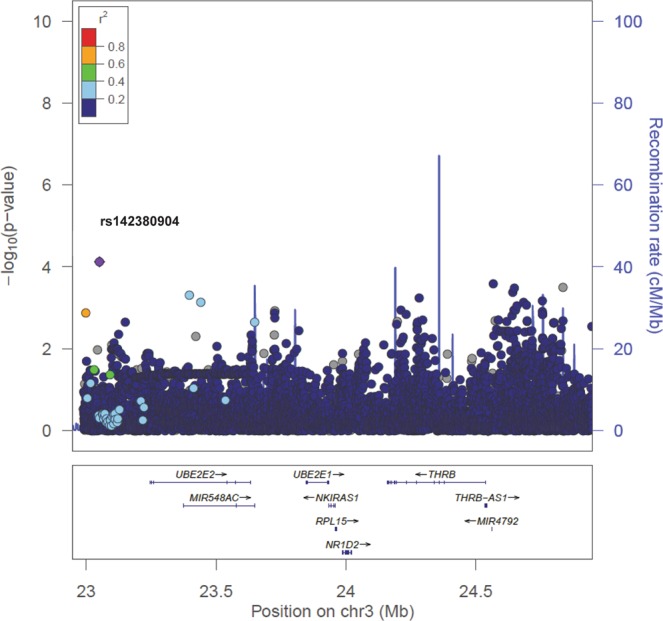
LocusZoom plot of fine mapping of the (3p24.2) region using both genotyped and imputed SNPs ± 1 Mb from the target region. The SNP rs142380904 with the lowest p-value is color coded in purple and labeled. The linkage disequilibrium between this SNP and the remaining nearby SNPs is indicated by the color coding according to r2 values based on admixed Americans (AMR) from 1000 Genomes Project.
Figure 4
Figure 4
Manhattan plot of the genome-wide association study (GWAS) analysis. The plot represents the −log10 transformed p values for all 10.4 M SNPs analyzed. The horizontal red line represents the standard genome-wide suggestive significance (p = 10-6). The rectangle highlights the hits for the five SNPs in the chromosome 7 (Table S1).

References

    1. Lin C-H, Lin E, Lane H-Y. Genetic Biomarkers on Age-Related Cognitive Decline. Front. Psychiatry. 2017;8:247. doi: 10.3389/fpsyt.2017.00247. - DOI - PMC - PubMed
    1. Desmond DW, et al. Frequency and clinical determinants of dementia after ischemic stroke. Neurology. 2000;54:1124–1131. doi: 10.1212/WNL.54.5.1124. - DOI - PubMed
    1. Lucin KM, Wyss-Coray T. Immune activation in brain aging and neurodegeneration: too much or too little? Neuron. 2009;64:110–122. doi: 10.1016/j.neuron.2009.08.039. - DOI - PMC - PubMed
    1. Reitz C, Brayne C, Mayeux R. Epidemiology of Alzheimer disease. Nat. Rev. Neurol. 2011;7:137–152. doi: 10.1038/nrneurol.2011.2. - DOI - PMC - PubMed
    1. Strachan MWJ, Reynolds RM, Marioni RE, Price JF. Cognitive function, dementia and type 2 diabetes mellitus in the elderly. Nat. Rev. Endocrinol. 2011;7:108–114. doi: 10.1038/nrendo.2010.228. - DOI - PubMed

Publication types