. 2019 Dec 2;9(1):18051.
doi: 10.1038/s41598-019-54409-2.

Changes in emm types and superantigen gene content of Streptococcus pyogenes causing invasive infections in Portugal

Collaborators, Affiliations

Changes in emm types and superantigen gene content of Streptococcus pyogenes causing invasive infections in Portugal

A Friães et al. Sci Rep. .

Abstract

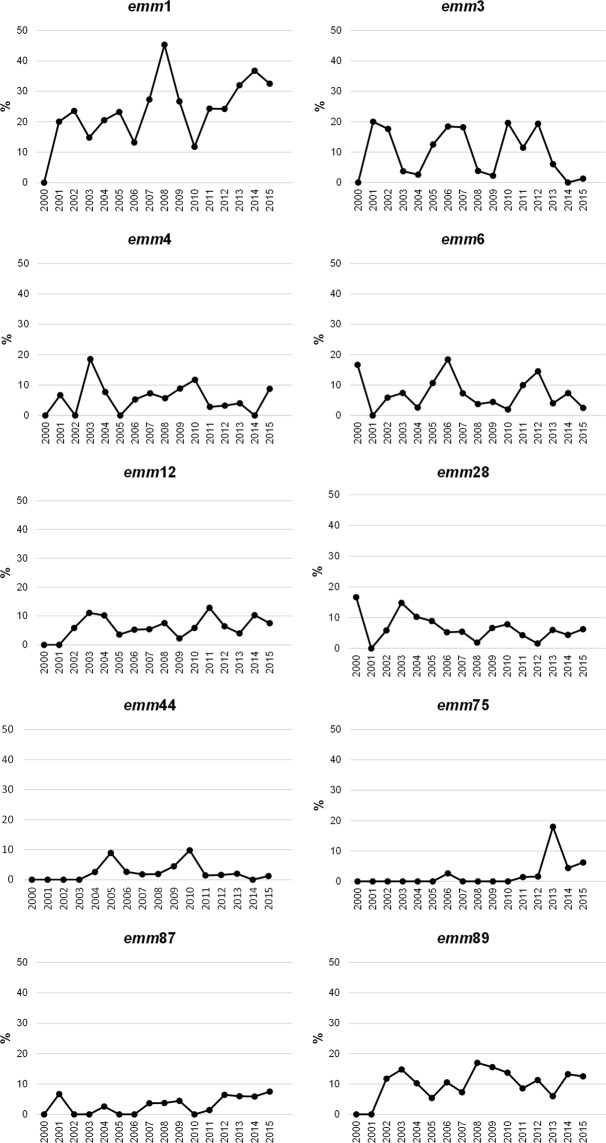
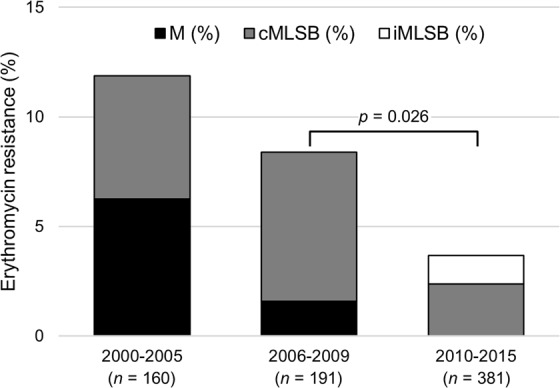
Fluctuations in the clonal composition of Group A Streptococcus (GAS) have been associated with the emergence of successful lineages and with upsurges of invasive infections (iGAS). This study aimed at identifying changes in the clones causing iGAS in Portugal. Antimicrobial susceptibility testing, emm typing and superantigen (SAg) gene profiling were performed for 381 iGAS isolates from 2010-2015. Macrolide resistance decreased to 4%, accompanied by the disappearance of the M phenotype and an increase of the iMLSB phenotype. The dominant emm types were: emm1 (28%), emm89 (11%), emm3 (9%), emm12 (8%), and emm6 (7%). There were no significant changes in the prevalence of individual emm types, emm clusters, or SAg profiles when comparing to 2006-2009, although an overall increasing trend was recorded during 2000-2015 for emm1, emm75, and emm87. Short-term increases in the prevalence of emm3, emm6, and emm75 may have been driven by concomitant SAg profile changes observed within these emm types, or reflect the emergence of novel genomic variants of the same emm types carrying different SAgs.


Conflict of interest statement

J.M.-C. has received research grants administered through his university and received honoraria for serving on the speakers bureaus of Pfzer and Merck Sharp and Dohme. M.R. has received honoraria for serving on the speakers bureau of Pfizer and for consulting for GlaxoSmithKline and Merck Sharp and Dohme. The other authors declare no conflict of interest. No company or financing body had any interference in the decision to publish.

Figures
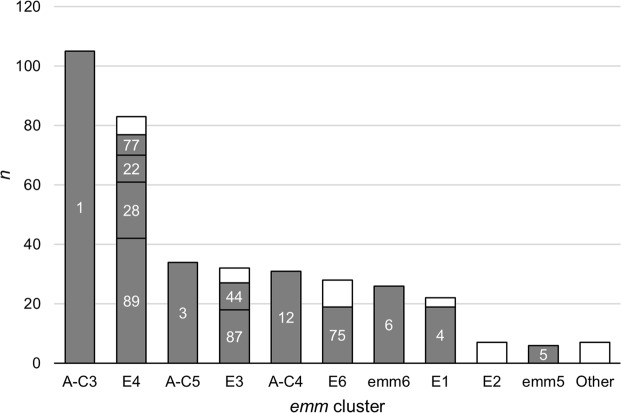
Figure 1
Figure 1
Distribution of GAS isolates recovered from normally sterile sites in Portugal during 2010–2015 according to emm cluster and emm type. Numbers inside the bars represent the emm types included in each cluster. White bars include emm types with <5 isolates [E4: emm102 (n = 2), emm2, emm73, emm84, and emm169 (each n = 1); E3: emm118 (n = 2), emm9, emm82, and emm103 (each n = 1); E6: emm11 (n = 4), emm81 (n = 2), emm85, emm94, and emm99 (each n = 1); E1: emm78 (n = 2) and emm165 (n = 1); E2: emm90, emm110 (each n = 2), emm50, emm66, and emm104 (each n = 1)]. M5 and M6 are singletons belonging to clade Y. “Other” includes emm clusters or singletons with <5 isolates each [D4: emm70 (n = 2), emm33, and emm43 (each n = 1); D2: emm71 (n = 1); D3: emm123 (n = 1); M18: emm18 (n = 1)].
Figure 2
Figure 2
Yearly prevalence (%) of emm types with ≥20 isolates in 2000–2015. Isolates from 2000–2009 were characterised previously,.
Figure 3
Figure 3
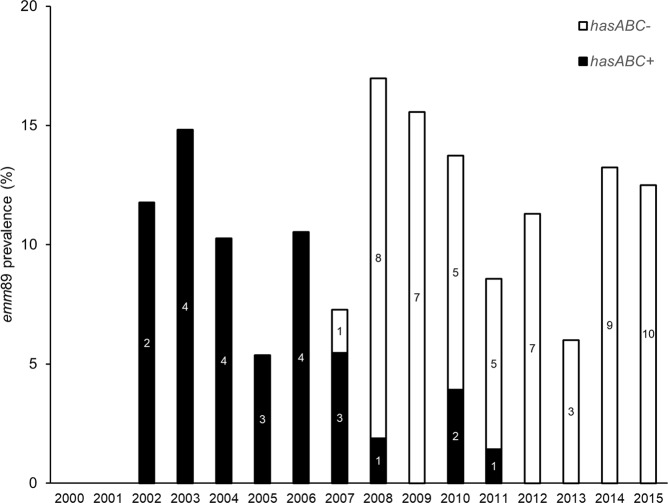
Yearly distribution of invasive emm89 isolates with (filled bars) and without (open bars) the hasABC locus. Numbers inside the bars represent number of isolates. Data from 2000–2009 was previously published.
Figure 4
Figure 4
Prevalence of erythromycin resistance and of macrolide resistance phenotypes among isolates recovered from invasive infections in Portugal during 2000–2015. The numbers below each period represent the total number of iGAS isolates recovered. Data from 2000–2005 and 2006–2009 was previously published,.

References

    1. Carapetis JR, Steer AC, Mulholland EK, Weber M. The global burden of group A streptococcal diseases. Lancet Infect. Dis. 2005;5:685–694. doi: 10.1016/S1473-3099(05)70267-X. - DOI - PubMed
    1. Walker MJ, et al. Disease manifestations and pathogenic mechanisms of group A Streptococcus. Clin. Microbiol. Rev. 2014;27:264–301. doi: 10.1128/CMR.00101-13. - DOI - PMC - PubMed
    1. Fischetti, V. A. Vaccine approaches to protect against group A streptococcal pharyngitis. Microbiol Spectr7 (2019). - PMC - PubMed
    1. Beall B, Facklam R, Thompson T. Sequencing emm-specific PCR products for routine and accurate typing of group A streptococci. J. Clin. Microbiol. 1996;34:953–958. - PMC - PubMed
    1. Sanderson-Smith M, et al. A systematic and functional classification of Streptococcus pyogenes that serves as a new tool for molecular typing and vaccine development. J Infect Dis. 2014;210:1325–1338. doi: 10.1093/infdis/jiu260. - DOI - PMC - PubMed

Publication types

MeSH terms