Review
. 2019 Dec;213(4):1145-1188.
doi: 10.1534/genetics.119.300238.

Biology of the Caenorhabditis elegans Germline Stem Cell System

Affiliations
Review

Biology of the Caenorhabditis elegans Germline Stem Cell System

E Jane Albert Hubbard et al. Genetics. 2019 Dec.

Abstract

Stem cell systems regulate tissue development and maintenance. The germline stem cell system is essential for animal reproduction, controlling both the timing and number of progeny through its influence on gamete production. In this review, we first draw general comparisons to stem cell systems in other organisms, and then present our current understanding of the germline stem cell system in Caenorhabditis elegans In contrast to stereotypic somatic development and cell number stasis of adult somatic cells in C. elegans, the germline stem cell system has a variable division pattern, and the system differs between larval development, early adult peak reproduction and age-related decline. We discuss the cell and developmental biology of the stem cell system and the Notch regulated genetic network that controls the key decision between the stem cell fate and meiotic development, as it occurs under optimal laboratory conditions in adult and larval stages. We then discuss alterations of the stem cell system in response to environmental perturbations and aging. A recurring distinction is between processes that control stem cell fate and those that control cell cycle regulation. C. elegans is a powerful model for understanding germline stem cells and stem cell biology.

Keywords: Caenorhabditis elegans; Notch; WormBook; network; niche; physiology; stem cell.


Figures

Figure 1
Figure 1
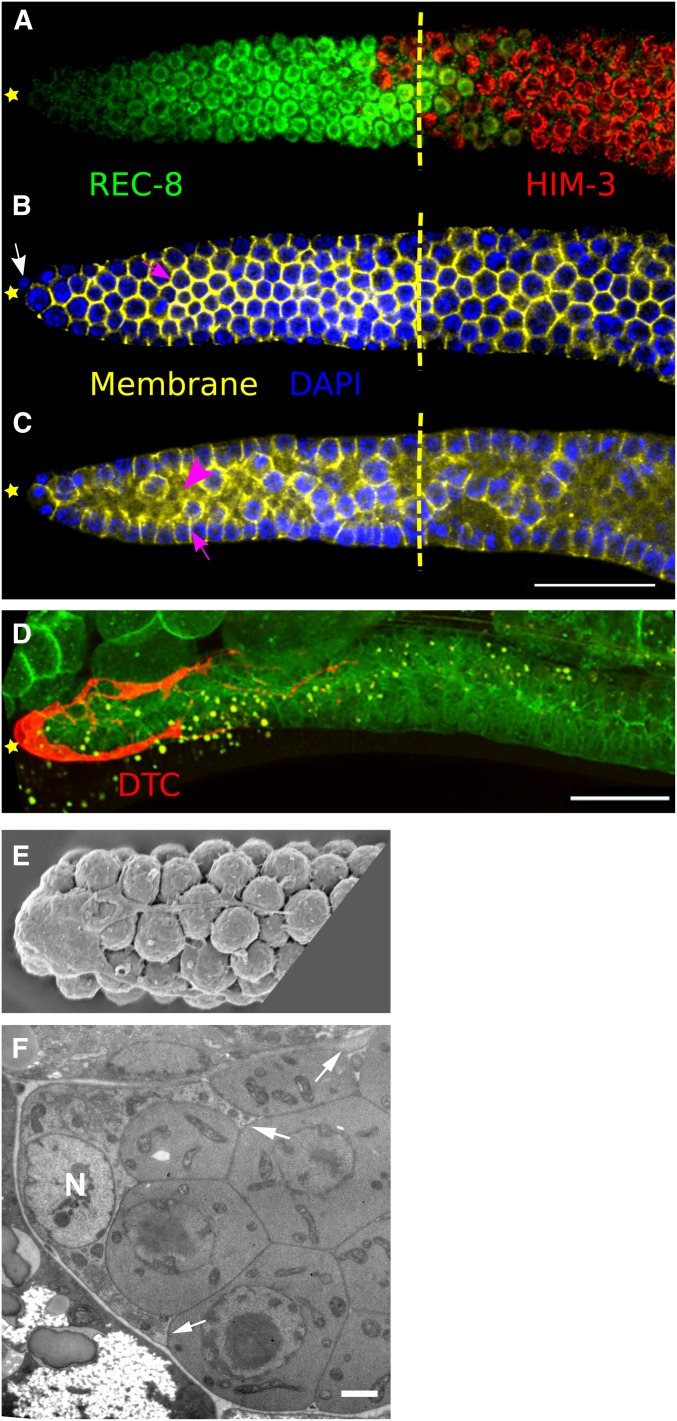
Cytology of the germline stem cell system. (A–C) Fluorescence micrographs of a dissected young adult hermaphrodite gonad. (A) Progenitor zone (PZ) cells are marked in green (nucleoplasmic REC-8) and cells in leptotene-zygotene are marked in red (meiotic chromosome axis protein HIM-3). (B) Surface view and (C) internal view of gonad with cell plasma membranes in yellow [GFP::PH(PLCdelta)] and nuclei in blue (DAPI). Pink arrows and arrowheads indicate plasma membranes and core (or rachis), respectively. For all panels, distal is left and proximal is right; white arrow marks distal tip cell (DTC) nucleus, yellow star marks the distal tip of the gonad, and yellow vertical dashed line marks the boundary of the PZ and leptotene. In this gonad, the boundary is at cell diameter 21 from the distal tip where more half of the cells in a row have switched from strong nucleoplasmic REC-8 staining to HIM-3 staining. (D) Fluorescence micrograph of DTC cytoplasm in a live young adult hermaphrodite (red, lag-2p::mCherry) and membranes (green, SYN-4::GFP). Bar, 20 µM (A–D). (E) Scanning electron micrograph of the surface of a dissected young adult hermaphrodite gonad (Hall et al. 1999). The dissected gonad preparation was digested with proteases prior to fixation, highlighting the DTC body, surface germ cells, and some DTC processes; removed are the surrounding basement membrane, intercalating DTC membranes and many processes. (F) Transmission electron micrograph of an interior section of a young adult hermaphrodite; DTC nucleus (N); arrows indicate intercalating DTC membranes and cytoplasm. Bar, 1 µM. Despite a small opening to the central core, each germ cell nucleus as seen in A–C and F, is surrounded by its own plasma membrane and cytoplasm as seen in E and F. A–C are from Ariz Mohammad, D is from Olga Pekar, and E and F are from David Hall (Hall et al. 1999), with permission.
Figure 2
Figure 2
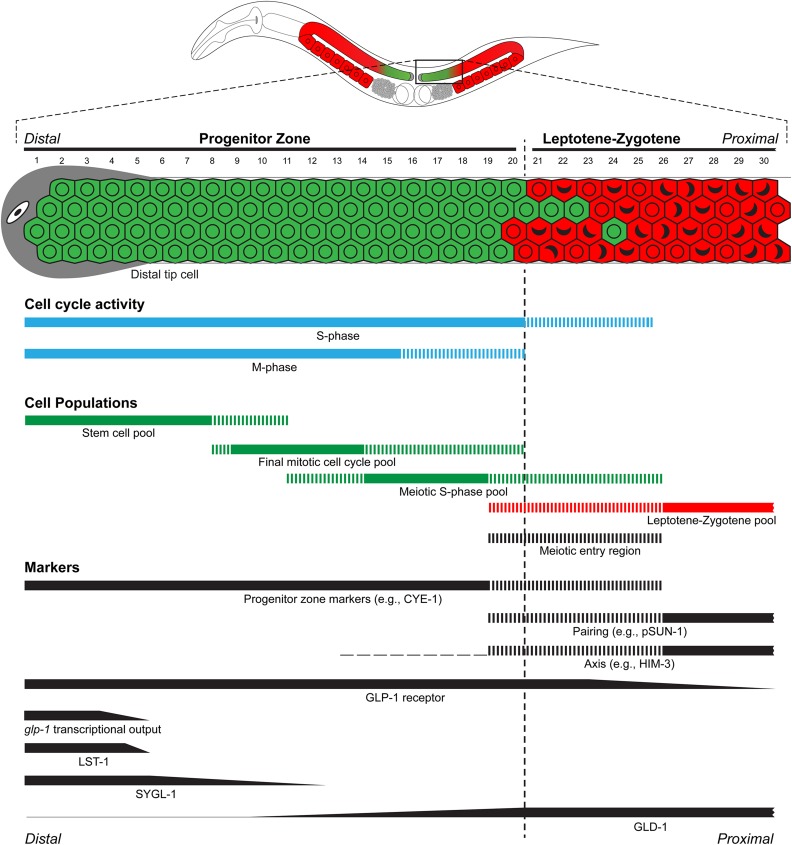
Organization and markers in the germline stem cell system. Schematic diagram of the distal germ line and the approximate extent of cell pools and marker accumulation as observed in the “day 1” adult hermaphrodite (∼24 hr past the mid-L4) under standard laboratory conditions (see text for details and references). Distal tip cell (gray), PZ cells (green), and leptotene-zygotene cells (red). Cell diameter numbers are indicated, with one at the distal tip through 30 in zygotene. The vertical black dashed line indicates the boundary of the PZ and leptotene (corresponding to yellow vertical line in Figure 1). The extent of M phase and S phase cell cycle activity is shown in blue horizontal bar, based on EdU incorporation and phospho-H3 staining, respectively. Cell populations in the progenitor zone (PZ; green bars): the stem cell pool, final mitotic cell cycle pool, and meiotic S phase pool as inferred from cell population analysis. The leptotene-zygotene pool (red bar) is based on staining of meiotic chromosome pairing or axis. Marker gene products (black bars): PZ markers include CYE-1, REC-8, and WAPL-1. Leptotene/overt meiotic entry markers include gene products that participate in meiotic chromosome pairing (e.g., phospho-SUN-1) or are part of the meiotic chromosome axes (e.g., HIM-3). For categorical markers and activities that show nuclear staining (PZ markers, etc.), the solid bar indicates region where all cells stain, while vertical hatching indicates region where only a subset of cells have nuclear staining. For meiotic prophase marker gene products whose accumulation is repressed by FBF (e.g., HIM-3, see text), accumulation is observed in the cytoplasm of the proximal PZ, as indicated by horizontal dashes. In the meiotic entry region (black vertical hatching) cells stain with either PZ or leptotene markers. Accumulation of regulator proteins GLP-1, LST-1, SYGL-1, and GLD-1 is based on antibody staining, while glp-1 transcriptional output is based on single-molecule fluorescent in situ hybridization using intron probes for lst-1 and sygl-1.
Figure 3
Figure 3
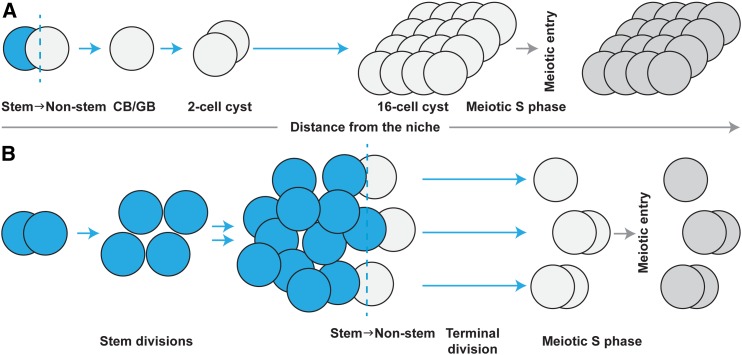
Comparison of single stem cell asymmetry and population asymmetry in germline stem cell systems of Drosophila and C. elegans. Schematic representation of the Drosophila and C. elegans adult germline stem cell systems, focusing on germ cell behavior. (A) Model for the Drosophila adult germline stem cell behavior. An asymmetric germline stem cell division gives rise to a daughter that is displaced from niche and becomes a nonstem progenitor (termed cystoblast “CB” in female and gonialblast “GB” in male) that synchronously divides four times to give rise to 16 cells, one of which becomes the oocyte in the female (the other 15 become nurse cells) and all of which become spermatocytes in the male. The latter divisions are considered “transit amplifying” divisions since many cells are generated for each stem/nonstem division. This renewal strategy can maintain a tissue with a small number of stem cells, but requires multiple cell divisions (and time) to regenerate the full complement of differentiating progeny. (B) Model for C. elegans adult hermaphrodite germline stem cell behavior. A symmetric stem cell division (within the pool of stem cells) gives rise to two stem cells, either or both of which may remain distal or may be displaced from the distal-most region, but each of which undergo, on average, an additional 1–2 symmetric germline stem cell divisions. Stem daughters are not maintained in a cyst, do not divide synchronously, and may be separated from each other; stem and nonstem pools of cells overlap to some extent (see Figure 2). After falling below a critical level of response to niche signaling (GLP-1 Notch), cells (three shown) become nonstem cells (indicated in gray), complete their ongoing mitotic cell cycle before entering meiotic S phase, and reach overt meiotic prophase (leptotene). No “transit amplifying” divisions of the nonstem daughter occur in this model. This renewal strategy requires a relatively large stem cell population but a relatively small number of cell divisions (and therefore relatively little time) to regenerate the full complement of differentiating progeny. Note that somatic gonad cells are not depicted.
Figure 4
Figure 4
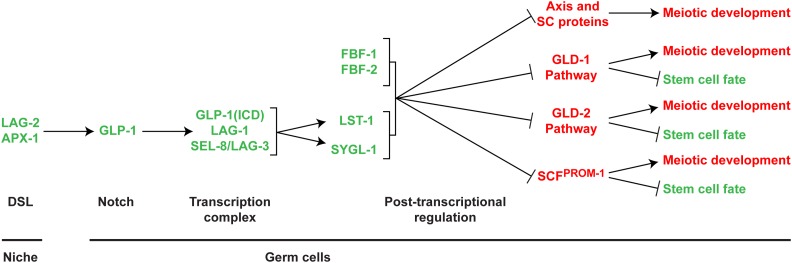
The genetic network for the stem cell fate vs. meiotic development decision. Top, model of the genetic network of gene products that promote the stem cell fate (green) by inhibition of three meiotic entry pathways, as well as inhibition of meiotic chromosome axis and SC protein expression (red), which together promote meiotic development. Arrows indicates positive regulation, lines with bar indicate inhibition. Bottom, regulatory class and location. DSL ligands, expressed in the niche/DTC, activate GLP-1 Notch in germ cells, leading to generation of GLP-1(ICD), which forms a transcriptional complex that results in spatially restricted expression of LST-1 and SYGL-1 that, together with ubiquitous PZ expressed FBF-1 and FBF-2, act in post-transcriptional repression of gene products that promote meiotic development.
Figure 5
Figure 5
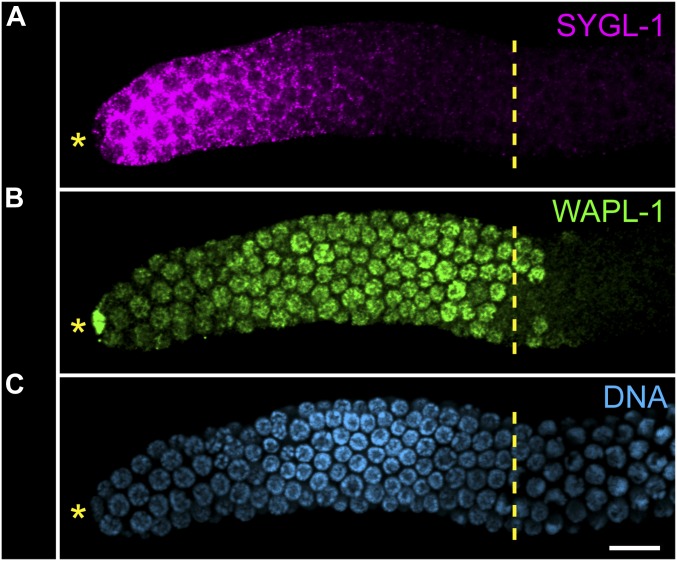
SYGL-1 accumulation in the young adult progenitor zone. Spatially restricted, but nonuniform accumulation of SYGL-1 in the PZ of a dissected young adult hermaphrodite gonad. (A) Cytoplasmic SYGL-1 (pink, SYGL-1::3×FLAG); (B) PZ cell nuclei, as well as the DTC nucleus (green, WAPL-1 staining); (C) all cell nuclei (blue, DAPI). Yellow dashed vertical line, boundary of the PZ and leptotene. Bar, 10 µM. Figure from Zuzana Kocsisova.
Figure 6
Figure 6
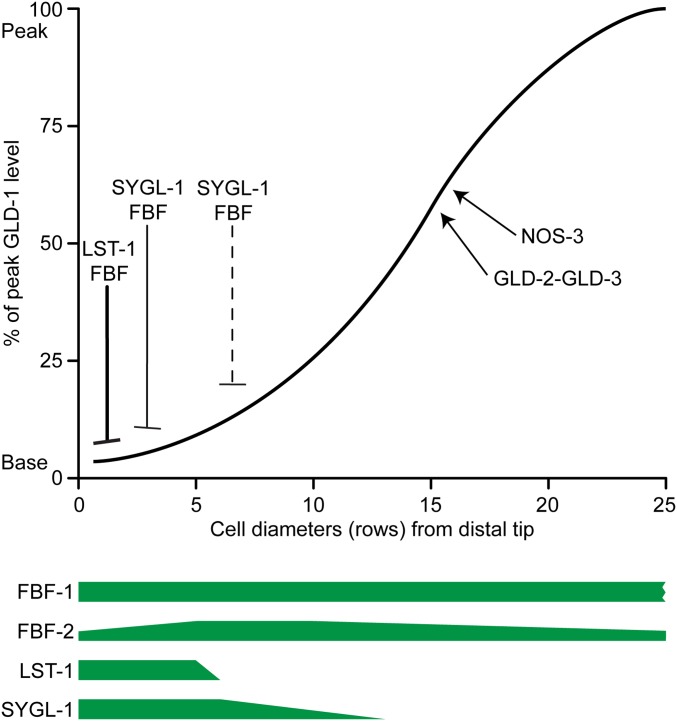
Control of GLD-1 accumulation in the progenitor zone. Model describing spatial control of GLD-1 accumulation in the young adult hermaphrodite. Spatial pattern of repressors of GLD-1 accumulation in the PZ: LST-1 and SYGL-1 accumulation are spatially restricted, while FBF-1 and FBF-2 accumulate throughout the PZ. LST-1 and SYGL-1 are proposed to limit the activity of FBF-mediated repression of GLD-1 to the distal-most region of the PZ. Activators of GLD-1 accumulation, NOS-3 and GLD-2/GLD-3, function redundantly with each other and accumulate essentially throughout the PZ (not shown). See text for details.
Figure 7
Figure 7
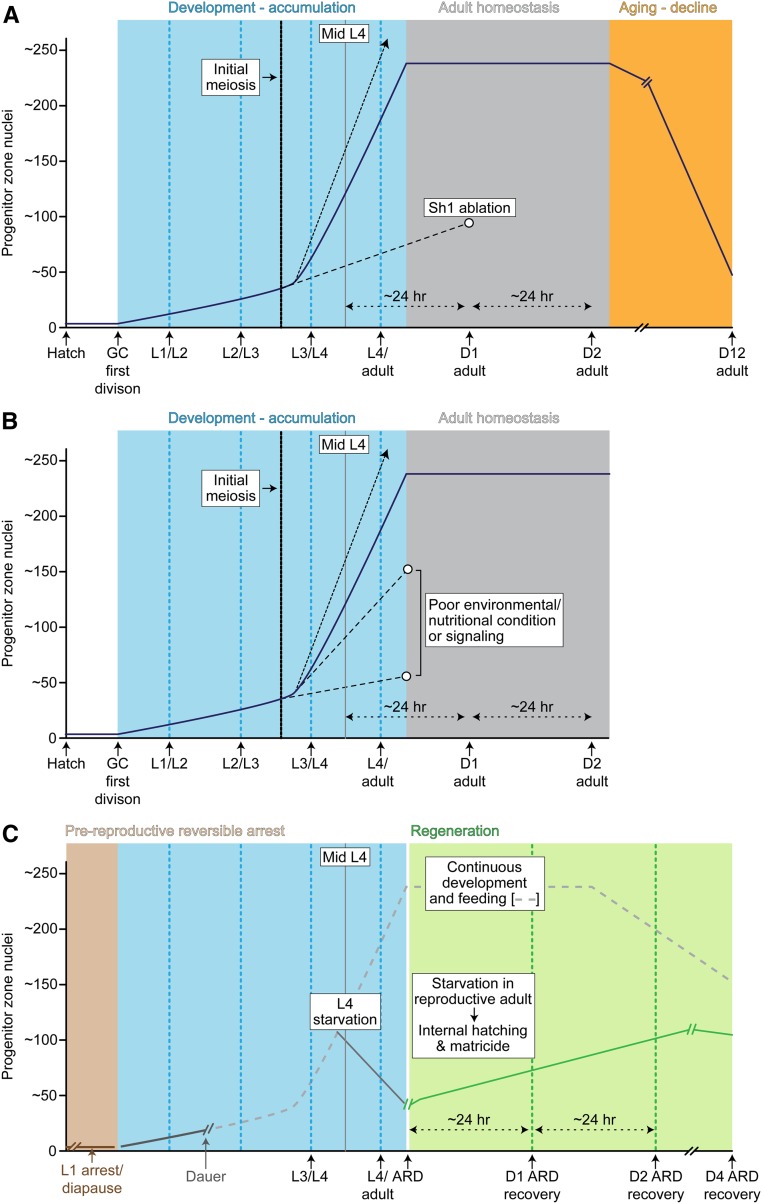
Dynamic changes in the germline stem cell system during development and adulthood and in altered environments. Approximate number of progenitor zone (PZ) nuclei per gonad arm over time. (A) PZ accumulation in standard laboratory conditions. Solid line: PZ accumulation in larval stages, homeostasis in early adult, and decline in aging. Dashed line: PZ accumulation after Sh1 (distal sheath cell pair) ablation. (B) Comparison of PZ accumulation in standard laboratory conditions (solid line) vs. poor conditions or reduced nutrient signaling (dashed lines). In A and B, time of initial meiosis and estimated trajectory for total PZ cells produced (including cells that enter meiotic prophase starting in the mid-L3; Berry et al. 1997) is represented by the dotted arrow. (C) Comparison of PZ accumulation in continuous development vs. developmental arrest (L1 arrest/diapause, dauer, and ARD; see text). L1, L2, etc. indicates first, second, etc. larval stages; D1, D2, etc. indicates adult age progression, e.g., “day 1” adult. Color code: blue, accumulation phase; gray, homeostasis; orange, decline; tan, continued quiescence; green, regrowth after ARD arrest and recovery. ARD, adult reproductive diapause; GC, germ cell.
Figure 8
Figure 8
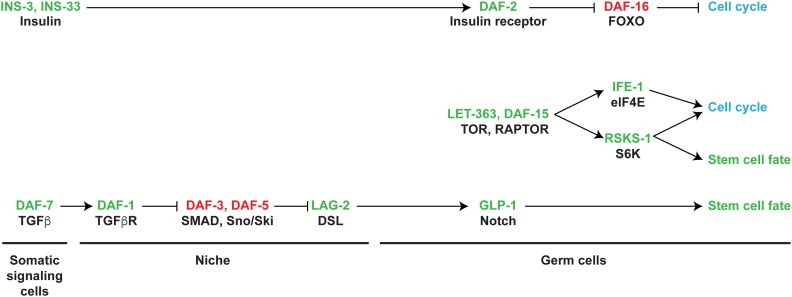
Physiological pathway control of stem cell fate and/or cell cycle in larvae. Signaling pathways: DAF-2 insulin-like signaling pathway (top), TOR (middle), and DAF-7 TGFβ (bottom) promote mitotic cell cycle progression (blue) and/or stem cell fate (green). Gene products that inhibit these activities shown in red.
None

References

    1. Ables E. T., and Drummond-Barbosa D., 2013. Cyclin E controls Drosophila female germline stem cell maintenance independently of its role in proliferation by modulating responsiveness to niche signals. Development 140: 530–540. 10.1242/dev.088583 - DOI - PMC - PubMed
    1. Ables E. T., Laws K. M., and Drummond-Barbosa D., 2012. Control of adult stem cells in vivo by a dynamic physiological environment: diet-dependent systemic factors in Drosophila and beyond. Wiley Interdiscip. Rev. Dev. Biol. 1: 657–674. 10.1002/wdev.48 - DOI - PMC - PubMed
    1. Agarwal I., Farnow C., Jiang J., Kim K.-S., Leet D. E. et al. , 2018. HOP-1 presenilin deficiency causes a late-onset notch signaling phenotype that affects adult germline function in Caenorhabditis elegans. Genetics 208: 745–762. 10.1534/genetics.117.300605 - DOI - PMC - PubMed
    1. Almeida M. V., Andrade-Navarro M. A., and Ketting R. F., 2019. Function and evolution of nematode RNAi pathways. Noncoding RNA 5: 8. 10.3390/ncrna5010008 - DOI - PMC - PubMed
    1. Ames K., Da Cunha D. S., Gonzalez B., Konta M., Lin F. et al. , 2017. A non-cell-autonomous role of BEC-1/BECN1/beclin1 in coordinating cell-cycle progression and stem cell proliferation during germline development. Curr. Biol. 27: 905–913. 10.1016/j.cub.2017.02.015 - DOI - PMC - PubMed