


Genetic risk for major depressive disorder and loneliness in sex-specific associations with coronary artery disease
- PMID: 31796895
- PMCID: PMC7266730
- DOI: 10.1038/s41380-019-0614-y
Genetic risk for major depressive disorder and loneliness in sex-specific associations with coronary artery disease
Abstract
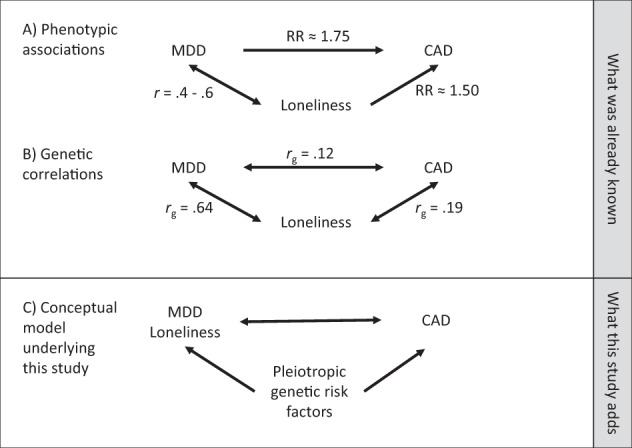
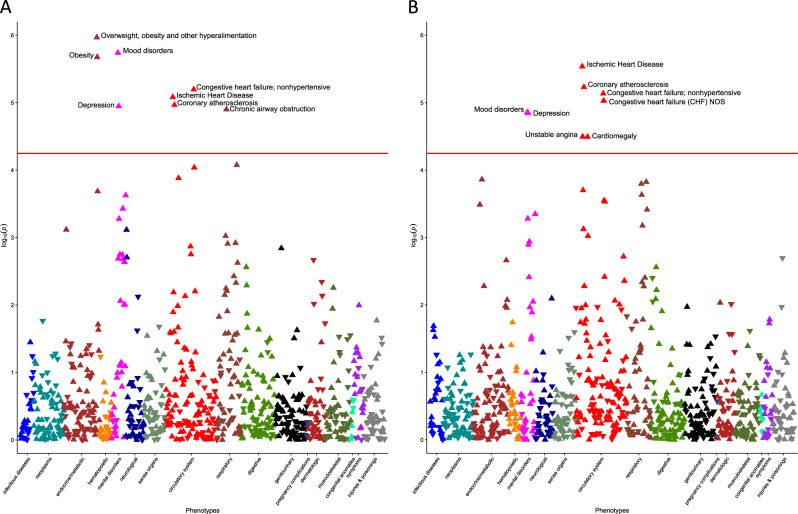
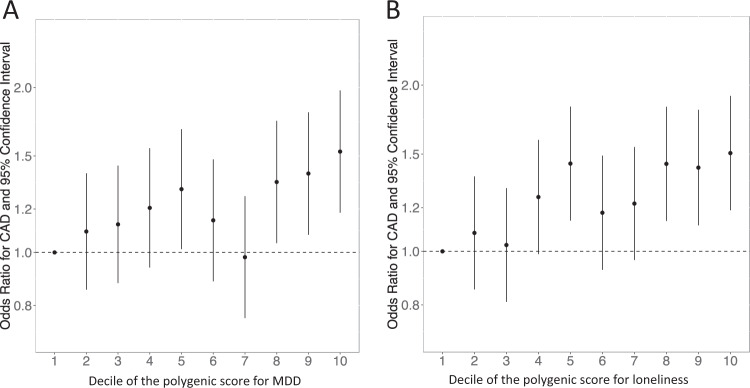
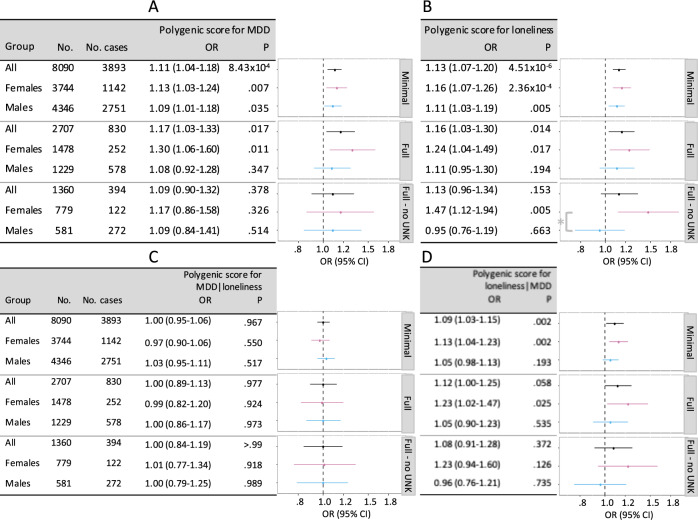
Major depressive disorder (MDD) and loneliness are phenotypically and genetically correlated with coronary artery disease (CAD), but whether these associations are explained by pleiotropic genetic variants or shared comorbidities is unclear. To tease apart these scenarios, we first assessed the medical morbidity pattern associated with genetic risk factors for MDD and loneliness by conducting a phenome-wide association study in 18,385 European-ancestry individuals in the Vanderbilt University Medical Center biobank, BioVU. Polygenic scores for MDD and loneliness were developed for each person using previously published meta-GWAS summary statistics, and were tested for association with 882 clinical diagnoses ascertained via billing codes in electronic health records. We discovered strong associations with heart disease diagnoses, and next embarked on targeted analyses of CAD in 3893 cases and 4197 controls. We found odds ratios of 1.11 (95% CI, 1.04-1.18; P 8.43 × 10⁻⁴) and 1.13 (95% CI, 1.07-1.20; P 4.51 × 10⁻⁶) per 1-SD increase in the polygenic scores for MDD and loneliness, respectively. Results were similar in patients without psychiatric symptoms, and the increased risk persisted in females even after adjusting for multiple conventional risk factors and a polygenic score for CAD. In a final sensitivity analysis, we statistically adjusted for the genetic correlation between MDD and loneliness and re-computed polygenic scores. The polygenic score unique to loneliness remained associated with CAD (OR 1.09, 95% CI 1.03-1.15; P 0.002), while the polygenic score unique to MDD did not (OR 1.00, 95% CI 0.95-1.06; P 0.97). Our replication sample was the Atherosclerosis Risk in Communities (ARIC) cohort of 7197 European-ancestry participants (1598 incident CAD cases). In ARIC, polygenic scores for MDD and loneliness were associated with hazard ratios of 1.07 (95% CI, 0.99-1.14; P = 0.07) and 1.07 (1.01-1.15; P = 0.03), respectively, and we replicated findings from the BioVU sensitivity analyses. We conclude that genetic risk factors for MDD and loneliness act pleiotropically to increase CAD risk in females.
© 2019. The Author(s).
Conflict of interest statement
PF and SLE are employees of 23andMe, Inc. No other disclosures are reported.
Figures
References
-
- Correll CU, Solmi M, Veronese N, Bortolato B, Rosson S, Santonastaso P, et al. Prevalence, incidence and mortality from cardiovascular disease in patients with pooled and specific severe mental illness: a large-scale meta-analysis of 3,211,768 patients and 113,383,368 controls. World Psychiatry. 2017;16:163–180. doi: 10.1002/wps.20420. - DOI - PMC - PubMed
-
- Hakulinen C, Pulkki-Raback L, Virtanen M, Jokela M, Kivimaki M, Elovainio M. Social isolation and loneliness as risk factors for myocardial infarction, stroke and mortality: UK Biobank cohort study of 479 054 men and women. Heart. 2018;104:1536–42. - PubMed
-
- Elovainio M, Hakulinen C, Pulkki-Raback L, Virtanen M, Josefsson K, Jokela M, et al. Contribution of risk factors to excess mortality in isolated and lonely individuals: an analysis of data from the UK Biobank cohort study. Lancet Public Health. 2017;2:e260–e266. doi: 10.1016/S2468-2667(17)30075-0. - DOI - PMC - PubMed
Publication types
MeSH terms
Grants and funding
- HHSN268201100012C/HL/NHLBI NIH HHS/United States
- HHSN268201100008C/HL/NHLBI NIH HHS/United States
- U54 MD010722/MD/NIMHD NIH HHS/United States
- HHSN268201100011C/HL/NHLBI NIH HHS/United States
- R01 HL140074/HL/NHLBI NIH HHS/United States
- 16FTF30130005/AHA/American Heart Association-American Stroke Association/United States
- HHSN268201100006C/HL/NHLBI NIH HHS/United States
- HHSN268201100005I/HL/NHLBI NIH HHS/United States
- R37 AG033590/AG/NIA NIH HHS/United States
- U01 HG009086/HG/NHGRI NIH HHS/United States
- P01 HL116263/HL/NHLBI NIH HHS/United States
- R01 MH113362/MH/NIMH NIH HHS/United States
- R56 MH120736/MH/NIMH NIH HHS/United States
- K08 HL145075/HL/NHLBI NIH HHS/United States
- HHSN268201100009I/HL/NHLBI NIH HHS/United States
- UL1 TR000445/TR/NCATS NIH HHS/United States
- UL1 TR000427/TR/NCATS NIH HHS/United States
- HHSN268201100010C/HL/NHLBI NIH HHS/United States
- HHSN268201100005G/HL/NHLBI NIH HHS/United States
- HHSN268201100008I/HL/NHLBI NIH HHS/United States
- HHSN268201100007C/HL/NHLBI NIH HHS/United States
- R01 MH118233/MH/NIMH NIH HHS/United States
- R25 MH081482/MH/NIMH NIH HHS/United States
- HHSN268201100011I/HL/NHLBI NIH HHS/United States
- R01 HL127173/HL/NHLBI NIH HHS/United States
- U01 HG004402/HG/NHGRI NIH HHS/United States
- UL1 TR002373/TR/NCATS NIH HHS/United States
- S10 OD025092/OD/NIH HHS/United States
- P50 DA037844/DA/NIDA NIH HHS/United States
- HHSN268201100009C/HL/NHLBI NIH HHS/United States
- HHSN268201100005C/HL/NHLBI NIH HHS/United States
- HHSN268201100007I/HL/NHLBI NIH HHS/United States
- UL1 RR024975/RR/NCRR NIH HHS/United States
LinkOut - more resources
Full Text Sources
Medical
Miscellaneous
