


Whole brain apparent diffusion coefficient measurements correlate with survival in glioblastoma patients
- PMID: 31797235
- PMCID: PMC6938471
- DOI: 10.1007/s11060-019-03357-y
Whole brain apparent diffusion coefficient measurements correlate with survival in glioblastoma patients
Abstract
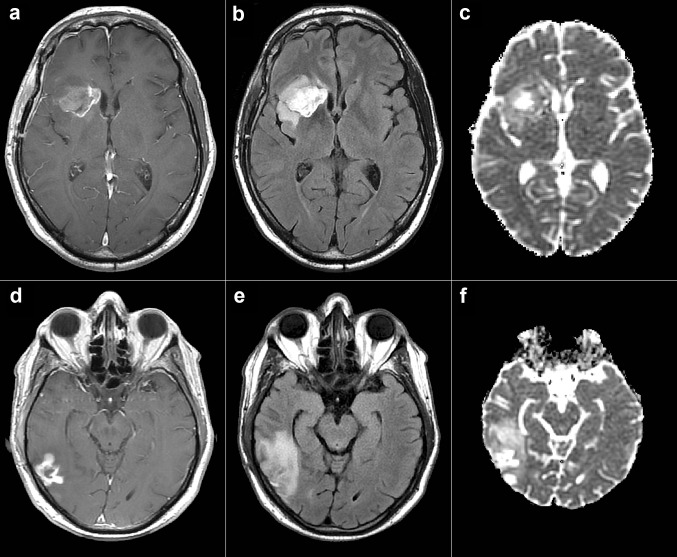
Introduction: Glioblastoma (GBM) is the most common malignant primary brain tumor, and methods to improve the early detection of disease progression and evaluate treatment response are highly desirable. We therefore explored changes in whole-brain apparent diffusion coefficient (ADC) values with respect to survival (progression-free [PFS], overall [OS]) in a cohort of GBM patients followed at regular intervals until disease progression.
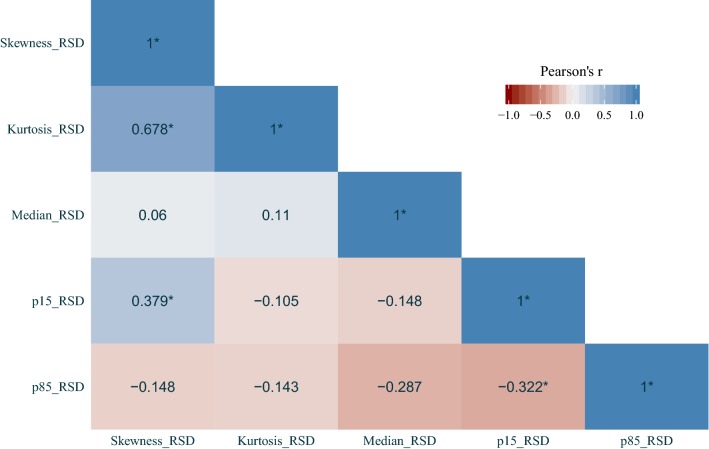
Methods: A total of 43 subjects met inclusion criteria and were analyzed retrospectively. Histogram data were extracted from standardized whole-brain ADC maps including skewness, kurtosis, entropy, median, mode, 15th percentile (p15) and 85th percentile (p85) values, and linear regression slopes (metrics versus time) were fitted. Regression slope directionality (positive/negative) was subjected to univariate Cox regression. The final model was determined by aLASSO on metrics above threshold.
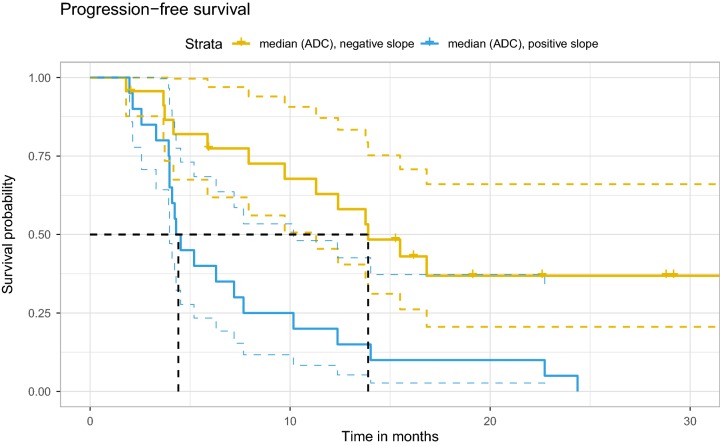
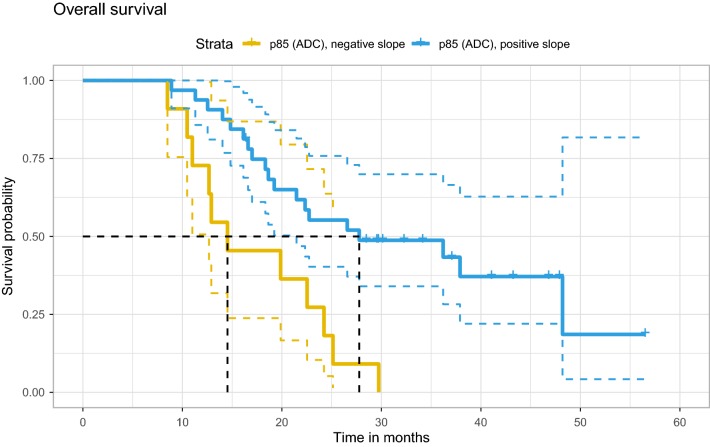
Results: Skewness, kurtosis, median, p15 and p85 were all below threshold for both PFS and OS and were analyzed further. Median regression slope directionality best modeled PFS (p = 0.001; HR 3.3; 95% CI 1.6-6.7), while p85 was selected for OS (p = 0.002; HR 0.29; 95% CI 0.13-0.64).
Conclusions: Our data show tantalizing potential in the use of whole-brain ADC measurements in the follow up of GBM patients, specifically serial median ADC values which correlated with PFS, and serial p85 values which correlated with OS. Whole-brain ADC measurements are fast and easy to perform, and free of ROI-placement bias.
Keywords: Apparent diffusion coefficient; Diffusion-weighted imaging; Glioblastoma; Histogram analyses; Magnetic resonance imaging.
Conflict of interest statement
JV is a consultant for Novocure.
Figures
References
-
- Tamimi AF, Juweid M. Epidemiology and outcome of glioblastoma. In: De Vleeschouwer S, editor. Glioblastoma. Brisbane (AU): Codon Publications; 2017. - PubMed
MeSH terms
Substances
Grants and funding
LinkOut - more resources
Full Text Sources
Medical
Miscellaneous
