


Effectiveness of nitrogen fixation in rhizobia
- PMID: 31797528
- PMCID: PMC7415380
- DOI: 10.1111/1751-7915.13517
Effectiveness of nitrogen fixation in rhizobia
Abstract
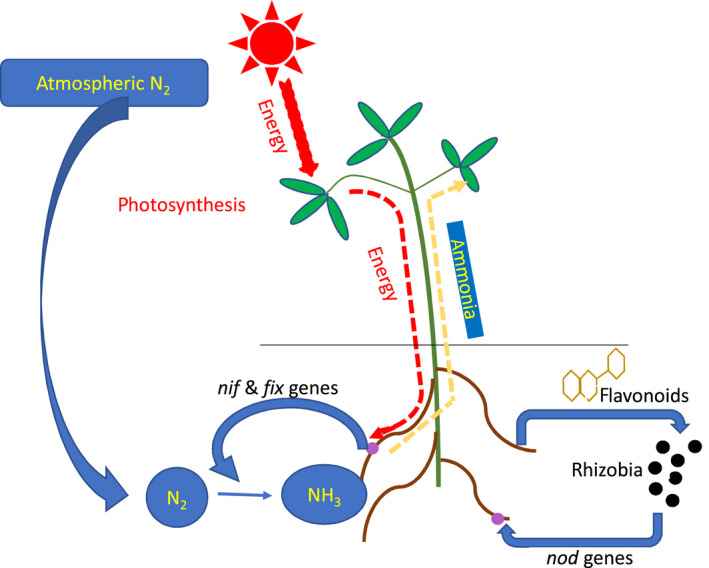
Biological nitrogen fixation in rhizobia occurs primarily in root or stem nodules and is induced by the bacteria present in legume plants. This symbiotic process has fascinated researchers for over a century, and the positive effects of legumes on soils and their food and feed value have been recognized for thousands of years. Symbiotic nitrogen fixation uses solar energy to reduce the inert N2 gas to ammonia at normal temperature and pressure, and is thus today, especially, important for sustainable food production. Increased productivity through improved effectiveness of the process is seen as a major research and development goal. The interaction between rhizobia and their legume hosts has thus been dissected at agronomic, plant physiological, microbiological and molecular levels to produce ample information about processes involved, but identification of major bottlenecks regarding efficiency of nitrogen fixation has proven to be complex. We review processes and results that contributed to the current understanding of this fascinating system, with focus on effectiveness of nitrogen fixation in rhizobia.
© 2019 The Authors. Microbial Biotechnology published by John Wiley & Sons Ltd and Society for Applied Microbiology.
Conflict of interest statement
There is no conflict of interest.
Figures
References
-
- Adv Bot ResHoch, G. , Little, H.N. , and Burris, R. (1957) Hydrogen evolution from soy‐bean root nodules. Nature 179: 430.
-
- Appleby, C.A. (1984) Leghemoglobin and Rhizobium respiration. Annu Rev Plant Physiol 35: 443–478.
-
- Atkins, C. (1984) Efficiencies and inefficiencies in the legume/Rhizobium symbiosis—A review. Plant Soil 82: 273–284.
Publication types
MeSH terms
LinkOut - more resources
Full Text Sources
