


Are there educational disparities in health and functioning among the oldest old? Evidence from the Nordic countries
- PMID: 31798367
- PMCID: PMC6857104
- DOI: 10.1007/s10433-019-00517-x
Are there educational disparities in health and functioning among the oldest old? Evidence from the Nordic countries
Abstract
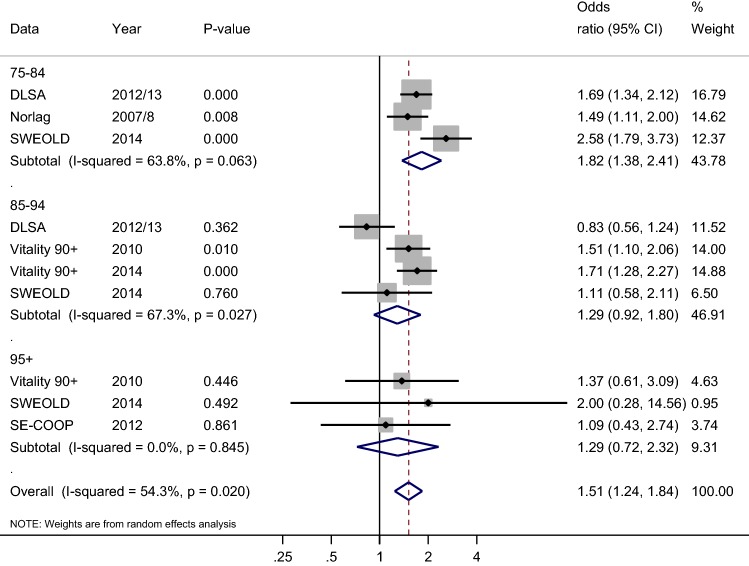
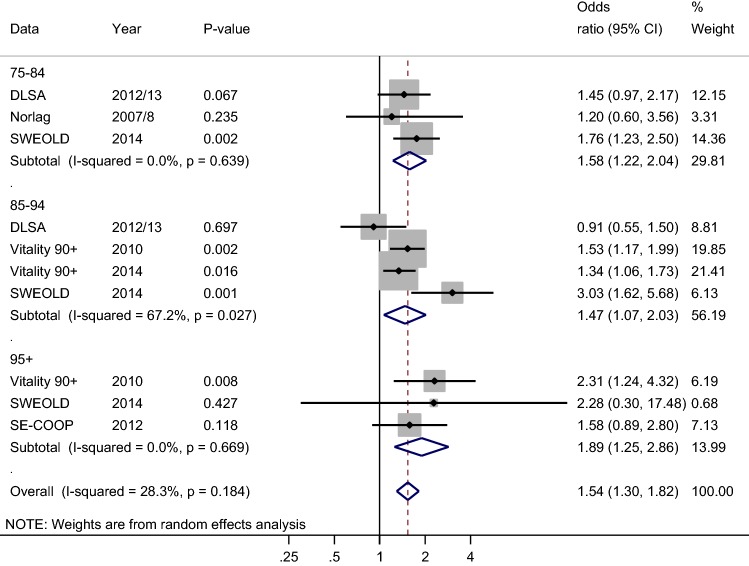
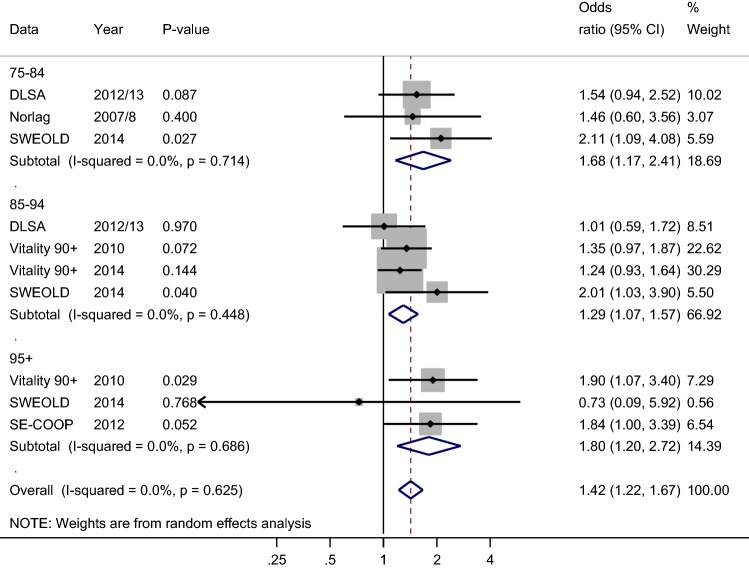
With the ageing of the population and recent pressures on important welfare state arrangements, updated knowledge on the linkage between socioeconomic status and health in old age is pertinent for shedding light on emerging patterns of health inequalities in the Nordic countries. This study examined self-rated health (SRH), mobility and activities of daily living (ADL) according to level of education in the three oldest old age groups 75-84, 85-94, and 95+, in four Nordic countries. Altogether, 6132 individuals from Danish Longitudinal Study of Ageing, Norwegian Life Course, Ageing and Generation study, Swedish Panel Study of Living Conditions of the Oldest Old, the 5-Country Oldest Old (Sweden) and Vitality 90 + Study were analysed. First, associations of education level with SRH, mobility, and ADL were estimated for each individual study by means of age- and gender-adjusted logistic regression. Second, results from individual studies were synthesized in a meta-analysis. Older adults with higher education level were more likely to report good SRH, and they were more often independent in mobility and ADL than those with basic education when all age groups were combined. In mobility and ADL, differences between education groups remained stable across the age groups but for SRH, differences seemed to be weaker in older ages. With only a few exceptions, in all age groups, individuals with higher education had more favourable health and functioning than those with basic education. This study shows remarkable persistence of health and functioning inequalities in the Nordic countries throughout later life.
Keywords: Functioning; Inequality; Nordic countries; Oldest old; Prospective meta-analysis; Self-rated health.
© The Author(s) 2019.
Conflict of interest statement
Conflict of interestThe authors declare that they have no conflict of interest.
Figures
References
-
- Bambra C. Changing social equality: the Nordic welfare model in the 21st century. Bristol: Policy Press; 2012. Social inequalities in health: the Nordic welfare state in a comparative context; pp. 143–164.
-
- Bjørshol E, Høstmark M, Lagerstrøm B (2007) Livsløp, generasjon og kjønn. LOGG 2007. Dokumentasjonsrapport. Oslo: Statistisk Sentralbyrå. Rapport: 19/2010
LinkOut - more resources
Full Text Sources
