Review
. 2019 Nov 19:10:2600.
doi: 10.3389/fimmu.2019.02600. eCollection 2019.

Keeping Allergen Names Clear and Defined

Affiliations
Review

Keeping Allergen Names Clear and Defined

Sanny K Chan et al. Front Immunol. .

Abstract

The World Health Organization/International Union of Immunological Societies (WHO/IUIS) Allergen Nomenclature Sub-Committee was established in 1986 by leading allergists to standardize names given to proteins that cause IgE-mediated reactions in humans. The Sub-Committee's objective is to assign unique names to allergens based on a critical analysis of confidentially submitted biochemical and clinical data from researchers, often prior to publication to preserve consistency. The Sub-Committee maintains and revises the database as the understanding of allergens evolves. This report summarizes recent developments that led to updates in classification of cockroach group 1 and 5 allergens to animal as well as environmental and occupational allergens. Interestingly, routes, doses, and frequency of exposure often affects allergenicity as does the biochemical properties of the proteins and similarity to self and other proteins. Information required by the Sub-Committee now is more extensive than previously as technology has improved. Identification of new allergens requires identification of the amino acid sequence and physical characteristics of the protein as well as demonstration of IgE binding from subjects verified by described clinical histories, proof of the presence of the protein in relevant exposure substances, and demonstration of biological activity (skin prick tests, activation of basophils, or mast cells). Names are assigned based on taxonomy with the abbreviation of genus and species and assignment of a number, which reflects the priority of discovery, but more often now, the relationships with homologous proteins in related species.

Keywords: WHO/IUIS; airway; allergen nomenclature; dermal; diagnostic; food; taxonomy.


Figures

Figure 1
Figure 1
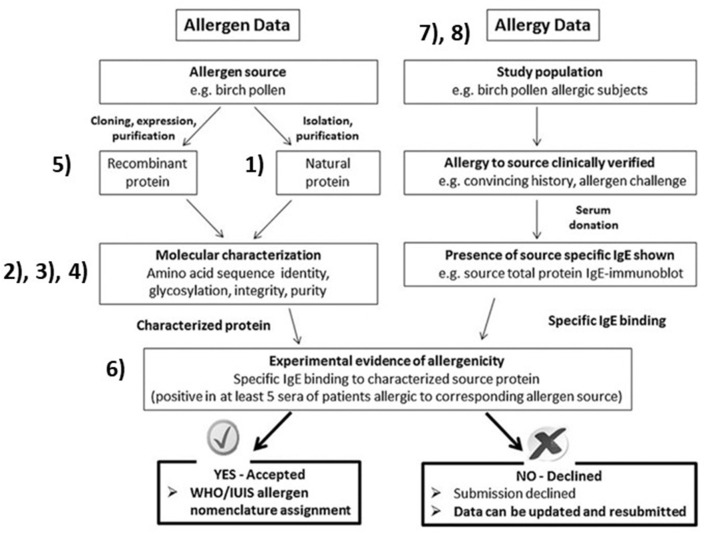
Overall allergen characterization for submission to the WHO/IUIS Allergen Nomenclature Sub-Committee for possible name recognition. Figure with copyright allowance from Pomés et al. (2). Numbers are inserted beside key blocks, identifying topical areas and challenges related to our evaluations. (1) Nearly identical repeated sequences confuse characterization of the natural protein. (2) Amino acid identity matches across distant taxonomic relations are unlikely to represent cross-reactive proteins. (3) Native allergens of co-valently linked independent proteins such as Fel d 1 and Ory 3. (4) Carbohydrate IgE binding epitopes (CCD, alpha-gal) are not (yet) named in this system. (5) Studies testing cloned, recombinant proteins without native protein bridging can leave doubts. (6) Biological evidence, either basophil histamine release or activation, or skin prick test with pure protein. (7) Aeroallergen identities in clinical tests are typically not verified in allergen diagnostic testing due to lack of available components. (8) Occupational and food allergen testing typically involve few study subjects.
Figure 2
Figure 2
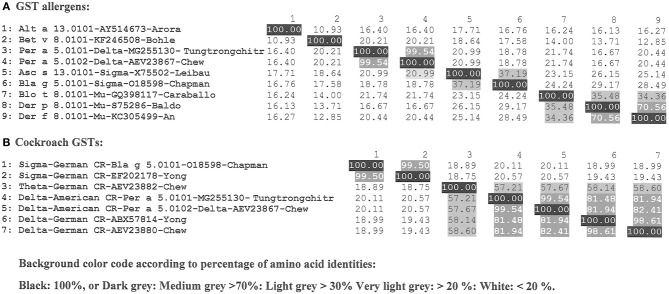
Homologous protein GST allergens are currently categorized as isoallergens with a threshold of 67% amino acid identity although they may belong to different protein classes (sigma, delta, theta, mu). Percent identities are shown. (A) Nine groups of GST allergens from different taxa to understand sequence identities across sources. (B) Cockroach GSTs within German and American cockroaches with known allergens and genomic sequences with comparison of amino acid sequence identities.

References

    1. Marsh DG, Goodfriend L, King TP, Lowenstein H, Platts-Mills TA. Allergen nomenclature. Bull World Health Organ. (1986) 64:767–74. - PMC - PubMed
    1. Pomés A, Davies JM, Gadermaier G, Hilger C, Holzhauser T, Lidholm J, et al. . WHO/IUIS allergen nomenclature: providing a common language. Mol Immunol. (2018) 100:3–13. 10.1016/j.molimm.2018.03.003 - DOI - PMC - PubMed
    1. Pomés A, Melén E, Vailes LD, Retief JD, Arruda LK, Chapman MD. Novel allergen structures with tandem amino acid repeats derived from German and American cockroach. J Biol Chem. (1998) 273:30801–7. 10.1074/jbc.273.46.30801 - DOI - PubMed
    1. Mueller GA, Pedersen LC, Lih FB, Glesner J, Moon AF, Chapman MD, et al. . The novel structure of the cockroach allergen Bla g 1 has implications for allergenicity and exposure assessment. J Allergy Clin Immunol. (2013) 132:1420–6. 10.1016/j.jaci.2013.06.014 - DOI - PMC - PubMed
    1. Harrison MC, Jongepier E, Robertson HM, Arning N, Bitard-Feildel T, Chao H, et al. . Hemimetabolous genomes reveal molecular basis of termite eusociality. Nat Ecol Evol. (2018) 2:557–66. 10.1038/s41559-017-0459-1 - DOI - PMC - PubMed

Publication types

LinkOut - more resources