


Treatment of hemorrhoids: A survey of surgical practice in Australia and New Zealand
- PMID: 31799299
- PMCID: PMC6887603
- DOI: 10.12998/wjcc.v7.i22.3742
Treatment of hemorrhoids: A survey of surgical practice in Australia and New Zealand
Abstract
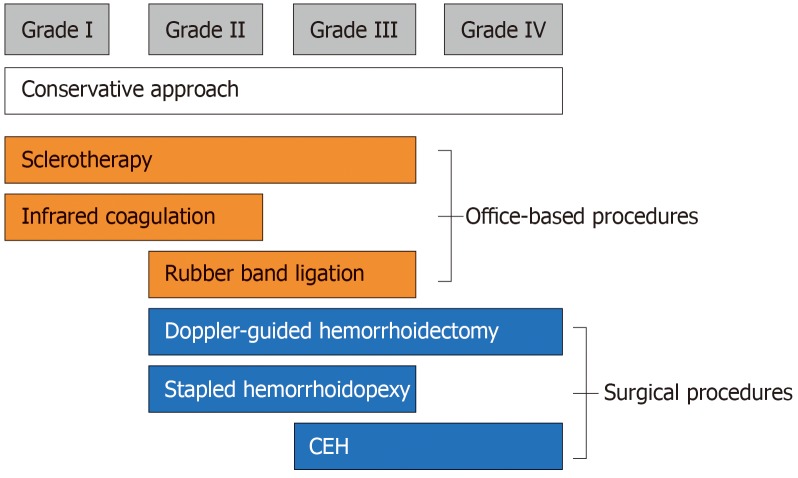
Background: Hemorrhoidal disease is the most common anorectal disorder. Hemorrhoids can be classified as external or internal, according to their relation to the dentate line. External hemorrhoids originate below the dentate line and are managed conservatively unless the patient cannot keep the perianal region clean, or they cause significant discomfort. Internal hemorrhoids originate above the dentate line and can be managed according to the graded degree of prolapse, as described by Goligher. Generally, low-grade internal hemorrhoids are effectively treated conservatively, by non-operative measures, while high-grade internal hemorrhoids warrant procedural intervention.
Aim: To determine the application of clinical practice guidelines for the current management of hemorrhoids and colorectal surgeon consensus in Australia and New Zealand.
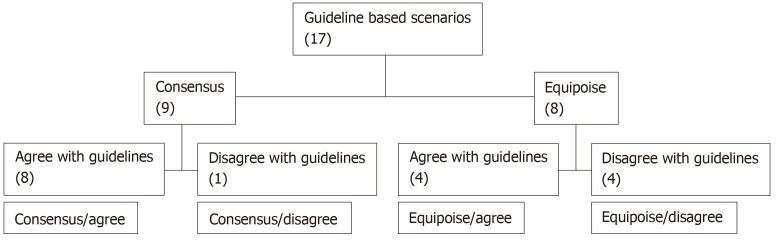
Methods: An online survey was distributed to 206 colorectal surgeons in Australia and New Zealand using 17 guideline-based hypothetical clinical scenarios.
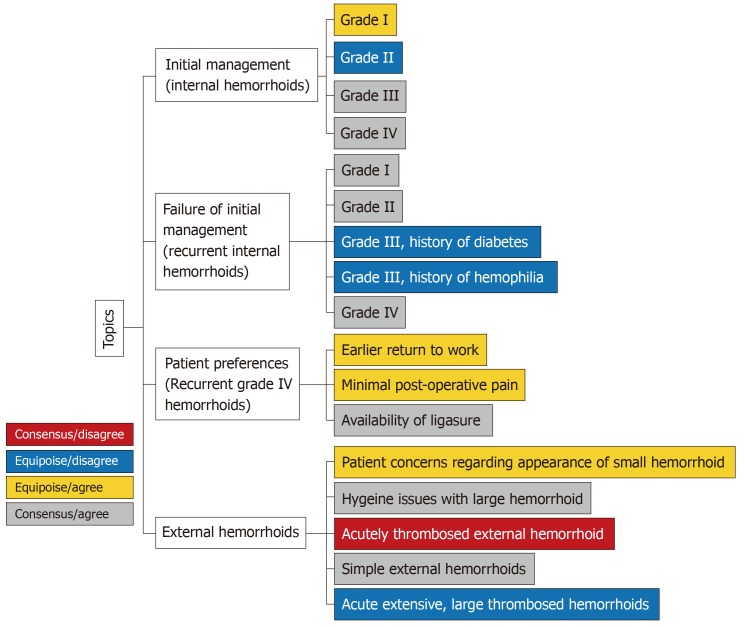
Results: There were 82 respondents (40%) to 17 guideline-based scenarios. Nine (53%) reached consensus, of which only 1 (6%) disagreed with the guidelines. This was based on low quality evidence for the management of acutely thrombosed external hemorrhoids. There were 8 scenarios which showed community equipoise (47%) and they were equally divided for agreeing or disagreeing with the guidelines. These topics were based on low and moderate levels of evidence. They included the initial management of grade I internal hemorrhoids, grade III internal hemorrhoids when initial management had failed and the patient had recognised risks factors for septic complications; and finally, the decision-making when considering patient preferences, including a prompt return to work, or minimal post-operative pain.
Conclusion: Although there are areas of consensus in the management of hemorrhoids, there are many areas of community equipoise which would benefit from further research.
Keywords: Clinical practice guidelines; Consensus; Hemorrhoids; Survey.
©The Author(s) 2019. Published by Baishideng Publishing Group Inc. All rights reserved.
Conflict of interest statement
Conflict-of-interest statement: The authors report no relevant conflicts of interest.
Figures
References
LinkOut - more resources
Full Text Sources
