


Trends in Recurrent Anterior Cruciate Ligament Injuries Differ From New Anterior Cruciate Ligament Injuries in College and High School Sports: 2009-2010 Through 2016-2017
- PMID: 31799331
- PMCID: PMC6873278
- DOI: 10.1177/2325967119883867
Trends in Recurrent Anterior Cruciate Ligament Injuries Differ From New Anterior Cruciate Ligament Injuries in College and High School Sports: 2009-2010 Through 2016-2017
Abstract
Background: Knee injuries are common and result in extended time missed from sports participation. Little is known regarding the comparative characteristics of recurrent versus first-time anterior cruciate ligament (ACL) injuries sustained during athletic events and how they are influenced by sex, sports participation level, and game-time features.
Purpose: To evaluate the characteristics (sex, sports level, and game timing [ie, early vs late in the game]) of recurrent ACL injury in National Collegiate Athletic Association (NCAA) and high school athletes compared with first-time ACL injury.
Study design: Descriptive epidemiology study.
Methods: Athletic trainers reported ACL injury occurrences and characteristics for collegiate athletes during the 2009-2010 through 2016-2017 academic years and for high school athletes during the 2011-2012 through 2013-2014 academic years. Logistic regression was used to estimate odds ratios (ORs) and 95% CIs for recurrent versus first-time ACL injury. The number of ACL injuries, proportions, and ORs were calculated by sex, competition level, and time in game played. Results were also classified according to injury mechanism: noncontact, overuse, or surface contact.
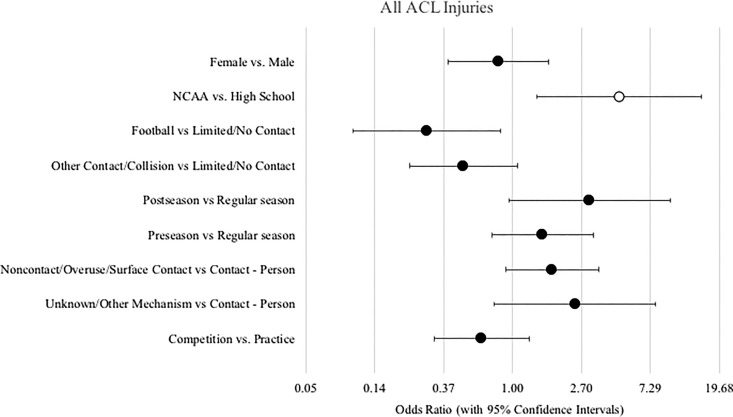
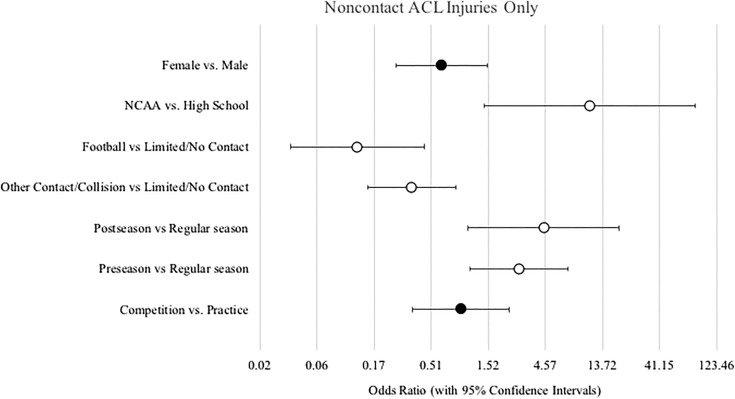
Results: A total of 705 ACL injuries were reported, including 644 first-time injures and 61 recurrent injuries. When restricting to noncontact ACL injuries, 416 were reported (373 first-time injuries and 43 recurrent injuries). The odds of a recurrent versus new ACL injury in NCAA student-athletes were 4.6 times that of high school student-athletes (95% CI, 1.41-15.24; P = .01). When restricting to noncontact ACL injuries, the odds of a recurrent versus new ACL injury during postseason and preseason were 4.5 and 2.8 times that during the regular season, respectively. Athletes in limited-contact and noncontact sports had greater odds of a recurrent versus new ACL injury compared with athletes playing football and other contact and collision sports. There was no significant difference in the odds of a recurrent ACL injury by sex or time in game.
Conclusion: Based on the current study, the odds of recurrent ACL injuries are associated with the level of competition but not associated with sex or timing of game play. Determinants of reinjury after primary ACL reconstruction will help advance care for young injured athletes who continue to participate in competitive sports.
Keywords: ACL; college; high school; injury; injury surveillance; knee; recurrent.
© The Author(s) 2019.
Conflict of interest statement
One or more of the authors has declared the following potential conflict of interest or source of funding: Funding for this study was provided by the National Athletic Trainers’ Association Research and Education Foundation, BioCrossroads in partnership with the Central Indiana Corporate Partnership Foundation, and the NCAA. AOSSM checks author disclosures against the Open Payments Database (OPD). AOSSM has not conducted an independent investigation on the OPD and disclaims any liability or responsibility relating thereto.
Figures
References
-
- Ahlden M, Samuelsson K, Sernert N, Forssblad M, Karlsson J, Kartus J. The Swedish National Anterior Cruciate Ligament Register: a report on baseline variables and outcomes of surgery for almost 18,000 patients. Am J Sports Med. 2012;40(10):2230–2235. - PubMed
-
- Andernord D, Desai N, Bjornsson H, Ylander M, Karlsson J, Samuelsson K. Patient predictors of early revision surgery after anterior cruciate ligament reconstruction: a cohort study of 16,930 patients with 2-year follow-up. Am J Sports Med. 2015;43(1):121–127. - PubMed
-
- Christino MA, Tepolt FA, Sugimoto D, Micheli LJ, Kocher MS. Revision ACL reconstruction in children and adolescents [published online March 5, 2018]. J Pediatr Orthop. doi:10.1097/BPO.0000000000001155. - PubMed
LinkOut - more resources
Full Text Sources
