Review
. 2020 May;30(3):679-690.
doi: 10.1111/bpa.12804. Epub 2019 Dec 16.

Medulloblastoma genomics in the modern molecular era

Affiliations
Review

Medulloblastoma genomics in the modern molecular era

Rahul Kumar et al. Brain Pathol. 2020 May.

Abstract

Medulloblastoma (MB) represents a spectrum of biologically and clinically distinct entities. Initially described histopathologically as a small, round blue cell tumor arising in the cerebellum, MB has emerged as a paradigm for molecular classification in cancer. Recent advances in genomic, transcriptomic and epigenomic profiling of MB have further refined molecular classification and complemented conventional histopathological diagnosis. Herein, we review the main clinical and molecular features of the four consensus subgroups of MB (WNT, SHH, Group 3 and Group 4). We also highlight hereditary predisposition syndromes associated with increased risk of MB. Finally, we explore advances in the classification of the consensus molecular groups while also presenting cutting-edge frontiers in identifying intratumoral heterogeneity and cellular origins of MB.

Keywords: genomics; medulloblastoma; molecular pathology; pediatrics.


Figures

Figure 1
Figure 1
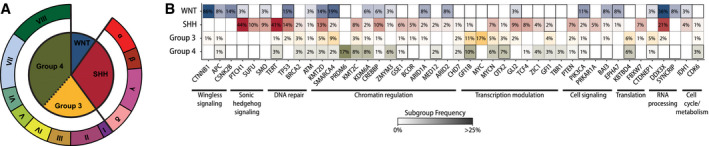
Molecular classification of medulloblastoma. A. Consensus molecular groups of MB are depicted according to relative frequency of incidence while emerging molecular subtypes of SHH (α, β, γ, δ) and Groups 3/4 (I–VIII) tumors are shown on the outer ring. B. Mutational landscape of the molecular groups of medulloblastoma is shown in a heatmap with genes arranged according to functional classes.
Figure 2
Figure 2
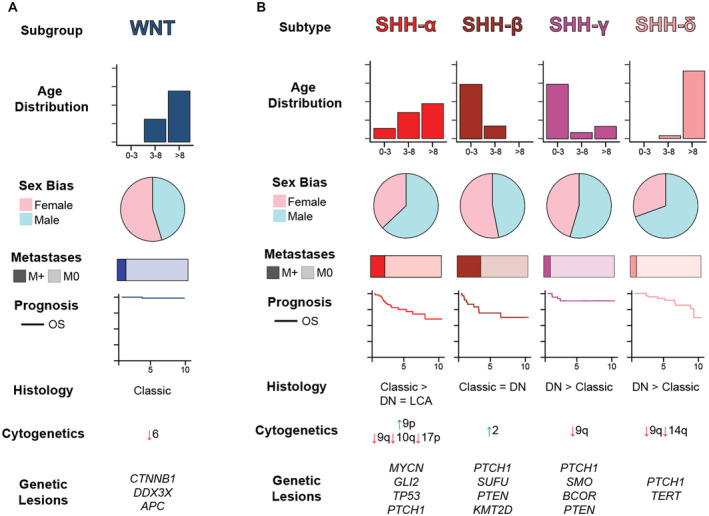
Summary of WNT and SHH medulloblastomas. A. WNT MBs are summarized by key clinicodemographic and molecular features. B. SHH MBs are summarized according to molecular subtypes proposed by Cavalli et al.
Figure 3
Figure 3
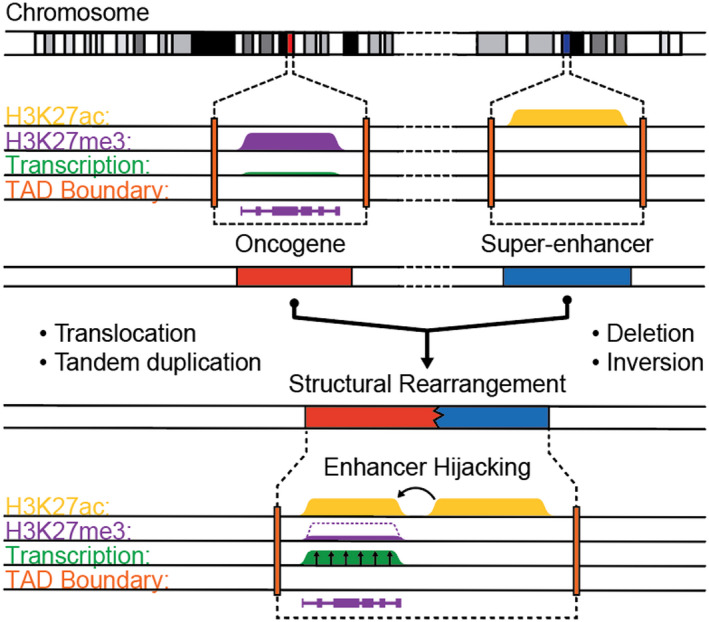
Schematic mechanism of enhancer hijacking in medulloblastoma. Juxtaposition of transcriptionally repressed oncogene locus with active gene regulatory elements (eg, super‐enhancers) can occur by various structural rearrangements. Such alterations to genomic architecture lead to reorganization of topologically associated domains (TADs, depicted by dashed boxes) by disruption of native boundary elements (orange). As a result, active gene regulatory elements (marked by H3K27ac, yellow) can spread to the normally repressed proto‐oncogene promoters (marked by H3K27me3, purple), leading to oncogene transcription (green).
Figure 4
Figure 4
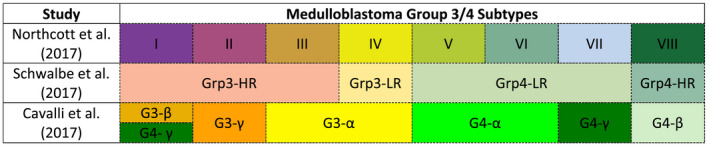
Overview of proposed Group 3/4 MB subtypes. Three independent studies have described four to eight molecular subtypes of Group 3 and Group 4 medulloblastoma. While concordance between subtypes across different studies is not definitive, an overlay of these subtypes according to study are depicted above according to nomenclature adopted within each study. LR = low‐risk; HR = high‐risk.
Figure 5
Figure 5
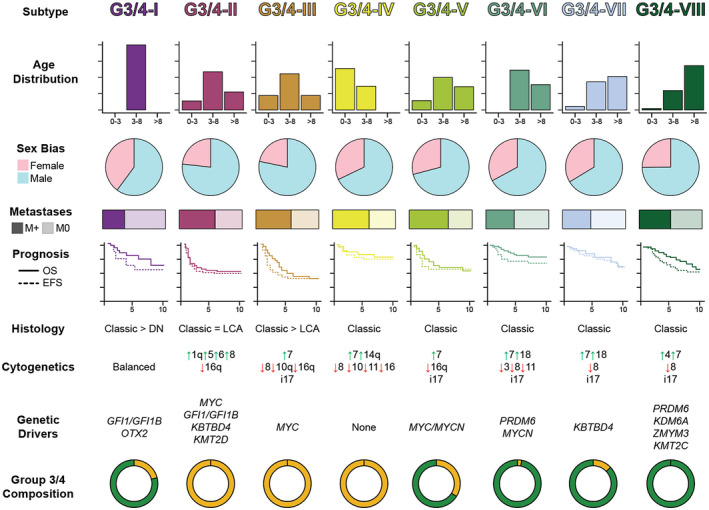
Summary of Group 3/4 medulloblastoma subtypes. Clinicopathologic and molecular summary of eight molecular subtypes of Group 3 and Group 4 medulloblastomas according to Northcott et al. (2017) and Sharma et al. (2019). The composition of each subtype according to consensus Group 3 or Group 4 profiling is shown at the bottom of the panel. LCA = large cell anaplastic; DN = desmoplastic/nodular.
Figure 6
Figure 6
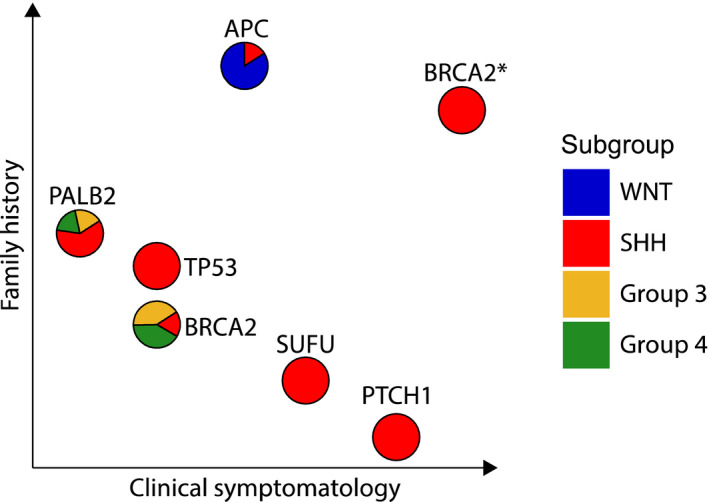
Germline predisposition genes in medulloblastoma. Six most commonly mutated genes (BRCA2* = compound heterozygous mutations) predisposing to medulloblastoma are depicted. Molecular subgroups of tumors associated with alterations in respective germline predisposition genes are plotted as pie charts. Distance along each axis represents the proportion of patients with positive family history or recognizable clinical signs of germline predisposition syndromes.

References

    1. Badiali M, Pession A, Basso G, Andreini L, Rigobello L, Galassi E et al (1991) N‐myc and c‐myc oncogenes amplification in medulloblastomas. Evidence of particularly aggressive behavior of a tumor with c‐myc amplification. Tumori J 77:118–121. - PubMed
    1. Bailey P, Cushing H (1925) Medulloblastoma cerebelli: a common type of midcerebellar glioma of childhood. Arch Neurol Psychiatry 14:192–224.
    1. Bigner SH, Friedman HS, Vogelstein B, Oakes WJ, Bigner DD (1990) Amplification of the c‐myc gene in human medulloblastoma cell lines and xenografts. Cancer Res 50:2347–2350. - PubMed
    1. Boulay G, Awad ME, Riggi N, Archer TC, Iyer S, Boonseng WE et al (2017) OTX2 Activity at distal regulatory elements shapes the chromatin landscape of group 3 medulloblastoma. Cancer Discov 7:288–301. - PMC - PubMed
    1. Bunt J, Hasselt NE, Zwijnenburg DA, Hamdi M, Koster J, Versteeg R et al (2012) OTX2 directly activates cell cycle genes and inhibits differentiation in medulloblastoma cells. Int J Cancer 131:E21–E32. - PubMed

Substances