Phase 3 Efficacy Analysis of a Typhoid Conjugate Vaccine Trial in Nepal
- PMID: 31800986
- PMCID: PMC6785806
- DOI: 10.1056/NEJMoa1905047
Phase 3 Efficacy Analysis of a Typhoid Conjugate Vaccine Trial in Nepal
Abstract
Background: Salmonella Typhi is a major cause of fever in children in low- and middle-income countries. A typhoid conjugate vaccine (TCV) that was recently prequalified by the World Health Organization was shown to be efficacious in a human challenge model, but data from efficacy trials in areas where typhoid is endemic are lacking.
Methods: In this phase 3, randomized, controlled trial in Lalitpur, Nepal, in which both the participants and observers were unaware of the trial-group assignments, we randomly assigned children who were between 9 months and 16 years of age, in a 1:1 ratio, to receive either a TCV or a capsular group A meningococcal conjugate vaccine (MenA) as a control. The primary outcome was typhoid fever confirmed by blood culture. We present the prespecified analysis of the primary and main secondary outcomes (including an immunogenicity subgroup); the 2-year trial follow-up is ongoing.
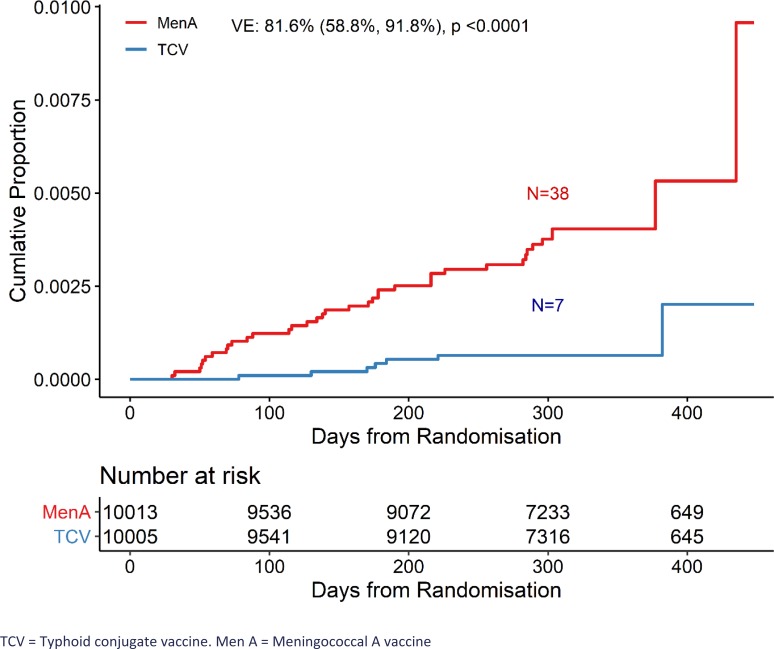
Results: A total of 10,005 participants received the TCV and 10,014 received the MenA vaccine. Blood culture-confirmed typhoid fever occurred in 7 participants who received TCV (79 cases per 100,000 person-years) and in 38 who received MenA vaccine (428 cases per 100,000 person-years) (vaccine efficacy, 81.6%; 95% confidence interval, 58.8 to 91.8; P<0.001). A total of 132 serious adverse events (61 in the TCV group and 71 in the MenA vaccine group) occurred in the first 6 months, and 1 event (pyrexia) was identified as being vaccine-related; the participant remained unaware of the trial-group assignment. Similar rates of adverse events were noted in the two trial groups; fever developed in 5.0% of participants in the TCV group and 5.4% in the MenA vaccine group in the first week after vaccination. In the immunogenicity subgroup, seroconversion (a Vi IgG level that at least quadrupled 28 days after vaccination) was 99% in the TCV group (677 of 683 participants) and 2% in the MenA vaccine group (8 of 380 participants).
Conclusions: A single dose of TCV was immunogenic and effective in reducing S. Typhi bacteremia in children 9 months to 16 years of age. (Funded by the Bill and Melinda Gates Foundation; Current Controlled Trials number, ISRCTN43385161.).
Copyright © 2019 Massachusetts Medical Society.
Conflict of interest statement
AJP is Chair of UK Dept. Health and Social Care's (DHSC) Joint Committee on Vaccination & Immunisation (JCVI) & the European Medicine Agency (EMA) scientific advisory group on vaccines, and is a member of the WHO's Strategic Advisory Group of Experts. KMN is a member of the WHO's Strategic Advisory Group of Experts.
All other authors report no conflicts of interest.
The views expressed in this article do not necessarily represent the views of DHSC, JCVI, EMA, or WHO.
Figures
Comment in
-
Parting the Clouds over Typhoid with a New Conjugate Vaccine.N Engl J Med. 2019 Dec 5;381(23):2262-2264. doi: 10.1056/NEJMe1914695. N Engl J Med. 2019. PMID: 31800994 No abstract available.
References
-
- Mogasale Vittal, Maskery Brian. Burden of typhoid fever in low-inocme and middle-income cuntries: a systematic, literature-based update with risk-factor adjustment. Lancet Glob Heal 2014;2:570–80. - PubMed
-
- World Health Organisation Typhoid vaccines: WHO position paper, March 2018 – Recommendations. Vaccine 2019;37(2):214–6. - PubMed
Publication types
MeSH terms
Substances
Associated data
Grants and funding
LinkOut - more resources
Full Text Sources
Other Literature Sources
Research Materials