


Cardioinformatics: the nexus of bioinformatics and precision cardiology
- PMID: 31802103
- PMCID: PMC7947182
- DOI: 10.1093/bib/bbz119
Cardioinformatics: the nexus of bioinformatics and precision cardiology
Abstract
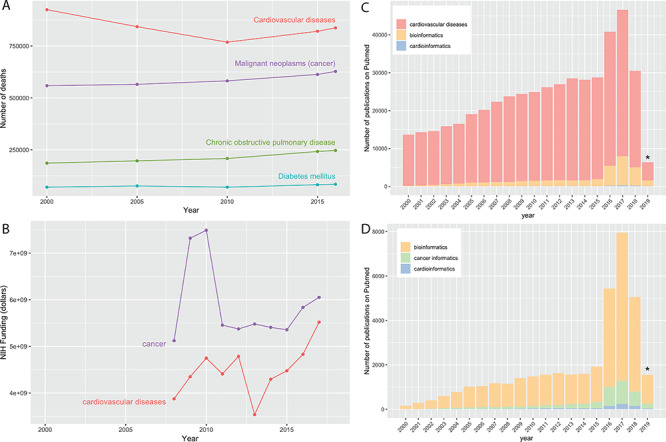
Cardiovascular disease (CVD) is the leading cause of death worldwide, causing over 17 million deaths per year, which outpaces global cancer mortality rates. Despite these sobering statistics, most bioinformatics and computational biology research and funding to date has been concentrated predominantly on cancer research, with a relatively modest footprint in CVD. In this paper, we review the existing literary landscape and critically assess the unmet need to further develop an emerging field at the multidisciplinary interface of bioinformatics and precision cardiovascular medicine, which we refer to as 'cardioinformatics'.
Keywords: bioinformatics; cardiology; cardiovascular disease; computational biology.
© The authors 2019. Published by Oxford University Press on behalf of the Institute of Mathematics and its Applications. All rights reserved.
Figures
References
-
- Roth GA, Abate D, Abate KH, et al. Global, regional, and national age–sex-specific mortality for 282 causes of death in 195 countries and territories, 1980–2017: a systematic analysis for the Global Burden of Disease Study 2017. Lancet 2018;392(10159):1736–88. doi: 10.1016/S0140-6736(18)32203-7. - DOI - DOI - PMC - PubMed
-
- Leopold JA, Loscalzo J. Emerging role of precision medicine in cardiovascular disease. Circ Res 2018;122(9):1302–15. doi: 10.1161/CIRCRESAHA.117.310782. - DOI - PMC - PubMed
-
- Heidenreich PA, Trogdon JG, Khavjou OA, et al. Forecasting the future of cardiovascular disease in the United States. Circulation 2011;123(8):933–44. doi: 10.1161/CIR.0b013e31820a55f5. - DOI - PubMed
-
- Joseph P, Leong D, McKee M, et al. Reducing the global burden of cardiovascular disease, part 1: the epidemiology and risk factors. Circ Res 2017;121(6):677–94. - PubMed
-
- Rogers MA, Aikawa E. Cardiovascular calcification: artificial intelligence and big data accelerate mechanistic discovery. Nat Rev Cardiol 2019;16(5):261–74. - PubMed
