


The Premonitory Urge for Tics Scale in a large sample of children and adolescents: psychometric properties in a developmental context. An EMTICS study
- PMID: 31802271
- PMCID: PMC7501098
- DOI: 10.1007/s00787-019-01450-1
The Premonitory Urge for Tics Scale in a large sample of children and adolescents: psychometric properties in a developmental context. An EMTICS study
Abstract
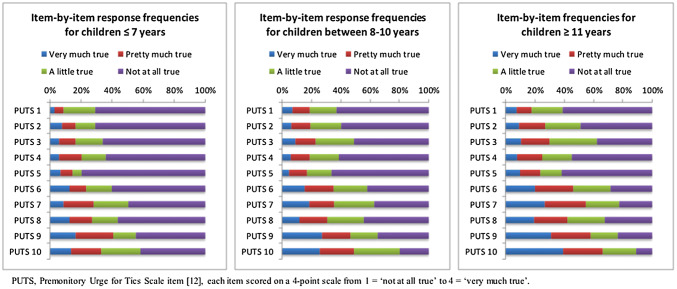
Premonitory urges are uncomfortable physical sensations preceding tics that occur in most individuals with a chronic tic disorder. The Premonitory Urge for Tics Scale (PUTS) is the most frequently used self-report measure to assess the severity of premonitory urges. We aimed to evaluate the psychometric properties of the PUTS in the largest sample size to date (n = 656), in children aged 3-16 years, from the baseline measurement of the longitudinal European Multicenter Tics in Children Study (EMTICS). Our psychometric evaluation was done in three age-groups: children aged 3-7 years (n = 103), children between 8 and 10 years (n = 253), and children aged 11-16 years (n = 300). The PUTS exhibited good internal reliability in children and adolescents, also under the age of 10, which is younger than previously thought. We observed significant but small correlations between the severity of urges and severity of tics and obsessive-compulsive symptoms, and between severity of urges and ratings of attention-deficit/hyperactivity disorder and internalizing and externalizing behaviors, however, only in children of 8-10 years. Consistent with previous results, the 10th item of the PUTS correlated less with the rest of the scale compared to the other items and, therefore, should not be used as part of the questionnaire. We found a two-factor structure of the PUTS in children of 11 years and older, distinguishing between sensory phenomena related to tics, and mental phenomena as often found in obsessive-compulsive disorder. The age-related differences observed in this study may indicate the need for the development of an age-specific questionnaire to assess premonitory urges.
Keywords: Obsessive–compulsive symptoms; Premonitory Urge for Tics Scale (PUTS); Premonitory urges; Psychometric properties; Tourette syndrome.
Conflict of interest statement
On behalf of all other authors, the corresponding author declares that the other authors have no conflict of interest.
Figures
References
-
- American Psychiatric Association . Diagnostic and statistical manual of mental disorders. 5. Washington, DC: American Psychiatric Press; 2013.
MeSH terms
Grants and funding
LinkOut - more resources
Full Text Sources
Medical
