


Older People's Attitudes And Perspectives Of Welfare Technology In Norway
- PMID: 31802884
- PMCID: PMC6801567
- DOI: 10.2147/JMDH.S219458
Older People's Attitudes And Perspectives Of Welfare Technology In Norway
Abstract
Background: In Norway, as in other European countries, the ageing population is increasing rapidly. Governments seek to enable older people stay in their homes for as long as possible, and welfare technology (WT) has been proposed as a possible solution. Human behaviour modelling (HBM) is a welfare technology that identifies an individual's behaviour patterns and detects abnormal behaviours, including falls and early signs of dementia. However, the successful development of HBM WT requires the consideration of the older people's attitudes on this.
Aim: The present study sought to explore attitudes and perspectives about welfare technology among older people living alone in Norway.
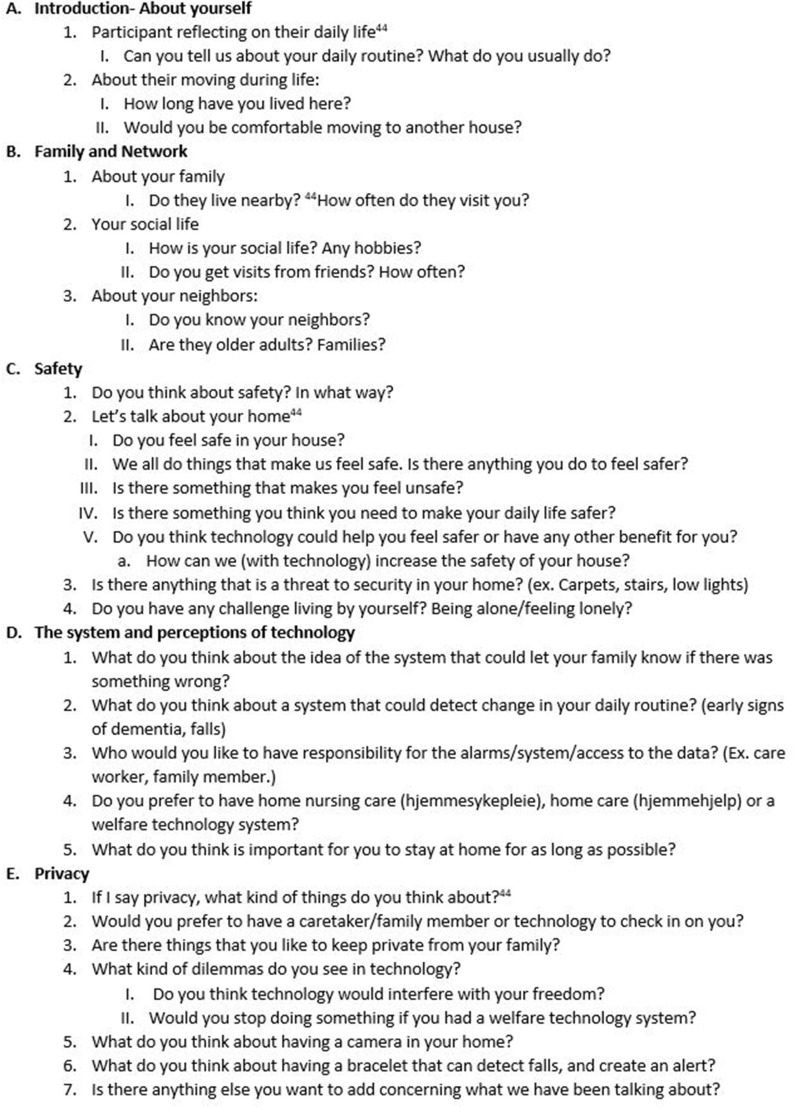
Methods: We used an exploratory, qualitative approach in which semi-structured, in-depth interviews were conducted with five women and four men between the ages of 79 and 91. The interviews were analysed using qualitative content analysis.
Results: Two categories and four subcategories were identified: 1) preferences and concerns of welfare technology (i) feeling confident-proactive approach of future technology, (ii) concerns and dilemmas, and 2) reflections of today and tomorrow- awareness of own health (i) feeling healthy, independent, self-sufficient and safe, (ii) facing own ageing- preparedness on unpredictable scenarios. The main theme, welfare technology - a valuable addition to tomorrow's homes, represents how the participants held positive and proactive attitudes towards the use of WT in their homes.
Conclusion: Participants trusted the Norwegian healthcare system and did not rely on their families for care. Independence, autonomy, and feeling safe were essential for all participants, and most participants regarded welfare technology as empowering them to remain in their homes for as long as possible. Participants already confidently used various technologies in their daily lives. Surprisingly, they expressed no concerns about privacy, but some mention concerns about loss of autonomy and dignity. We conclude that a person-centred approach to integrating new WT is necessary.
Keywords: ageing in place; ambient assistive living; assistive technology; ethical challenges; healthcare; human behaviour.
© 2019 Sánchez et al.
Conflict of interest statement
The authors report no conflicts of interest in this work.
Figures
References
-
- Eurostat. Population structure and ageing. May 2018. Available from: https://ec.europa.eu/eurostat/statistics-explained/index.php/Population_... Accessed March27, 2019.
-
- Norway S. Population projections. June 26, 2018. Available from: https://www.ssb.no/en/folkfram Accessed March27, 2019.
-
- Sanchez VG, Pfeiffer CF Legal aspects on smart house welfare technology for older people in Norway. Paper presented at: Intelligent Environments (Workshops); London, UK, 2016.
-
- Norway S. Innbyggerne i store kommuner venter lengst på omsorgstjenester. 2017. Available from: https://www.ssb.no/helse/artikler-og-publikasjoner/innbyggerne-i-store-k... Accessed April17, 2019.
-
- Vike H. Politics and Bureaucracy in the Norwegian Welfare State: An Anthropological Approach. Springer; 2017.
LinkOut - more resources
Full Text Sources
