


Gaps in knowledge and future directions for the use of faecal microbiota transplant in the treatment of inflammatory bowel disease
- PMID: 31803254
- PMCID: PMC6878609
- DOI: 10.1177/1756284819891038
Gaps in knowledge and future directions for the use of faecal microbiota transplant in the treatment of inflammatory bowel disease
Abstract
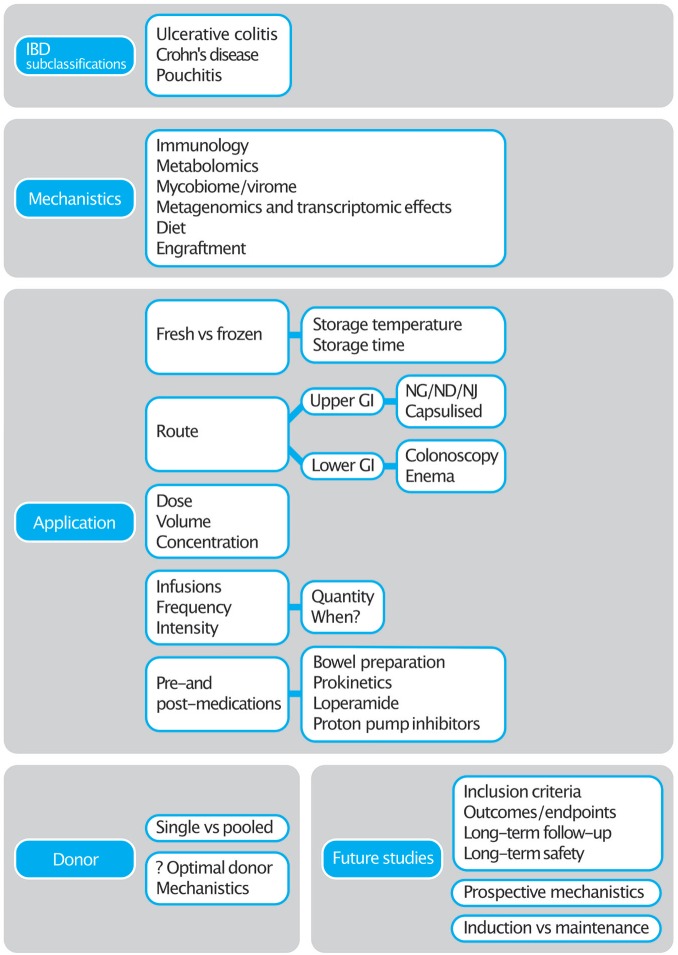
Faecal microbiota transplant (FMT) has now been established into clinical guidelines for the treatment of recurrent and refractory Clostridioides difficile infection (CDI). Its therapeutic application in inflammatory bowel disease (IBD) is currently at an early stage. To date, there have been four randomized controlled trials for FMT in IBD and a multitude of observational studies. However, significant gaps in our knowledge regarding optimum methods for FMT preparation, technical aspects and logistics of its administration, as well as mechanistic underpinnings, still remain. In this article, we aim to highlight these gaps by reviewing evidence and making key recommendations on the direction of future studies in this field. In addition, we provide an overview of the current evidence of potential mechanisms of FMT in treating IBD.
Keywords: faecal microbiota transplantation; inflammatory bowel disease; microbiota.
© The Author(s), 2019.
Conflict of interest statement
Conflict of interest statement: The authors declare that there is no conflict of interest.
Figures
References
-
- Quraishi MN, Widlak M, Bhala N, et al. Systematic review with meta-analysis: the efficacy of faecal microbiota transplantation for the treatment of recurrent and refractory Clostridium difficile infection. Aliment Pharmacol Ther 2017; 46: 479–493. - PubMed
-
- Mullish BH, Quraishi MN, Segal JP, et al. The use of faecal microbiota transplant as treatment for recurrent or refractory Clostridium difficile infection and other potential indications: joint British Society of Gastroenterology (BSG) and Healthcare Infection Society (HIS) guidelines. Gut 2018; 67: 1920–1941. - PubMed
-
- Mullish BH, Quraishi MN, Segal JP, et al. The use of faecal microbiota transplant as treatment for recurrent or refractory Clostridium difficile infection and other potential indications: joint British Society of Gastroenterology (BSG) and Healthcare Infection Society (HIS) guidelines. J Hosp Infect 2018; 100(Suppl. 1): S1–S31. - PubMed
-
- Moayyedi P, Yuan Y, Baharith H, et al. Faecal microbiota transplantation for Clostridium difficile -associated diarrhoea: a systematic review of randomised controlled trials. Med J Aust 2017; 207: 166–172. - PubMed
Publication types
Grants and funding
LinkOut - more resources
Full Text Sources
