Observational Study
. 2019 Dec 5;14(12):e0223515.
doi: 10.1371/journal.pone.0223515. eCollection 2019.

Incidence of statin use in older adults with and without cardiovascular disease and diabetes mellitus, January 2008- March 2018

Affiliations
Observational Study

Incidence of statin use in older adults with and without cardiovascular disease and diabetes mellitus, January 2008- March 2018

Catherine A Panozzo et al. PLoS One. .

Abstract

Background: Data from randomized controlled trials and observational studies on older adults who take statins for primary prevention of atherosclerotic cardiovascular disease are limited. To determine the incidence of statin use in older adults with and without cardiovascular disease (CVD) and/or diabetes (DM), we conducted a descriptive observational study.

Methods: The cohort consisted of health plan members in the NIH Collaboratory Distributed Research Network aged >75 years who had continuous drug and medical benefits for ≥183 days during the study period, January 1, 2008- March 31, 2018. We defined DM and CVD using diagnosis codes, and identified statins using dispensing data. Statin use was considered incident if a member had no evidence of statin exposure in the claims during the previous 183 days, and the use was considered long-term if statins were supplied for ≥180 days. Incidence rates were reported among members with and without CVD and/or diabetes, and stratified by year, sex, and age group.

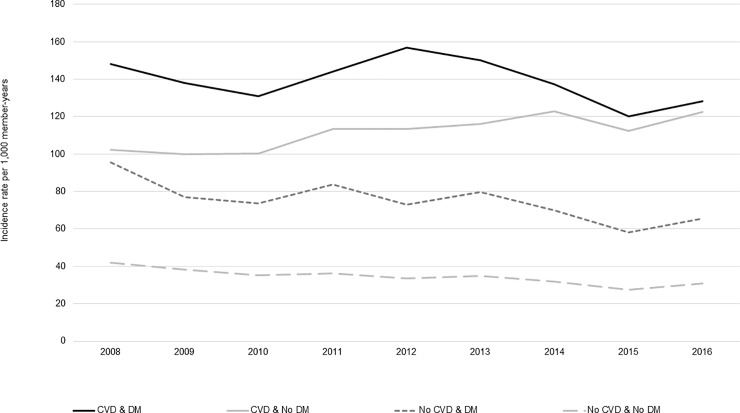
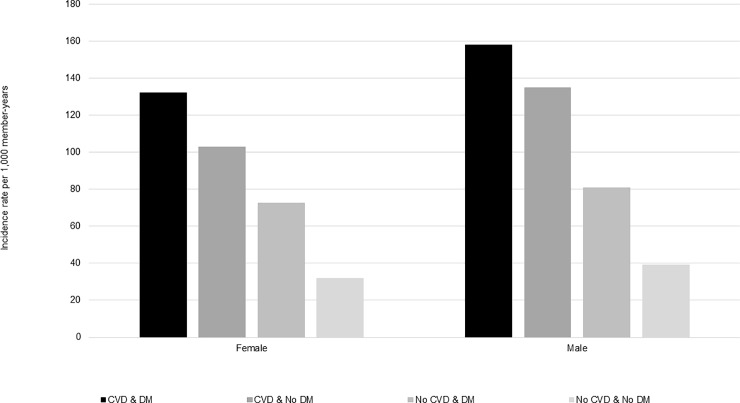
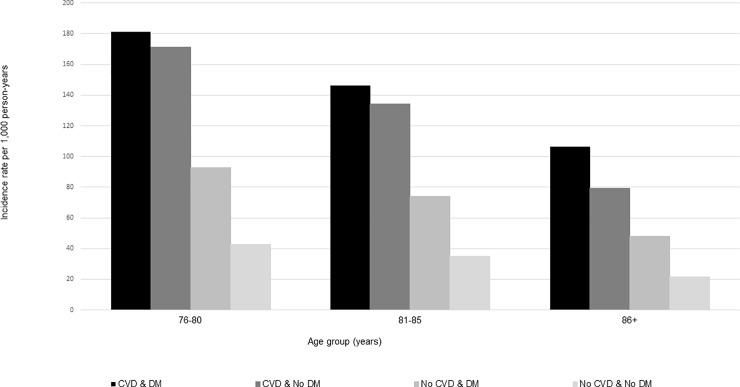
Results: Among 757,569 eligible members, 109,306 older adults initiated statins and 54,624 became long-term users. Health plan members with CVD had the highest incidence of statin use (143.9 initiators per 1,000 member-years for CVD & DM; 114.5 initiators per 1,000 member-years for CVD & No DM). Among health plan members without CVD, those with DM had rates of statin use that were over two times higher than members without DM (76.1 versus 34.5 initiators per 1,000 member-years, respectively). Statin initiation remained steady throughout 2008-2016, was slightly higher in males, and declined with increasing age.

Conclusion: Incidence of statin use varied by CVD and DM comorbidity, and was lowest among those without CVD. These results highlight the potential clinical equipoise to conduct large pragmatic clinical trials to generate evidence that could be used to inform future blood cholesterol guidelines.


Conflict of interest statement

I have read the journal's policy and the authors of this manuscript have the following competing interests: One of the authors [KH] is employed by HealthCore, Inc. Dr. Curtis has research contracts with Glaxo Smith Kline, Medtronic, and Novartis. None of the work is related to this manuscript. Dr. Hernandez consults and conducts research for AstraZeneca, Merck, and Novartis. He consults for Bayer. The other authors have declared that no competing interests exist. There are no patents, products in development or marketed products to declare. This does not alter our adherence to all the PLOS ONE policies on sharing data and materials.

Figures
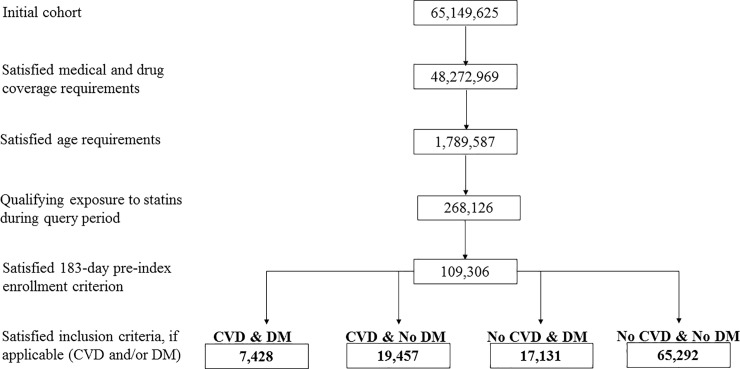
Fig 1
Fig 1. Cohort attrition for CVD & DM, CVD & No DM, No CVD & DM, and No CVD & No DM cohorts, all duration of statin use among initiators aged >75 years, NIH Collaboratory Distributed Research Network, January 1, 2008- March 31, 2018.
Abbreviations: CVD = cardiovascular disease; DM = diabetes mellitus.
Fig 2
Fig 2. Statin initiation rates among older adults aged >75 years with and without cardiovascular disease and diabetes mellitus by calendar year, NIH Collaboratory Distributed Research Network, January 1, 2008- December 31, 2016*.
Abbreviations: CVD = cardiovascular disease; DM = diabetes mellitus *Data were incomplete in 2017 and 2018 so these years were excluded from this analysis to prevent misleading information that can arise from unstable data.
Fig 3
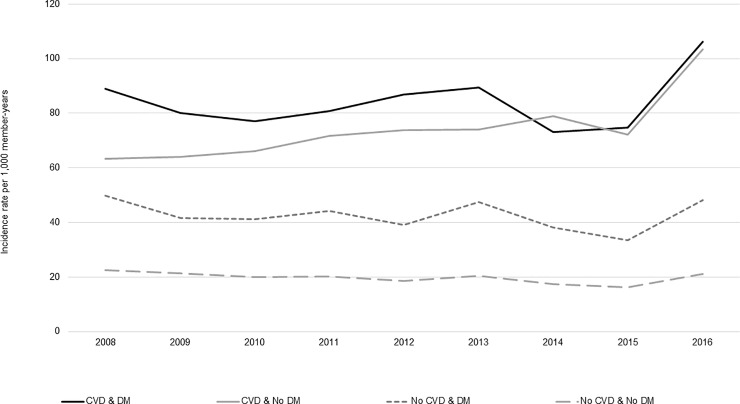
Fig 3. Statin initiation rates among older adults aged >75 years with and without cardiovascular disease and diabetes mellitus by calendar year, who go on to use statins long-term,* NIH Collaboratory Distributed Research Network, January 1, 2008- December 31, 2016†.
Abbreviations: CVD = cardiovascular disease; DM = diabetes mellitus *Long-term use was defined as a minimum of 180 days of statin exposure based on the number of days supplied, allowing for gaps of up to 30 days and including an exposure episode extension period of 30 days Data were incomplete in 2017 and 2018 so these years were excluded from this analysis to prevent misleading information that can arise from unstable data.
Fig 4
Fig 4. Statin initiation rates among older adults aged >75 years with and without cardiovascular disease and diabetes mellitus by sex, NIH Collaboratory Distributed Research Network, January 1, 2008- March 31, 2018.
Abbreviations: CVD = cardiovascular disease; DM = diabetes mellitus.
Fig 5
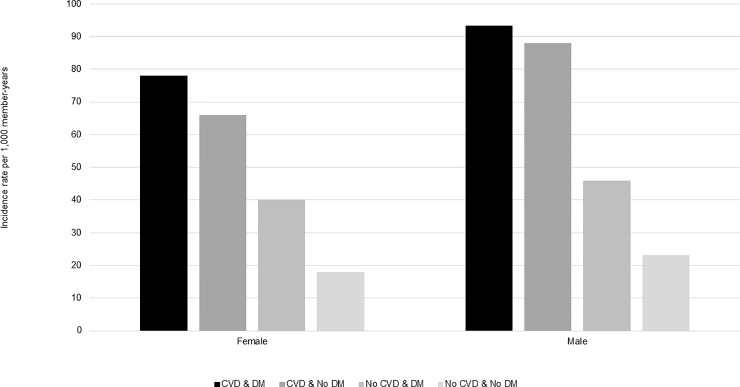
Fig 5. Statin initiation rates among older adults aged >75 years with and without cardiovascular disease and diabetes mellitus by sex, and who go on to use statins long-term,* NIH Collaboratory Distributed Research Network, January 1, 2008- March 31, 2018.
Abbreviations: CVD = cardiovascular disease; DM = diabetes mellitus *Long-term use was defined as a minimum of 180 days of statin exposure based on the number of days supplied, allowing for gaps of up to 30 days and including an exposure episode extension period of 30 days.
Fig 6
Fig 6. Statin initiation rates among older adults aged >75 years with and without cardiovascular disease and diabetes mellitus by age group, NIH Collaboratory Distributed Research Network, January 1, 2008- March 31, 2018.
Abbreviations: CVD = cardiovascular disease; DM = diabetes mellitus.
Fig 7
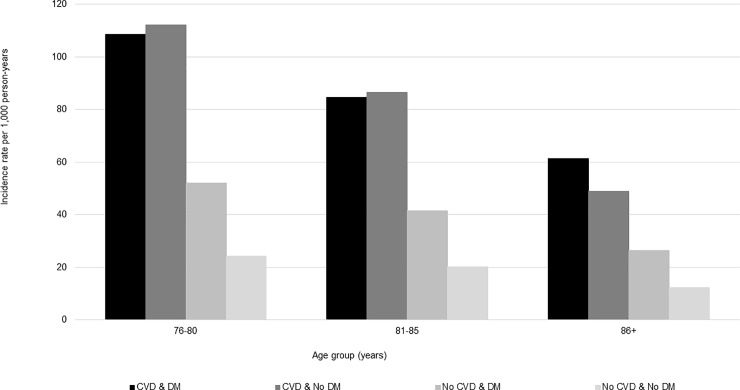
Fig 7. Statin initiation rates among older adults aged >75 years with and without cardiovascular disease and diabetes mellitus by age group, and who go on to use statins long-term,* NIH Collaboratory Distributed Research Network, January 1, 2008- March 31, 2018.
Abbreviations: CVD = cardiovascular disease; DM = diabetes mellitus *Long-term use was defined as a minimum of 180 days of statin exposure based on the number of days supplied, allowing for gaps of up to 30 days and including an exposure episode extension period of 30 days.

References

    1. Gurwitz JH, Go AS, Fortmann SP. Statins for Primary Prevention in Older Adults: Uncertainty and the Need for More Evidence. Jama. 2016;316(19):1971–2. 10.1001/jama.2016.15212 - DOI - PMC - PubMed
    1. Giral P, Neumann A, Weill A, Coste J. Cardiovascular effect of discontinuing statins for primary prevention at the age of 75 years: a nationwide population-based cohort study in France. European heart journal. 2019. - PMC - PubMed
    1. Ridker PM, Danielson E, Fonseca FA, Genest J, Gotto AM Jr., Kastelein JJ, et al. Rosuvastatin to prevent vascular events in men and women with elevated C-reactive protein. The New England journal of medicine. 2008;359(21):2195–207. 10.1056/NEJMoa0807646 - DOI - PubMed
    1. Yusuf S, Bosch J, Dagenais G, Zhu J, Xavier D, Liu L, et al. Cholesterol Lowering in Intermediate-Risk Persons without Cardiovascular Disease. The New England journal of medicine. 2016;374(21):2021–31. 10.1056/NEJMoa1600176 - DOI - PubMed
    1. Ridker PM, Lonn E, Paynter NP, Glynn R, Yusuf S. Primary Prevention With Statin Therapy in the Elderly: New Meta-Analyses From the Contemporary JUPITER and HOPE-3 Randomized Trials. Circulation. 2017;135(20):1979–81. 10.1161/CIRCULATIONAHA.117.028271 - DOI - PubMed

Publication types

MeSH terms

Substances