


Pediatric Cutaneous Emergencies and their Outcome: Study from a Tertiary Care Center in South India
- PMID: 31807443
- PMCID: PMC6859774
- DOI: 10.4103/idoj.IDOJ_37_19
Pediatric Cutaneous Emergencies and their Outcome: Study from a Tertiary Care Center in South India
Abstract
Background: Skin problems are commonly encountered in the pediatric emergency department (PED). Although there are a few studies on the prevalence and spectrum of skin conditions in children attending the PED, only limited information is available on the outcome of the children with skin-related ailments requiring hospitalization.
Aim: To study the clinical profile of skin manifestations in children presenting to the PED over a period of one year and assess the impact of skin lesions on the clinical outcome.
Materials and methods: All children <16 years of age attending the PED were screened and children with skin lesions were referred to the dermatologist for further evaluation, and those admitted were followed up until discharge. Children with skin lesions were categorized into seven subsets based on their diagnosis. Outcomes evaluated were duration of hospital stay, associated systemic inflammatory response syndrome (SIRS), and mortality.
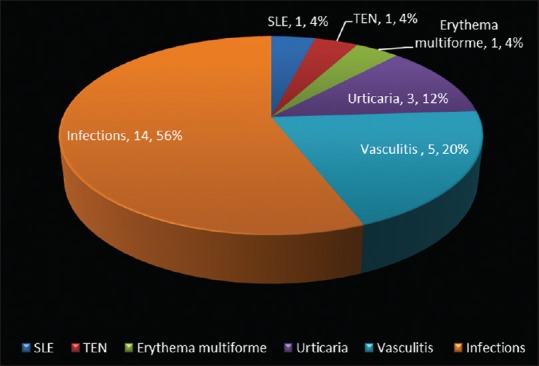
Results: Of the 24,324 patients screened, 203 (0.83%) had skin lesions, of whom 158 (77.83%) were discharged from the PED. Forty five (22.16%) patients required admission of whom 2 (0.99%) died. Inflammatory disorders were the most common, 102 (50.24%), followed by infections in 91 (44.82%) patients. Among the hospitalized patients, 25 (55.6%) had SIRS, which included infections in 14 (56%), vasculitis in 5 (20%), and urticaria in 3 (12%) patients. Two patients with SIRS died and the causes were purpura fulminans and febrile exanthem of probable viral etiology.
Conclusion: Our study highlights the spectrum of pediatric cutaneous emergencies and their outcome. A subset of patients can present with severe skin ailments and SIRS in whom early diagnosis and prompt treatment can impact the outcome.
Keywords: Cutaneous emergencies; pediatric emergency department; skin manifestations; systemic inflammatory response syndrome.
Copyright: © 2019 Indian Dermatology Online Journal.
Conflict of interest statement
There are no conflicts of interest.
Figures
References
-
- Gupta S, Sandhu K, Kumar B. Evaluation of emergency dermatological consultations in a tertiary care centre in North India. J Eur Acad Dermatol Venereol. 2003;17:303–5. - PubMed
-
- Kramkimel N, Soussan V, Beauchet A, Duhamel A, Saiag P, Chevallier B, et al. High frequency, diversity and severity of skin diseases in a paediatric emergency department. J Eur Acad Dermatol Venereol. 2010;24:1468–75. - PubMed
-
- Landolt B, Staubli G, Lips U, Weibel L. Skin disorders encountered in a Swiss pediatric emergency department. Swiss Med Wkly. 2013;143:w13731. - PubMed
-
- Mathias RC, Jayaseelan E, Augustine M. Spectrum of pediatric dermatological emergencies at a tertiary care hospital in India: A descriptive study. Int J Dermatol. 2013;52:27–31. - PubMed
-
- Sarkar R, Basu S, Patwari AK, Sharma RC, Dutta AK, Sardana K. An appraisal of pediatric dermatological emergencies. Indian Pediatr. 2000;37:425–9. - PubMed
LinkOut - more resources
Full Text Sources
