Review
. 2020 Jul;40(5):675-693.
doi: 10.1007/s10571-019-00767-4. Epub 2019 Dec 5.

Inflammatory Pathways Following Subarachnoid Hemorrhage

Affiliations
Review

Inflammatory Pathways Following Subarachnoid Hemorrhage

Kevin Min Wei Khey et al. Cell Mol Neurobiol. 2020 Jul.

Abstract

Aneurysmal subarachnoid hemorrhage (SAH) is an acute cerebrovascular emergency resulting from the rupture of a brain aneurysm. Despite only accounting for 5% of all strokes, SAH imposes a significant health burden on society due to its relatively young age at onset. Those who survive the initial bleed are often afflicted with severe disabilities thought to result from delayed cerebral ischemia (DCI). Consequently, elucidating the underlying mechanistic pathways implicated in DCI development following SAH remains a priority. Neuroinflammation has recently been implicated as a promising new theory for the development of SAH complications. However, despite this interest, clinical trials have failed to provide consistent evidence for the use of anti-inflammatory agents in SAH patients. This may be explained by the complexity of SAH as a plethora of inflammatory pathways have been shown to be activated in the disease. By determining how these pathways may overlap and interact, we hope to better understand the developmental processes of SAH complications and how to prevent them. The goal of this review is to provide insight into the available evidence regarding the molecular pathways involved in the development of inflammation following SAH and how SAH complications may arise as a result of these inflammatory pathways.

Keywords: Delayed cerebral ischemia; Inflammation; Ruptured aneurysm; Subarachnoid hemorrhage; Vasospasm.


Conflict of interest statement

The authors declare that they have no conflict of interest.

Figures
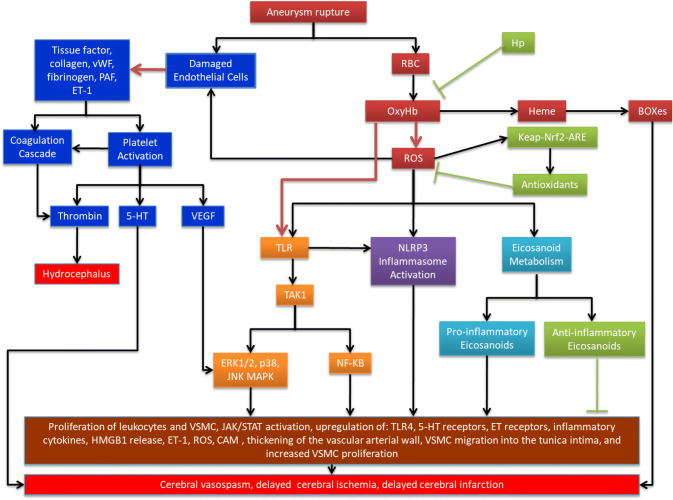
Fig. 1
Fig. 1
The proposed mechanism of inflammation following SAH. Aneurysm rupture primarily initiates the inflammatory cascade via two main pathways: the introduction of red blood cells (RBCs) into the subarachnoid space and the endothelial cell damage. In the first pathway, lysis of RBCs release oxyhemoglobin (OxyHb) which can be metabolized into heme and methemoglobin (metHb). Heme is then metabolized into bilirubin and then bilirubin oxidation products (BOXes), compounds that induce cerebral vasospasm. OxyHb and MetHb (not depicted in this diagram), act as danger-associated molecular patterns (DAMP) and activate toll-like receptors (TLR). In addition, oxyHb-induced reactive oxygen species (ROS) release further stimulates several inflammatory pathways, including TLR/TAK1, nucleotide binding and oligomerization domain-like receptor family pyrin domain-containing 3 (NLRP3) inflammasome, and eicosanoid metabolism. These pathways induce the activation and upregulation of multiple pro-inflammatory and vasospasmogenic processes and agents. Furthermore, the majority of these upregulated agents may feedback into the previously stated pathways, enhancing their effects in a positive feedback loop. As a result, SAH complications, such as cerebral vasospasm, delayed cerebral ischemia, and delayed cerebral infarction may occur. In the second pathway, damaged endothelial cells release a variety of pro-thrombotic and pro-inflammatory factors. These factors ultimately act to initiate the coagulation cascade and the activation of platelets. Thrombin, a downstream component of the coagulation cascade and a product of platelet activation, has been implicated to contribute to hydrocephalus, while other products released from platelets, such as serotonin (5-HT) and vascular endothelial growth factor (VEGF) contribute to other pro-inflammatory pathways resulting in SAH complications. Anti-inflammatory mechanisms are also depicted. These include haptoglobin (Hp), kelch-like ECH-associated protein 1-nuclear factor erythroid 2 related factor 2-antioxidant response element (Keap-Nrf2-ARE), and anti-inflammatory eicosanoids which act on various pathways to attenuate inflammation in SAH and prevent SAH complications. CAM cell adhesion molecule, ERK extracellular signal-regulated kinase, Et-1 endothelin-1, HMGB high mobility group box, JAK/STAT janus kinases/signal transducer and activator of transcription proteins, JNK c-Jun N-terminal kinases, MAPK mitogen-activated protein kinase, NF-kB nuclear factor kappa B, TAK transforming growth factor beta-activated kinase, VSMC vascular smooth muscle cell, vWF Von Willebrand Factor. Red arrows depict the main effector pathways initiating the inflammatory response

References

    1. Abais JM, Xia M, Zhang Y, Boini KM, Li PL (2015) Redox regulation of NLRP3 inflammasomes: ROS as trigger or effector? Antioxid Redox Signal 22:1111–1129. 10.1089/ars.2014.5994 - DOI - PMC - PubMed
    1. Abe Y, Kasuya H, Suzuki S, Yamanishi Y, Hori T (2002) Effect of a platelet-activating factor antagonist, E5880, on cerebrovasospasm following subarachnoid hemorrhage in a canine double-hemorrhage model. Eur J Pharmacol 455:127–133 - DOI - PubMed
    1. Ansar S, Edvinsson L (2008) Subtype activation and interaction of protein kinase C and mitogen-activated protein kinase controlling receptor expression in cerebral arteries and microvessels after subarachnoid hemorrhage. Stroke 39:185–190. 10.1161/strokeaha.107.487827 - DOI - PubMed
    1. Ansar S, Edvinsson L (2009) Equal contribution of increased intracranial pressure and subarachnoid blood to cerebral blood flow reduction and receptor upregulation after subarachnoid hemorrhage. Lab Invest J Neurosurg 111:978–987. 10.3171/2007.3.16738 - DOI - PubMed
    1. Ansar S, Vikman P, Nielsen M, Edvinsson L (2007) Cerebrovascular ETB, 5-HT1B, and AT1 receptor upregulation correlates with reduction in regional CBF after subarachnoid hemorrhage. Am J Physiol 293:3750 - PubMed

MeSH terms

LinkOut - more resources
