. 2019 Dec 2;9(12):815.
doi: 10.3390/biom9120815.

ClpG Provides Increased Heat Resistance by Acting as Superior Disaggregase

Affiliations

ClpG Provides Increased Heat Resistance by Acting as Superior Disaggregase

Panagiotis Katikaridis et al. Biomolecules. .

Abstract

Elevation of temperature within and above the physiological limit causes the unfolding and aggregation of cellular proteins, which can ultimately lead to cell death. Bacteria are therefore equipped with Hsp100 disaggregation machines that revert the aggregation process and reactivate proteins otherwise lost by aggregation. In Gram-negative bacteria, two disaggregation systems have been described: the widespread ClpB disaggregase, which requires cooperation with an Hsp70 chaperone, and the standalone ClpG disaggregase. ClpG co-exists with ClpB in selected bacteria and provides superior heat resistance. Here, we compared the activities of both disaggregases towards diverse model substrates aggregated in vitro and in vivo at different temperatures. We show that ClpG exhibits robust activity towards all disordered aggregates, whereas ClpB acts poorly on the protein aggregates formed at very high temperatures. Extreme temperatures are expected not only to cause extended protein unfolding, but also to result in an accelerated formation of protein aggregates with potentially altered chemical and physical parameters, including increased stability. We show that ClpG exerts higher threading forces as compared to ClpB, likely enabling ClpG to process "tight" aggregates formed during severe heat stress. This defines ClpG as a more powerful disaggregase and mechanistically explains how ClpG provides increased heat resistance.

Keywords: AAA protein, Hsp100; chaperone; heat resistance; protein aggregation; protein disaggregation.


Conflict of interest statement

The authors declare no conflict of interest.

Figures
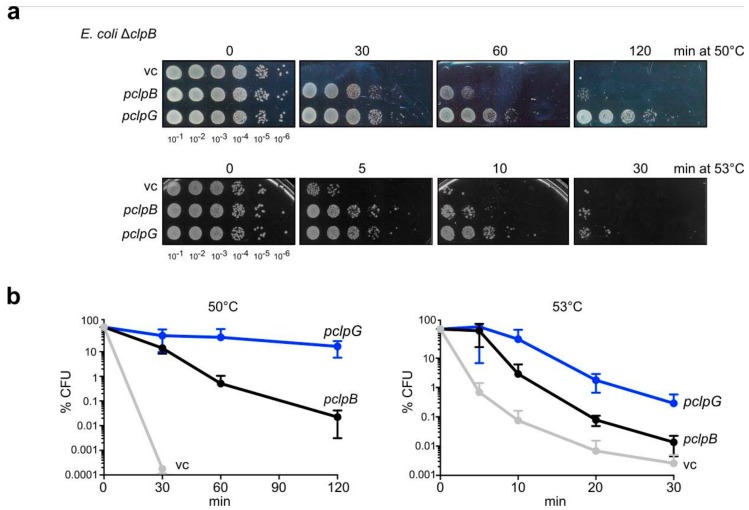
Figure 1
Figure 1
ClpG provides superior heat resistance. (a) E. coli ΔclpB cells harboring plasmids for expression of E. coli clpB or P. aeruginosa clpG (vc: empty vector control) were grown at 30 °C to mid-logarithmic growth phase and shifted to 50 °C or 53 °C. Serial dilutions of cells were prepared at the indicated time points, spotted on LB plates and incubated at 30 °C. (b) Colony numbers (CFU) were determined after 24 h and set to 100% for non-heat shocked samples. Standard deviations are provided (n = 3: 50 °C; n = 2: 53 °C).
Figure 2
Figure 2
ClpG exhibits highest disaggregation activity towards diverse model substrates. (a) Domain organizations of ClpB and ClpG. Both Hsp100 proteins harbor two ATPase domains (AAA-1, AAA-2), a homologous N2 domain and a middle (M) domain. ClpG harbors additionally the N-terminal N1 domain and a C-terminal extension (C). The ClpB M-domain mutant K476C has increased ATPase and disaggregation activity due to dissociation of repressing M-domains. (be) Disaggregation of aggregated malate dehydrogenase (b), Luciferase (c), α-Glucosidase (d) and Citrate Synthase (e) by ClpB, ClpB-K476C or ClpG was monitored by light scattering. Sample turbidities at 0 min were set to 100%. Disaggregation reactions with ClpB and ClpB-K476C included the cooperating DnaK system. Disaggregation rates were determined based on the linear decrease in sample turbidity. Standard deviations are provided (n = 3).
Figure 3
Figure 3
ClpG has higher disaggregation activity towards complex aggregates. (a) Soluble 3H-labeled proteins from an E. coli ΔclpB cell lysate (including Luciferase) were heat shocked to 46 °C for 15 min. Protein aggregates were isolated by centrifugation and resuspended in buffer. Disaggregase activities were monitored by determining the amount of solubilized 3H-labeled proteins (b,c) or Luciferase refolding (d,e). Disaggregation reactions with ClpB and ClpB-K476C included the cooperating DnaK system. Luciferase activities before heat shock were set to 100%. Rates of protein solubilization (c) and Luciferase reactivation (e) were determined. Standard deviations are given (n = 3).
Figure 4
Figure 4
ClpG becomes a superior disaggregase in E. coli cells upon severe heat stress. (a,b) E. coli ΔclpB cells harboring plasmids for constitutive expression of Luciferase and IPTG-controlled expression of E. coli clpB, E. coli clpB-K476C or P. aeruginosa clpG (vc: empty vector control) were grown at 30 °C to mid-logarithmic growth phase and shifted to 42–50 °C for 15 min. Tetracycline was added directly after heat shock and cells were shifted to 30 °C. Luciferase activities were determined before and after heat stress and during the recovery period at 30 °C. Luciferase activities determined before heat stress were set as 100%. Absolute Luciferase refolding activities were compared after 120 min (c). Relative disaggregation activities (d) were calculated setting the absolute Luciferase activities determined in (c) after 42 °C heat shock as 100% for each disaggregase. Standard deviations are given (n = 3).
Figure 5
Figure 5
ClpG but not ClpB exhibits robust disaggregase activity. (a) Disaggregation activities of ClpB, ClpB-K476C and ClpG towards Luciferase aggregates generated at the indicated stress conditions were determined. Disaggregation reactions with ClpB and ClpB-K476C included the cooperating DnaK system. A reaction without chaperones served as control. Activities of native Luciferase (25 nM or 200 nM) were set as 100%. Absolute Luciferase refolding activities were compared after 120 min (b). Relative disaggregation activities (c) were calculated based on (b) by defining the activity of each disaggregase determined for 25 nM Luciferase aggregates generated at 42 °C as 100%. Standard deviations are given (n = 3).
Figure 6
Figure 6
Characterization of Luciferase aggregates. (a) The sizes of Luciferase aggregates (radius: nm) were determined by dynamic light scattering. Denaturation conditions (temperature, Luciferase concentration (nM Luci)) applied to generate Luciferase aggregates are indicated. (b) Binding of bis-ANS to Luciferase aggregates. Denaturation conditions (temperature, Luciferase concentration) applied to generate Luciferase aggregates are indicated. The buffer control refers to bis-ANS fluorescence in the absence of Luciferase aggregates. (c) Disaggregation activities of ClpG and the DnaK system (KJE) towards Luciferase aggregates (Luci) generated at the indicated stress conditions were determined. The activities of ClpG determined in absence of the DnaK system were set as 100% for each specific Luciferase aggregate. Standard deviations are provided (n = 3). (d) ATPase-deficient ClpG-DWB was incubated in absence or presence of the DnaK system (KJE) with aggregated Luciferase. Soluble and insoluble fractions were separated by centrifugation and analyzed by SDS-PAGE and Coomassie staining. The amount of ClpG-DWB in the supernatant and pellet fractions (readout for aggregate binding) was quantified by Image J. A sample without Luciferase aggregates served as a control. Standard deviations are provided (n = 3).
Figure 7
Figure 7
ClpG has high unfolding power. (a) Luciferase-YFP was incubated at 46°C leading to unfolding of the Luciferase moiety and the formation of mixed aggregates comprising misfolded Luciferase and native YFP. YFP fluorescence was monitored during disaggregation reactions as readout for unfolding power of the disaggregases. (b,c) Aggregated Luciferase-YFP was incubated with ClpB, ClpB-K476C or ClpG. Disaggregation reactions with ClpB and ClpB-K476C included the cooperating DnaK system. Disaggregation was monitored by light scattering (b). Sample turbidities at 0 min were set to 100%. Disaggregation rates were determined based on the linear decrease in sample turbidity. Changes in YFP fluorescence were simultaneously recorded (c). Initial YFP fluorescence was set as 100%. YFP unfolding rates were determined based on the linear decrease of YFP fluorescence. Standard deviations are provided (n = 3).

References

    1. Mogk A., Tomoyasu T., Goloubinoff P., Rüdiger S., Röder D., Langen H., Bukau B. Identification of thermolabile Escherichia coli proteins: Prevention and reversion of aggregation by DnaK and ClpB. EMBO J. 1999;18:6934–6949. doi: 10.1093/emboj/18.24.6934. - DOI - PMC - PubMed
    1. Pu Y., Li Y., Jin X., Tian T., Ma Q., Zhao Z., Lin S.Y., Chen Z., Li B., Yao G., et al. ATP-Dependent Dynamic Protein Aggregation Regulates Bacterial Dormancy Depth Critical for Antibiotic Tolerance. Mol. Cell. 2019;73:143–156. doi: 10.1016/j.molcel.2018.10.022. - DOI - PubMed
    1. Li H., Gänzle M. Some Like It Hot: Heat Resistance of Escherichia coli in Food. Front. Microbiol. 2016;7:1763. doi: 10.3389/fmicb.2016.01763. - DOI - PMC - PubMed
    1. Mogk A., Bukau B., Kampinga H.H. Cellular Handling of Protein Aggregates by Disaggregation Machines. Mol. Cell. 2018;69:214–226. doi: 10.1016/j.molcel.2018.01.004. - DOI - PubMed
    1. Puchades C., Rampello A.J., Shin M., Giuliano C.J., Wiseman R.L., Glynn S.E., Lander G.C. Structure of the mitochondrial inner membrane AAA+ protease YME1 gives insight into substrate processing. Science. 2017;358:eaao0464. doi: 10.1126/science.aao0464. - DOI - PMC - PubMed

Publication types

MeSH terms

LinkOut - more resources
