. 2020 Jan 7;118(1):128-137.
doi: 10.1016/j.bpj.2019.11.011. Epub 2019 Nov 20.

Insights on the Conformational Ensemble of Cyt C Reveal a Compact State during Peroxidase Activity

Affiliations

Insights on the Conformational Ensemble of Cyt C Reveal a Compact State during Peroxidase Activity

Emily E Chea et al. Biophys J. .

Abstract

Cytochrome c (cyt c) is known for its role in the electron transport chain but transitions to a peroxidase-active state upon exposure to oxidative species. The peroxidase activity ultimately results in the release of cyt c into the cytosol for the engagement of apoptosis. The accumulation of oxidative modifications that accompany the onset of the peroxidase function are well-characterized. However, the concurrent structural and conformational transitions of cyt c remain undercharacterized. Fast photochemical oxidation of proteins (FPOP) coupled with mass spectrometry is a protein footprinting technique used to structurally characterize proteins. FPOP coupled with native ion mobility separation shows that exposure to H2O2 results in the accumulation of a compact state of cyt c. Subsequent top-down fragmentation to localize FPOP modifications reveals changes in heme coordination between conformers. A time-resolved functional assay suggests that this compact conformer is peroxidase active. Altogether, combining FPOP, ion mobility separation, and top-down and bottom-up mass spectrometry allows us to discern individual conformations in solution and obtain a better understanding of the conformational ensemble and structural transitions of cyt c as it transitions from a respiratory role to a proapoptotic role.


Figures

Figure 1
Figure 1
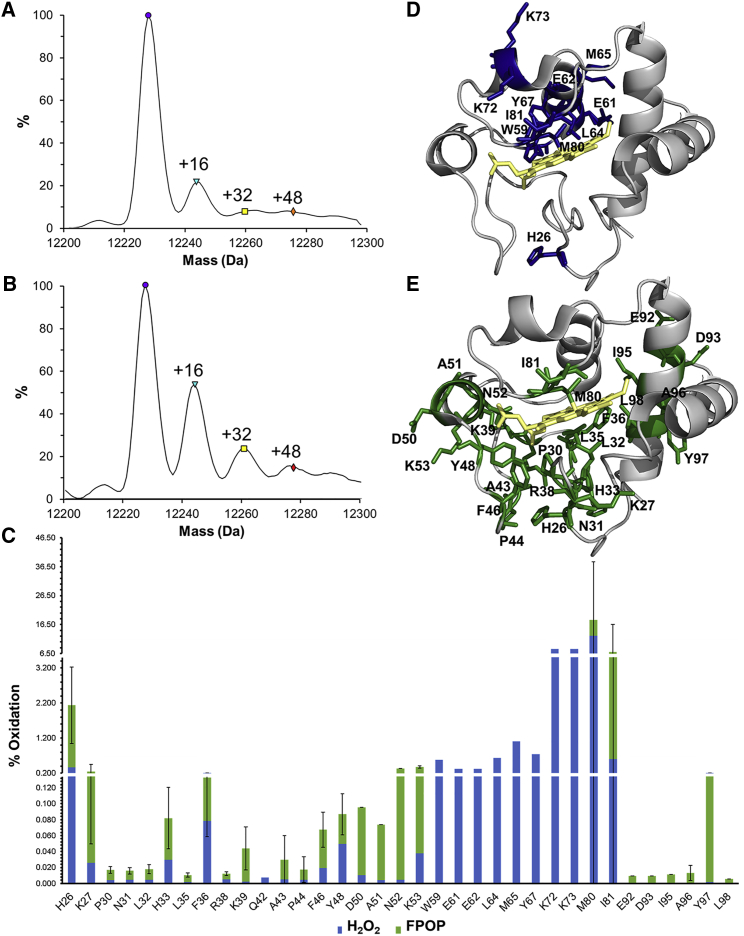
Oxidative modifications of cyt c. (A and B) Intact analysis of cyt c of the (A) H2O2 control and (B) FPOP sample is shown. (C) The extent of modification calculated for each residue is shown (mean of three experiments ± standard error). The extent of oxidation in the H2O2 sample is represented in blue. The additional modifications detected in the FPOP sample are shown in green. (D) Shown is the crystal structure of bovine cyt c (PDB: 2B4Z) highlighting residues with oxidation attained from H2O2 greater than 0.3%. (E) The crystal structure with all residues showing FPOP modifications is depicted. To see this figure in color, go online.
Figure 2
Figure 2
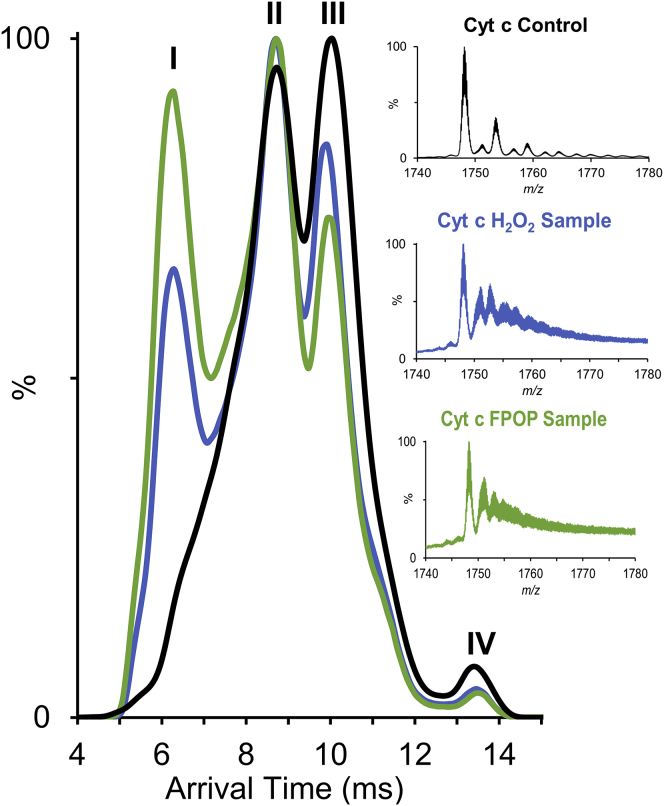
Ion mobility separation of cyt c before and after H2O2 exposure. Shown is the arrival time distribution of cyt c control (black), cyt c H2O2 control (blue), and cyt c FPOP sample (green) with the m/z region selected shown in the inset. To see this figure in color, go online.
Figure 3
Figure 3
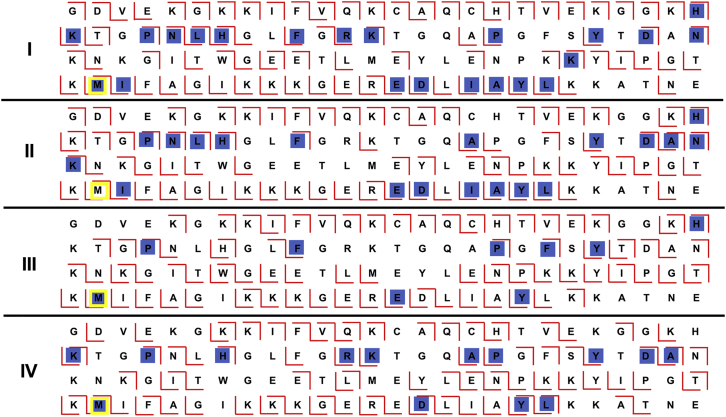
Top-down proteomics detecting FPOP modifications from individual conformers. After IMS separation, each conformer (I–IV) undergoes CID fragmentation in the transfer cell with the energy set to 90 eV. The coverage of each conformer is between 66 and 70%. Red ticks represent the detected b and y ions, and the residues with hydroxyl radical modifications are highlighted in blue. A biologically important residue, M80, is accented to show the ability of FPOP combined with native IMS and top-down in providing important structural information. To see this figure in color, go online.
Figure 4
Figure 4
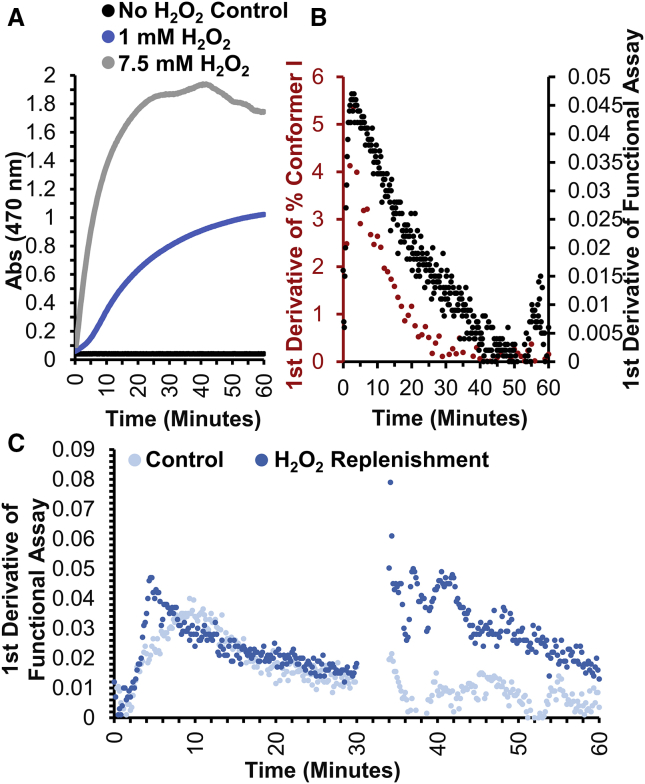
Tracking conformer compaction to peroxidase activity. (A) The oxidation of 10 mM guaiacol was spectroscopically monitored at 470 nm to measure the peroxidase activity of 14.7 μM cyt c exposed to 1 mM and 7.5 mM H2O2. The control omits cyt c to observe any background oxidation that can take place from H2O2. (B) Shown in red is the rate of accumulation of conformer I with 14.7 μM cyt c exposed to 1 mM H2O2, and black is the rate of accumulation of guaiacol detected in the peroxidase activity using the same concentrations. (C) The change in the rate of cyt c’s peroxidase activity with and without replenishing H2O2 is shown. The light-blue curve is the control, whereas the dark-blue curve is the substrate replenished sample. In each condition, 14.7 μM cyt c was exposed to 1 mM H2O2 for 30 min. After 30 min, 10 μL of ammonium acetate was spiked in the control, whereas 10 μL of 1 mM H2O2 was spiked into the substrate replenished sample. To see this figure in color, go online.
Figure 5
Figure 5
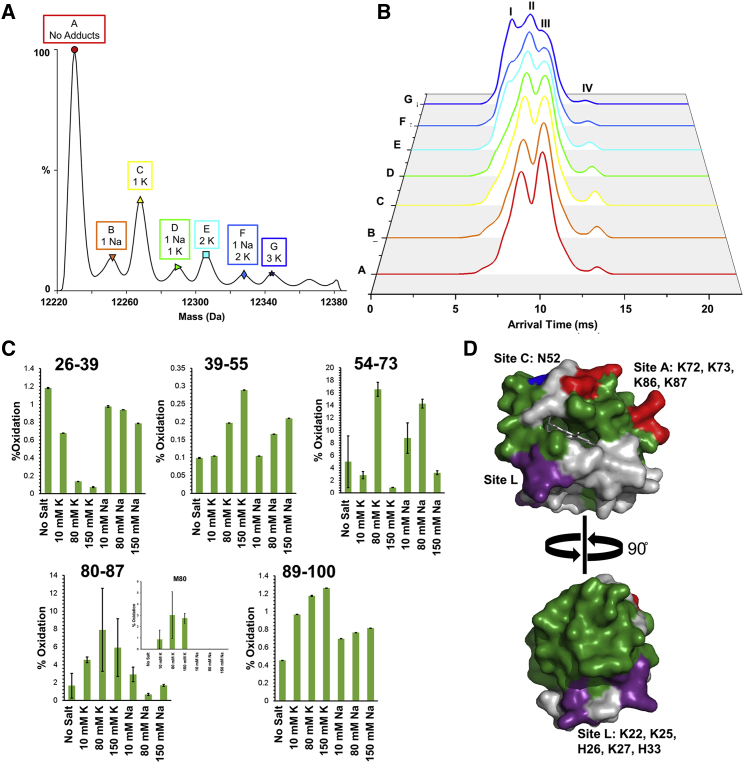
Salt’s effects on cyt c’s conformation. (A) The native cyt c charge state 7+ with labeled salt adducts is shown. (B) The corresponding arrival time distribution of native cyt c for each labeled salt adduct ion shows the appearance of conformer I with increased K+ adducts. (C) The extent of FPOP oxidation for each peptide of cyt c after dialysis (no salt) and with 10, 80, and 150 mM of added KCl and NaCl is shown (mean of three experiments ± standard error). The inset on peptide 80–87 shows the extent of FPOP modification on residue Met80, indicating the significant increase in oxidation with increased K+. (D) The crystal structure (PDB: 2B4Z) of cyt c with the FPOP-labeled peptides highlighted in green, site A highlighted in red, site C highlighted in blue, and site L highlighted in purple is shown. To see this figure in color, go online.

References

    1. Jiang X., Wang X. Cytochrome C-mediated apoptosis. Annu. Rev. Biochem. 2004;73:87–106. - PubMed
    1. Ow Y.P., Green D.R., Mak T.W. Cytochrome c: functions beyond respiration. Nat. Rev. Mol. Cell Biol. 2008;9:532–542. - PubMed
    1. Li P., Nijhawan D., Wang X. Cytochrome c and dATP-dependent formation of Apaf-1/caspase-9 complex initiates an apoptotic protease cascade. Cell. 1997;91:479–489. - PubMed
    1. Zou H., Li Y., Wang X. An APAF-1.cytochrome c multimeric complex is a functional apoptosome that activates procaspase-9. J. Biol. Chem. 1999;274:11549–11556. - PubMed
    1. Platoshyn O., Zhang S., Yuan J.X. Cytochrome c activates K+ channels before inducing apoptosis. Am. J. Physiol. Cell Physiol. 2002;283:C1298–C1305. - PubMed

Publication types

LinkOut - more resources