Review
. 2020 Jan;41(1):61-76.
doi: 10.1016/j.it.2019.11.007. Epub 2019 Dec 5.

T Cell Antifungal Immunity and the Role of C-Type Lectin Receptors

Affiliations
Review

T Cell Antifungal Immunity and the Role of C-Type Lectin Receptors

Emily A Speakman et al. Trends Immunol. 2020 Jan.

Abstract

Fungi can cause disease in humans, from mucocutaneous to life-threatening systemic infections. Initiation of antifungal immunity involves fungal recognition by pattern recognition receptors such as C-type lectin receptors (CLRs). These germline-encoded receptors trigger a multitude of innate responses including phagocytosis, fungal killing, and antigen presentation which can also shape the development of adaptive immunity. Recently, studies have shed light on how CLRs directly or indirectly modulate lymphocyte function. Moreover, CLR-mediated recognition of commensal fungi maintains homeostasis and prevents invasion from opportunistic commensals. We present an overview of current knowledge of antifungal T cell immune responses, with emphasis on the role of C-type lectins, and discuss how these receptors modulate these responses at different levels.

Keywords: C-type lectin receptors; adaptive T cell immunity; antifungal immunity; fungal pathogens; mycobiome.


Figures

Figure 1
Figure 1
Central Role of Mammalian Dendritic Cells (DCs) in Innate and Adaptive Immunity to Fungi. Innate immune responses to fungi are mainly orchestrated by phagocytes and the epithelium. Toxins secreted by fungi such as candidalysin can directly damage epithelial membranes and trigger a danger-response signaling pathway that activates epithelial immunity [1]. Paneth cells produce molecules with antimicrobial activity as well as cytokines that can recruit other immune cells to contribute to fungal clearance [5, 6, 7]. Phagocytes such as macrophages are activated by interferon (IFN)-γ produced by T helper (Th)1 cells, and invariant natural killer T (iNKT) cells (not shown) can also play a pivotal role during superficial systemic infections [4]. The chemokine receptor CX3CR1+ mononuclear phagocytes express C-type lectin receptors (CLRs) that recognize the fungal component of the microbiota and promote antifungal immunity [109]. Neutrophils are activated by interleukin (IL)-17 produced by Th17 and γδ T cells (not shown), and are important at mucosal sites [9]. Th17 cells also produce IL-22 that promotes secretion of antimicrobial peptides (AMPs) such as β-defensins by epithelial cells [37]. CLR expression on DCs is important for sensing fungi and activating antigen-specific CD4+ T cell differentiation. Diverse subsets of DCs are present at different anatomical tissue sites and their CLR expression patterns as well as their roles during fungal infections are emerging. For instance, CD103+CD11b+RALDH+ DCs regulate gut mycobiota by promoting Th17 immunity, Foxp3+ Treg induction, and IgA production [16]. By contrast, CD103+CD11b DCs can support Th1 immunity via IL-12 production [17, 18, 19]. Questions (?) remain regarding CLR expression in the nonhematopoietic component (i.e., epithelial and endothelial cells) of different tissues. This becomes relevant at mucosal sites where epithelial cells provide a crucial first line of defense against pathogens, whereas endothelial cells may play a pivotal role during systemic infections. Abbreviations: NET, neutrophil extracellular trap; RA, retinoic acid; ROS, reactive oxygen species; TGF-β, transforming growth factor β; Treg, regulatory T cell.
Figure 2
Figure 2
Key Figure. Signaling via C-Type Lectin Receptors (CLRs) Can Influence Antifungal CD4+ T Cell Immunity CLR intracellular signaling pathways promote dendritic cell (DC) maturation and migration to the draining lymph nodes where they activate naïve T cells. Dectin-1 signals through intracellular immunoreceptor tyrosine-based activation motif (ITAM) domains, whereas Dectin-2, MCL, and Mincle recruit FcRγ chains which promote the recruitment of Syk and subsequent formation of the caspase recruitment domain family member 9/mucosa-associated lymphoid tissue lymphoma translocation protein 1/B cell lymphoma 10 (CARD9/MALT1/Bcl10) complex. Dectin-1 also induces other signaling molecules such as Ras/Raf-1, Ca2+/calcineurin/NFAT, and NLRP3/caspase-1 in a Syk-dependent and -independent manner. These signaling cascades activate transcription factors such as nuclear factor (NF)-κB, nuclear factor of activated T-cells (NFAT), and AP1 that promote inflammation [9]. Synergistic and/or antagonistic interactions could arise from simultaneous engagement of several CLRs. For instance, Mincle can interfere with Dectin-1-mediated interleukin (IL)-12 production and type 1 T helper cell (Th1) polarization by targeting interferon regulatory factor 1 (IRF1) for degradation through the PI3K/Akt-dependent activation of the E3 ubiquitin ligase Mdm2 (red arrow) [74]. CLR signaling can modulate three signals required for T cell activation. Signal 1 (antigen presentation): antigenic peptides are presented on MHC-II molecules for recognition and priming of naïve CD4+ T cells. Signal 2 (co-stimulation): provides support to peptide–MHC/T cell receptor (TCR) activation. CLRs such as Dectin-1, Dectin-2, and Mincle activate the induction of co-stimulatory molecules including CD40 and CD86 [115, 116, 117]). Signal 3 (cytokines and chemokines): CLR signaling has been directly linked to the release of chemokines and cytokines that promote CD4+ T cell differentiation into specific T helper cell subsets including Th1, Th2, Th9, Th17, and regulatory T cells (Tregs). Dectin-1 can support both Th1 and Th17 responses through the induction of IL-12 and IL-23 that are required for systemic and mucosal immunity, respectively. Dectin-2 preferentially promotes Th17 responses via the induction of IL-23, IL-6, and IL-1β [65,66]. The induction of these T helper cells produces a second wave of chemokines and cytokines that promote the maturation, activation, and recruitment of other immune cells such as neutrophils and monocytes, resulting in fungal killing and clearance. Outstanding questions (?) remain: how do different fungal morphologies influence antigen processing and presentation? In the skin, filamentous forms of Candida albicans can induce a Th1 response, whereas yeast forms preferentially promote a Th17 response through Dectin-1 engagement on Langerhans cells [90]. Identification of specific immunodominant epitopes from fungal pathogens could help to better understand this process. Are additional co-stimulatory or coinhibitory molecules regulated by CLRs? How is the ligation of multiple CLRs integrated to achieve an appropriate adaptive immune response? Abbreviation: GM-CSF, granulocyte-macrophage colony-stimulating factor; IFN, interferon; P, phosphorylation; ROS, reactive oxygen species; TNF, tumor necrosis factor.
Figure 3
Figure 3
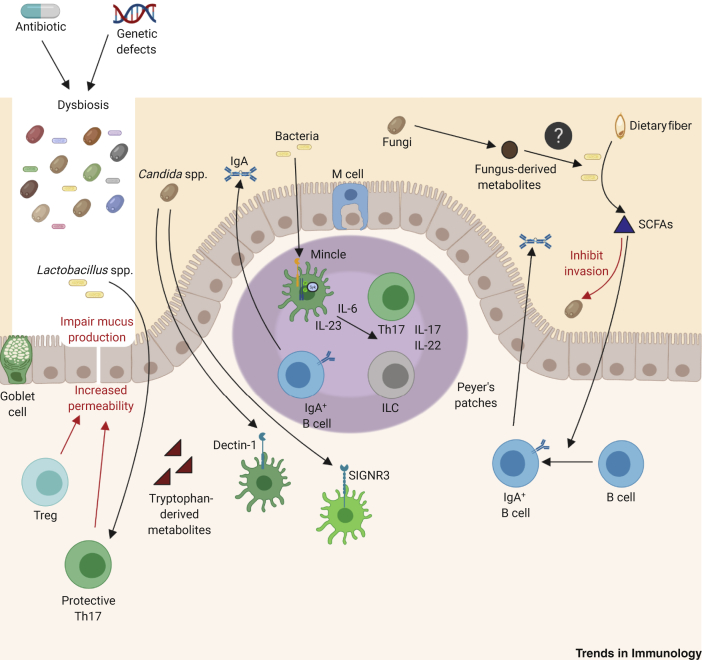
C-Type Lectin Receptors (CLRs) Can Shape Microbial Communities in the Gut and Maintain Homeostasis. Dysbiosis caused by antibiotic use or specific genetic defects (i.e., Dectin-1, CARD9, etc.) causes physiological and metabolic changes in the gut epithelium that increase susceptibility to inflammatory bowel disease (IBD) [96, 97, 98, 99, 100]. Tryptophan-derived metabolites produced by the gut microbiome and indoleamine 2,3-dioxygenase-expressing tolerogenic dendritic cells (DCs, not shown) support the differentiation of regulatory T cells (Tregs) and type 17 T helper cells (Th17s) that are important in protecting the gut from inflammatory disorders (red arrows) [50,83,103]. Short-chain fatty acid (SCFA) metabolites can inhibit Candida tissue invasion and promote colonization (red arrow) [57,58]. SCFAs also support plasma B cell differentiation, thus promoting antibody responses and decreasing susceptibility to infection [59]. CLRs expressed on intestinal DCs (i.e., Dectin-1 and SIGNR3) sense fungi present in the commensal microbiota, such as Candida albicans, and can influence the development of colitis [107,108]. DCs expressing Mincle play a central role in the Peyer’s patches and support Th17 cell differentiation by sensing mucosa-resident bacteria and producing interleukin (IL)-23 and IL-6 in a Syk-dependent manner [105]. The role of fungus-derived metabolites in gut homeostasis and other microbial communities is currently elusive (?). Abbreviation: ILC, innate lymphoid cell.

References

    1. Moyes D.L. Candidalysin is a fungal peptide toxin critical for mucosal infection. Nature. 2016;532:64–68. - PMC - PubMed
    1. Feigal D.W. The prevalence of oral lesions in HIV-infected homosexual and bisexual men: three San Francisco epidemiological cohorts. AIDS. 1991;5:519–525. - PubMed
    1. Montagna M.T. Epidemiology of invasive fungal infections in the intensive care unit: results of a multicenter Italian survey (AURORA Project) Infection. 2013;41:645–653. - PMC - PubMed
    1. Brown G.D. Innate antifungal immunity: the key role of phagocytes. Annu. Rev. Immunol. 2011;29:1–21. - PMC - PubMed
    1. Swidergall M., Ernst J.F. Interplay between Candida albicans and the antimicrobial peptide armory. Eukaryot. Cell. 2014;13:950–957. - PMC - PubMed

Publication types

Substances