Review
. 2019 Dec 9;18(1):180.
doi: 10.1186/s12943-019-1110-3.

Molecular networks of FOXP family: dual biologic functions, interplay with other molecules and clinical implications in cancer progression

Affiliations
Review

Molecular networks of FOXP family: dual biologic functions, interplay with other molecules and clinical implications in cancer progression

Ju-Ha Kim et al. Mol Cancer. .

Abstract

Though Forkhead box P (FOXP) transcription factors comprising of FOXP1, FOXP2, FOXP3 and FOXP4 are involved in the embryonic development, immune disorders and cancer progression, the underlying function of FOXP3 targeting CD4 + CD25+ regulatory T (Treg) cells and the dual roles of FOXP proteins as an oncogene or a tumor suppressor are unclear and controversial in cancers to date. Thus, the present review highlighted research history, dual roles of FOXP proteins as a tumor suppressor or an oncogene, their molecular networks with other proteins and noncoding RNAs, cellular immunotherapy targeting FOXP3, and clinical implications in cancer progression.

Keywords: Cellular immunotherapy; Clinical implications and cancer progression; FOXP proteins; Molecular networks; Noncoding RNAs.


Conflict of interest statement

The authors declare that they have no competing interests.

Figures
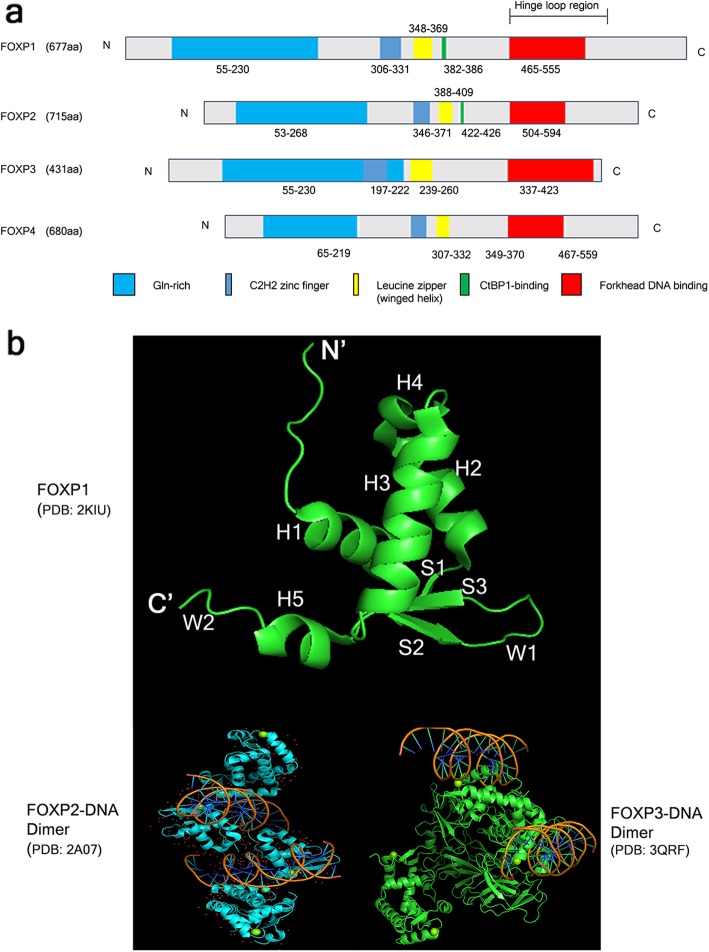
Fig. 1
Fig. 1
Domains and crystal structures of FOXP family. a Domains of FOXP1, FOXP2, FOXP3 and FOXP4. FOXP members share a highly conserved C2H2 zinc finger domain, leucine zipper domain, Forkhead DNA binding domain and about 50 residues N terminal domain. Also, FOXP1 and FOXP2 contain CtBP1 binding domain different from FOXP3 and FOXP4. b Crystal structures of FOXP1 (PDB: 2KIU), FOXP2-DNA complex (PDB: 2A07) and FOXP3-DNA complex (PDB:3QRF) by using The PyMOL Molecular Graphics System Version 2.3.0
Fig. 2
Fig. 2
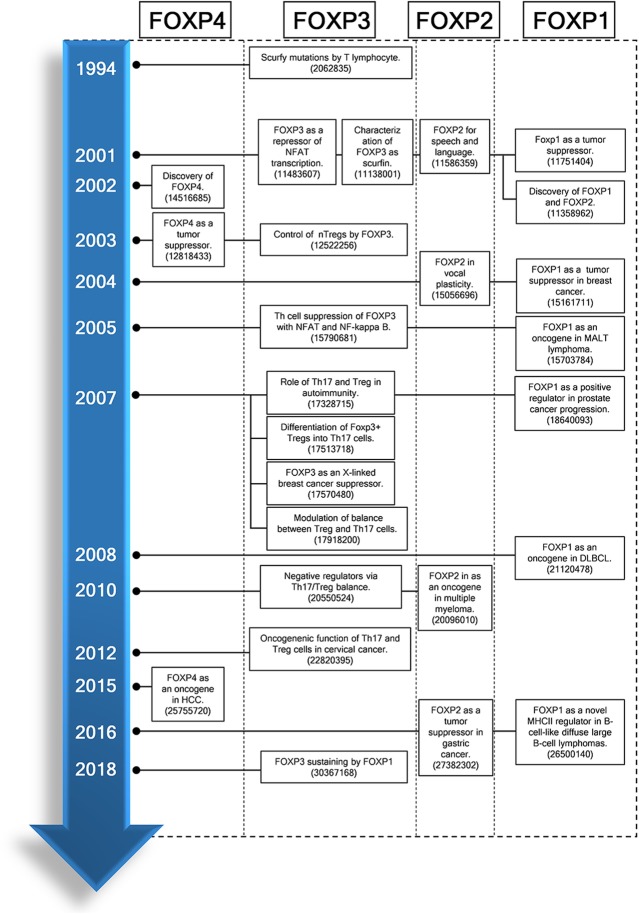
Timeline for FOXP family research history. DLBCL, diffuse large B-cell lymphoma; FOXP1–4, forkhead box P1–4; NFAT, Nuclear factor of activated T-cells; Th17, T helper 17; Treg, T regulatory; nTreg cells, naïve T regulatory cells; NF-kappa B, Nuclear factor kappa B. The numbers in references indicate PMID of PubMed
Fig. 3
Fig. 3
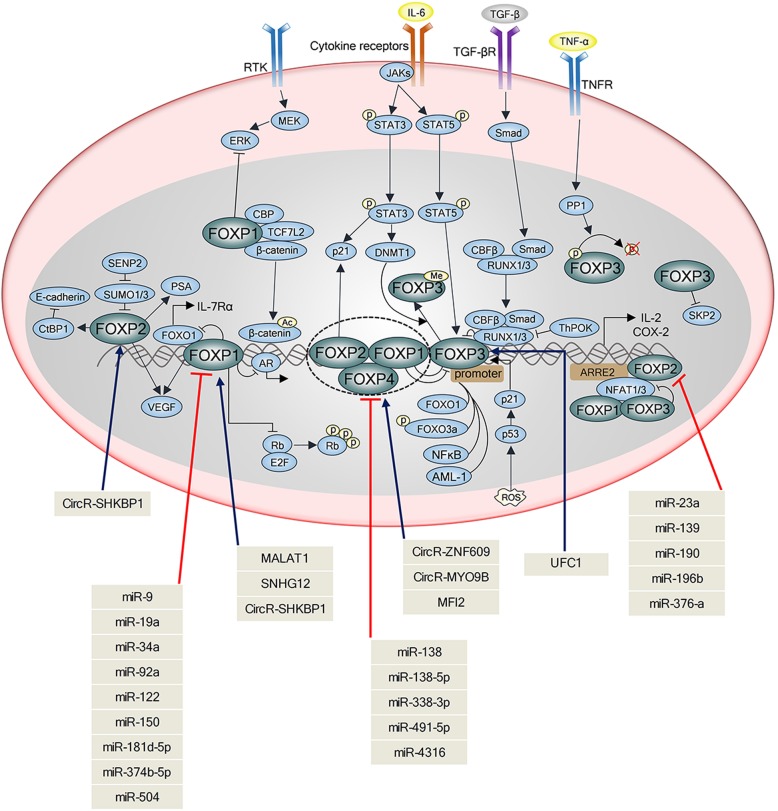
Interplay between FOXP family and their related molecules targeted by noncoding RNAs. FOXP family members consist of FOXP1, FOXP2, FOXP3 and FOXP4 that communicate with other molecules. Interleukin-6 (IL-6) activates the Janus tyrosine kinase (JAK) family members (JAK1, JAK2, and TYK2), leading to the activation of transcription factors of the signal transducer and activator of transcription (STAT) family including STAT3 and STAT5. Also, IL-6 induces DNA-methyltransferase 1 (DNMT1) expression and promotes STAT3-dependent methylation of FOXP3. FOXP2 overexpression upregulates the expression of p53/ p21, a downstream effector of gp130/STAT3. Transforming growth factor-β (TGF-β) activates phosphorylation of SMAD, which forms complex with CBFβ/RUNX1/3 for maintenance of FOXP3, but ThPOK blocks RUNX [219]. TNF-α stimulates protein phosphatase 1 (PP1) for dephosphorylation of FOXP3 (S418). FOXP3 interacts with two key transcription factors such as nuclear factor of activated T cells (NFAT) and NF-κB. FOXO3a phosphorylation increases FOXP3 and FOXO1 acts as a negative regulator and FOXP1. The receptor tyrosine kinases (RTKs) activate MEK-ERK signaling axis, which is repressed by FOXP1. Among noncoding RNAs, MALAT1, SNHG12 and CircRNA SHKBP1 activate FOXP1, while miR-9, miR-19a, miR-34a, miR-92a, miR-122, miR-150, miR-181–5p, miR-374-5p and miR-504 downregulate FOXP1. CircRNA SHKBP1 increases FOXP2, while miR-23a, miR-139, miR-190, miR-196b and miR-376a suppress FOXP2. UFC1 activates FOXP3 and miR-138, miR-338-3p and miR-491–5p downregulate FOXP4, while circR-SHKBP1, CircR-MYO9B and MFI2 upregulate FOXP4
Fig. 4
Fig. 4
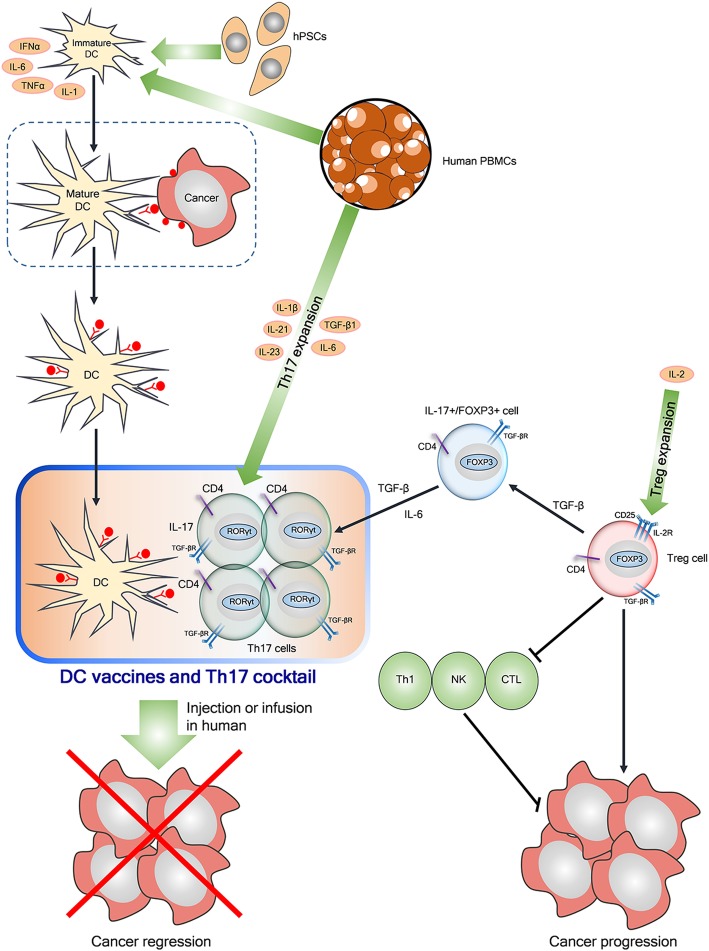
Cellular cancer immunotherapy by using Th17 cells and DC vaccine cocktail. Proinflammatory T helper 17 (Th17) cells, one of the CD4+ T cells, can produce IL-17 and protect cells against microbial infection, expressing RORγt (orphan nuclear receptor) [143], while excessive activation of Treg cells suppresses antipathogenic or anticancer immunity by inactivation of Th1, CTL and NK cells [220], leading to chronic infection and tumor progression [144]. Dendritic cells (DCs), the most efficient antigen-presenting cells (APCs) of the innate immune system, can be produced from peripheral blood mononuclear cells (PBMCs) or human pluripotent stem cells (hPSC) including embryonic stem cells and induced pluripotent stem cells [221]. Loading tumor specific antigens on immature DCs is the first step for DC vaccine production and DCs can be activated for maturation by defined cytokine formulation such as IL-1β+ IL-6+ PGE2+ TNF and TLR agonists (IL-2, IFNα/γ, GM-CSF, bacterial toxoids). Combination of TGFβ1 and IL-6 can be used for Th7 differentiation by reprogramming Treg cells into Th17 cells [146] and also a cocktail of TGFβ1, IL-6,IL-23, IL-1β and IL-21 is used for Th17 differentiation expansion from human PBMCs [218, 222]. Next generation cancer immunotherapy by a cocktail of DC vaccines and Th17 cells is suggested for cancer regression, which should be validated in vivo or clinically by intradermal injection or infusion after checking safety in the future

References

    1. Bray F, Ferlay J, Soerjomataram I, Siegel RL, Torre LA, Jemal A. Global cancer statistics 2018: GLOBOCAN estimates of incidence and mortality worldwide for 36 cancers in 185 countries. CA Cancer J Clin. 2018;68:394–424. doi: 10.3322/caac.21492. - DOI - PubMed
    1. Valastyan S, Weinberg RA. Tumor metastasis: molecular insights and evolving paradigms. Cell. 2011;147:275–292. doi: 10.1016/j.cell.2011.09.024. - DOI - PMC - PubMed
    1. Santos ME, Athanasiadis A, Leitao AB, DuPasquier L, Sucena E. Alternative splicing and gene duplication in the evolution of the FoxP gene subfamily. Mol Biol Evol. 2011;28:237–247. doi: 10.1093/molbev/msq182. - DOI - PMC - PubMed
    1. Jackson BC, Carpenter C, Nebert DW, Vasiliou V. Update of human and mouse forkhead box (FOX) gene families. Hum Genomics. 2010;4:345–352. - PMC - PubMed
    1. Myatt SS, Lam EW. The emerging roles of forkhead box (Fox) proteins in cancer. Nat Rev Cancer. 2007;7:847–859. doi: 10.1038/nrc2223. - DOI - PubMed

Publication types

MeSH terms

Substances