


Mechanisms of immune-related adverse events during the treatment of cancer with immune checkpoint inhibitors
- PMID: 31816080
- PMCID: PMC6900913
- DOI: 10.1093/rheumatology/kez308
Mechanisms of immune-related adverse events during the treatment of cancer with immune checkpoint inhibitors
Abstract
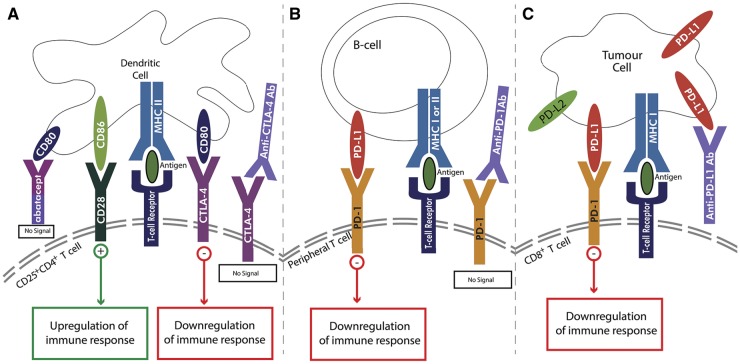
Immune checkpoint inhibitors are novel biologic agents to treat cancer by inhibiting the regulatory interactions that limit T cell cytotoxicity to tumours. Current agents target either CTLA-4 or the PD-1/PD-L1 axis. Because checkpoints may also regulate autoreactivity, immune checkpoint inhibitor therapy is complicated by side effects known as immune-related adverse events (irAEs). The aim of this article is to review the mechanisms of these events. irAEs can involve different tissues and include arthritis and other rheumatic manifestations. The frequency of irAEs is related to the checkpoint inhibited, with the combination of agents more toxic. Because of their severity, irAEs can limit therapy and require immunosuppressive treatment. The mechanisms leading to irAEs are likely similar to those promoting anti-tumour responses and involve expansion of the T cell repertoire; furthermore, immune checkpoint inhibitors can affect B cell responses and induce autoantibody production. Better understanding of the mechanisms of irAEs will be important to improve patient outcome as well as quality of life during treatment.
Keywords: B cell; CTLA-4; PD-1; PD-L1; T cell; arthritis; autoantibodies; autoreactivity; checkpoint; co-stimulation.
© The Author(s) 2019. Published by Oxford University Press on behalf of the British Society for Rheumatology.
Figures
References
-
- Wei SC, Duffy CR, Allison JP.. Fundamental mechanisms of immune checkpoint blockade therapy. Cancer Discov 2018;8:1069–86. - PubMed
-
- Galon J, Angell HK, Bedognetti D, Marincola FM.. The continuum of cancer immunosurveillance: prognostic, predictive, and mechanistic signatures. Immunity 2013;39:11–26. - PubMed
Publication types
MeSH terms
Substances
LinkOut - more resources
Full Text Sources
Research Materials
