. 2019 Dec 9;11(23):11673-11685.
doi: 10.18632/aging.102571. Epub 2019 Dec 9.

Identification of molecular correlations of RBM8A with autophagy in Alzheimer's disease

Affiliations

Identification of molecular correlations of RBM8A with autophagy in Alzheimer's disease

Donghua Zou et al. Aging (Albany NY). .

Abstract

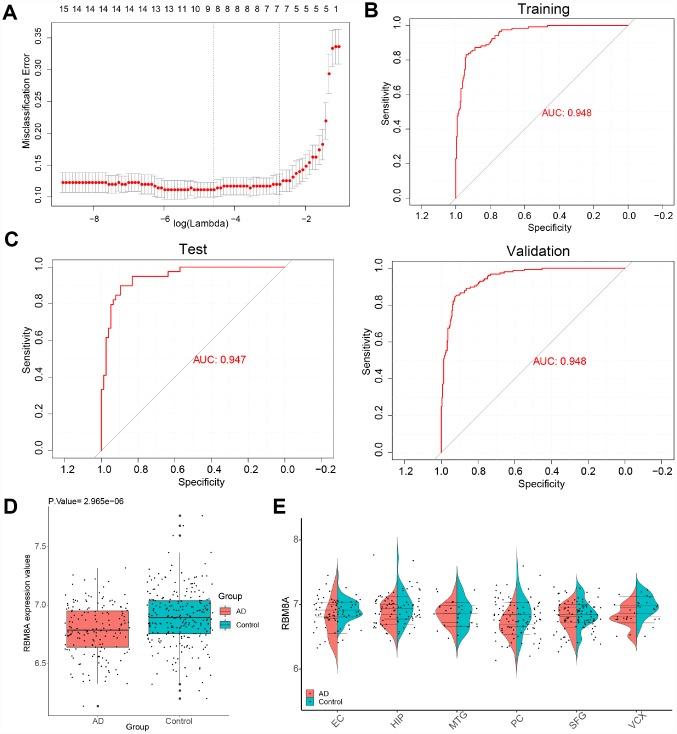
Our previous studies revealed RBM8A may play a role in various progressive neurological diseases. The present study aimed to explore the role of RBM8A in Alzheimer's disease (AD). RBM8A is significantly down-regulated in AD. Interestingly, 9186 differentially expressed genes are overlapped from comparisons of AD versus control and RBM8A-low versus RBM8A-high. Weight gene correlation analysis was performed and 9 functional modules were identified. Modules positively correlated with AD and RBM8A-low are significantly involved in the RAP1 signaling pathway, PI3K-AKT signaling pathway, hematopoietic cell lineage, autophagy and APELIN signaling pathway. Fifteen genes (RBM8A, RHBDF2, TNFRSF10B, ACP1, ANKRD39, CA10, CAMK4, CBLN4, LOC284214, NOVA1, PAK1, PPEF1, RGS4, TCEB1 and TMEM118) are identified as hub genes, and the hub gene-based LASSO model can accurately predict the occurrence of AD (AUC = 0.948). Moreover, the RBM8A-module-pathway network was constructed, and low expression of RBM8A down-regulates multiple module genes, including FIP200, Beclin 1, NRBF2, VPS15 and ATG12, which composes key complexes of autophagy. Thus, our study supports that low expression of RBM8A correlates with the decrease of the components of key complexes in autophagy, which could potentially contribute to pathophysiological changes of AD.

Keywords: Alzheimer's disease; RBM8A; exon junction complex; neurodevelopment.


Conflict of interest statement

CONFLICTS OF INTEREST: The authors report no conflicts of interest in this work.

Figures

Figure 1
Figure 1
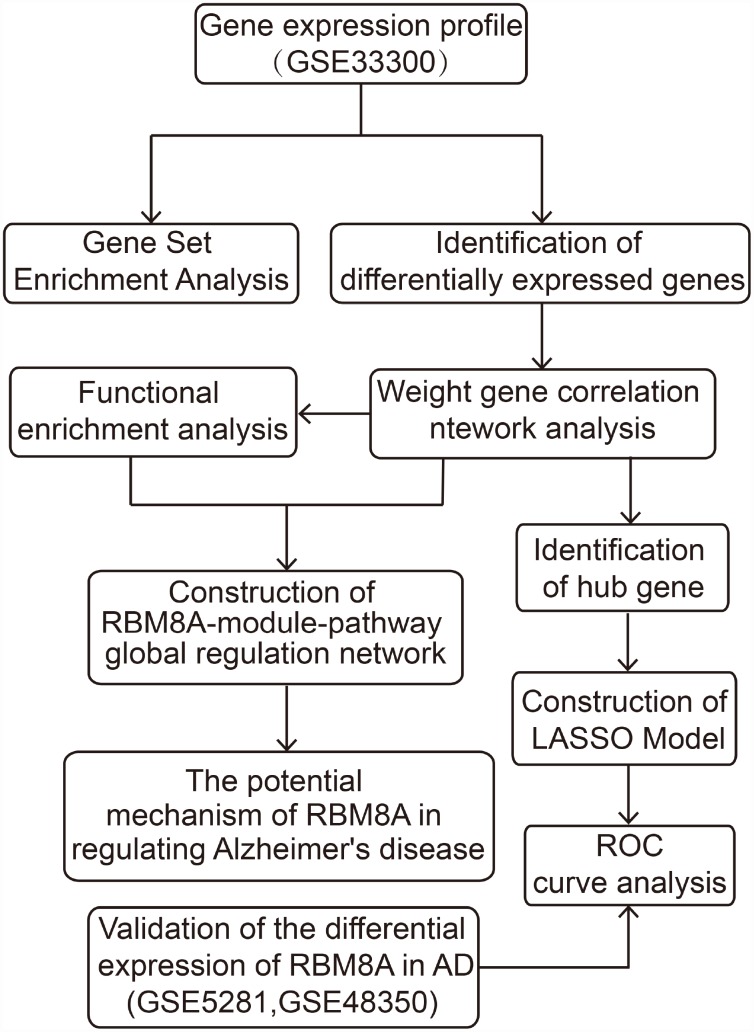
The workflow of the present study.
Figure 2
Figure 2
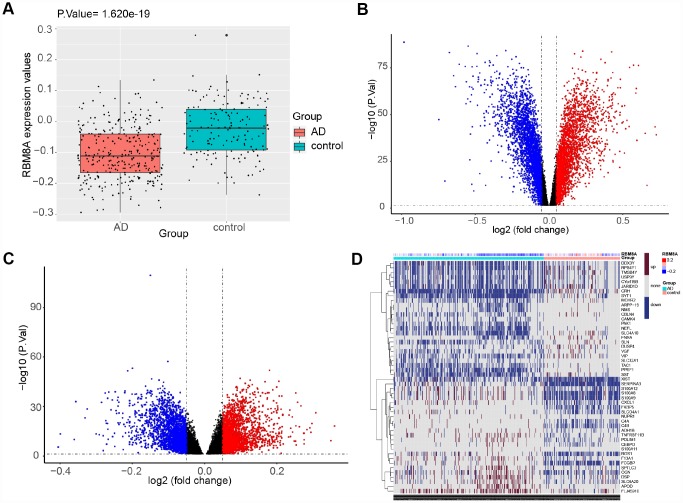
Differential expression gene analysis. (A) RBM8A is down-regulated in AD (P= 1.620e−19, 310 AD patients and 157 normal people's postmortem prefrontal cortex samples are contained). (B) Volcano plot of the AD-control, red represents up-regulated genes, blue represents down-regulated genes, and black represents no significantly differentially expressed genes. (C) Volcano plot of the RBM8A-low/high, blue represents down-regulated genes, and black represents no significantly differentially expressed genes. (D) A heatmap of 25 most up-regulated and 25 most down-regulated genes.
Figure 3
Figure 3
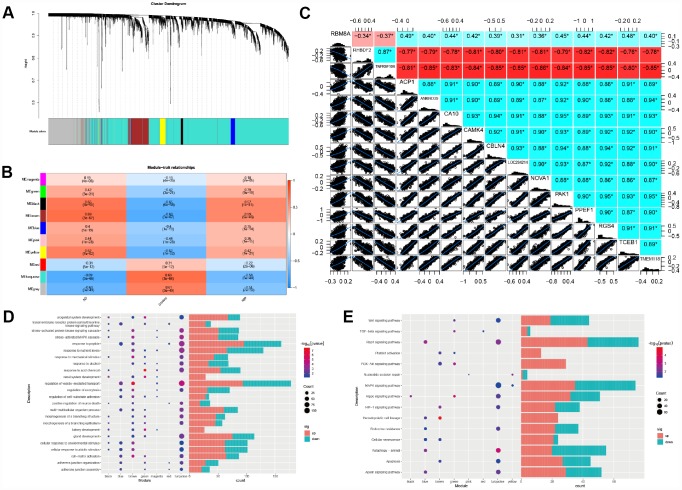
Weighted correlation network analysis. (A) Recognition module, each module was given an individual color as identifiers, including 10 different modules. (B) Correlation heat map of gene modules and phenotypes, the red is positively correlated with the phenotype, blue is negatively correlated with the phenotype. (C) The correlation between RBM8A and hub genes, red indicates negative correlation and blue indicates positive correlation (D) Biological processes of module genes, the significance of enrichment gradually increases from blue to red, and the size of the dots indicates the number of differential genes contained in the corresponding pathway. (E) KEGG pathways analysis of module genes. The significance of enrichment gradually increases from blue to red, and the size of the dots indicates the number of differential genes contained in the corresponding pathway.
Figure 4
Figure 4
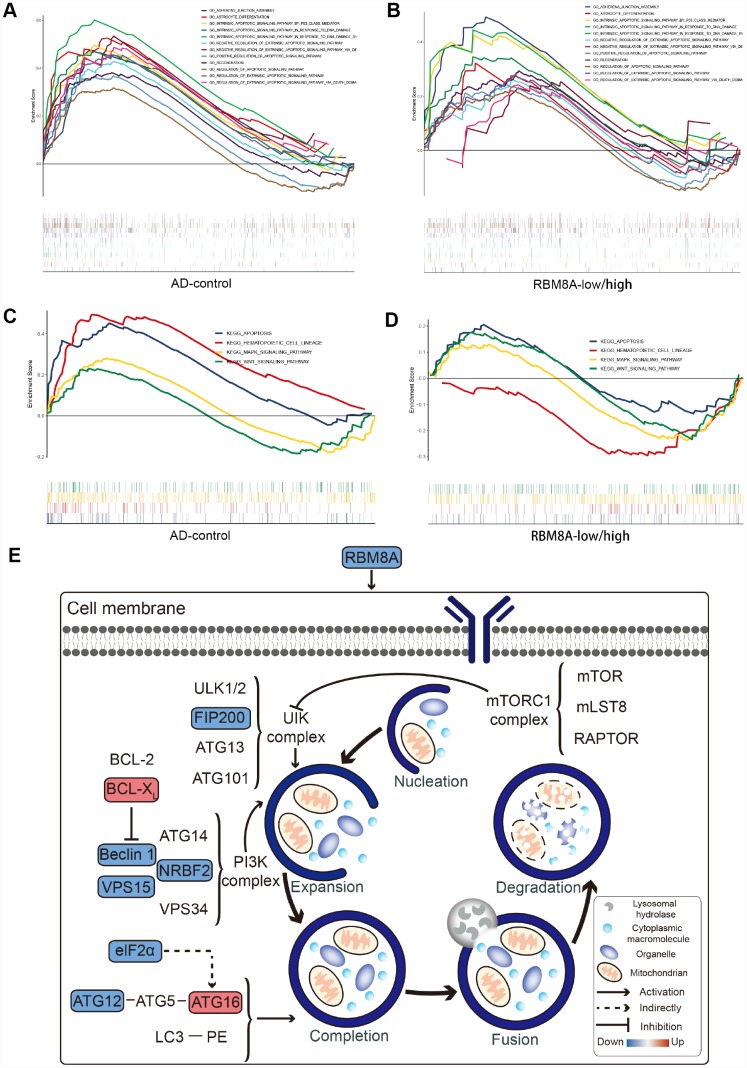
Result of Gene Set Enrichment Analysis. (A) Biological processes enriched in AD. (B) Biological processes enriched in RBM8A-low. (C) KEGG pathways enriched in AD. (D) KEGG pathways enriched in RBM8A-low. (E) Potential mechanism of low expression of RBM8A associated with AD, blue indicates the down-regulated gene and red indicates the up-regulated gene.
Figure 5
Figure 5
A model for predicting AD and verification of differential expression of RBM8A. (A) LASSO model. (B) ROC curves analysis of train set (GSE33000). (C) ROC curves analysis of test set (GSE3300) and validation (GSE5281 and GSE48350) (D) RBM8A is down-regulated in AD (P= 2.965e-06, 157 AD patients and 247 normal samples are contained). (E) RBM8A is down-regulated in various brain regions. EC: entorhinal cortex, HIP: hippocampus, MTG: medial temporal gyrus, PC: posterior cingulate, SFG: superior frontal gyrus, VCX: primary visual cortex.

References

    1. Scheltens P, Blennow K, Breteler MM, de Strooper B, Frisoni GB, Salloway S, Van der Flier WM. Alzheimer’s disease. Lancet. 2016; 388:505–17. 10.1016/S0140-6736(15)01124-1 - DOI - PubMed
    1. Ballard C, Gauthier S, Corbett A, Brayne C, Aarsland D, Jones E. Alzheimer’s disease. Lancet. 2011; 377:1019–31. 10.1016/S0140-6736(10)61349-9 - DOI - PubMed
    1. Zhu JB, Tan CC, Tan L, Yu JT. State of Play in Alzheimer’s Disease Genetics. J Alzheimers Dis. 2017; 58:631–59. 10.3233/JAD-170062 - DOI - PubMed
    1. Mondragón-Rodríguez S, Basurto-Islas G, Lee HG, Perry G, Zhu X, Castellani RJ, Smith MA. Causes versus effects: the increasing complexities of Alzheimer’s disease pathogenesis. Expert Rev Neurother. 2010; 10:683–91. 10.1586/ern.10.27 - DOI - PMC - PubMed
    1. Bernardi L, Geracitano S, Colao R, Puccio G, Gallo M, Anfossi M, Frangipane F, Curcio SA, Mirabelli M, Tomaino C, Vasso F, Smirne N, Maletta R, Bruni AC. AbetaPP A713T mutation in late onset Alzheimer’s disease with cerebrovascular lesions. J Alzheimers Dis. 2009; 17:383–89. 10.3233/JAD-2009-1061 - DOI - PubMed

Publication types

MeSH terms