. 2019 Dec 4;19(24):5348.
doi: 10.3390/s19245348.

A GSH Fluorescent Probe with a Large Stokes Shift and Its Application in Living Cells

Affiliations

A GSH Fluorescent Probe with a Large Stokes Shift and Its Application in Living Cells

Yueyuan Mao et al. Sensors (Basel). .

Abstract

Intracellular GSH is the most abundant non-protein biothiol and acts as a central antioxidant to defend against aging toxins and radicals. Meanwhile abnormal level of intracellular GSH concentration is directly related to some diseases. In this case, detecting intracellular GSH rapidly and sensitively is of great significance. We synthesize a simple fluorescent probe (named GP) which can discriminate GSH from Cys (cysteine) or Hcy (homocysteine) and presents a 50-fold fluorescence increasing. The response time of GP to GSH was only 5 min and the product GO (the product of GP after reacting with GSH) after reacting with GSH possesses a larger Stokes shift for 135 nm than that in reported work. Probe GP can detect intracellular effectively and shows obvious yellow fluorescence. Briefly, probe GP can detect intracellular GSH rapidly and effectively both in vitro and in living cells.

Keywords: GSH; cell imaging; fluorescent probe.


Conflict of interest statement

The authors declare no conflict of interest. The funders had no role in the design of the study; in the collection, analyses, or interpretation of data; in the writing of the manuscript, or in the decision to publish the results.

Figures

Scheme 1
Scheme 1
Molecular structure of probe GP, detection mechanism and the corresponding reaction product GO.
Scheme 2
Scheme 2
Synthesis procedure of probe GP.
Figure 1
Figure 1
Normalized fluorescent spectra of probe GP (10 μM) in PBS (pH = 7.4, 0.05 M): DMSO = 7:3 after adding different concentrations (0 μM–1000 μM) of GSH (a), Cys (b), or Hcy (c) and incubating the mixture at 37 °C for 60 min. Fluorescence intensity at 569 nm of a mixture containing 10 μM GP and biothiols changes as the concentration of biothiols (GSH or Cys or Hcy) increased gradually. (d) Ex = 370 nm.
Figure 2
Figure 2
The normalized fluorescence intensity at 569 nm containing 10 μM GP and 1000 μM biothiols (GSH or Cys or Hcy) in PBS (pH = 7.4): DMSO (v:v = 7:3) mixed solvent change as the incubating time prolonged at 37 °C. Ex = 370 nm.
Figure 3
Figure 3
Normalized fluorescent intensity of probe GP (10 μM) in PBS (pH = 7.4)/DMSO mixed solvent (v:v = 7:3) containing NEM and 1000 μM biothiols ((a): GSH, (b): Cys, (c): Hcy) changed as the concentration of NEM increased from 0 μM to 1000 μM. The fluorescence intensity of probe GP at 569 nm changed as the concentration of biothiols increased (d). Ex = 370 nm.
Figure 4
Figure 4
Selectivity of GP to other amino acids or ions. Fluorescent spectra (a) were conducted after adding different 1000 μM amino acids or ions into the solution of probe GP (10 μM). The fluorescence intensity at 569 nm was plotted as the bar graph (b). 0–37 represent Blank, GSH, Hcy, Cys, H2S, BSA, Phe, Ala, Gly, Glu, Gln, Cystine, Arg, Lys, Tyr, Leu, Pro, Trp, Ser, Thr, Asn, His, Ca2+, Cu2+, Fe2+, K+, OH, Mg2+, Na+, HCO3, Cl, I, Br, NH4+, Sn2+, Zn2+, and PO43−, HPO42−. Different amino acids and ions were added into the solution of GP in PBS (pH = 7.4)/DMSO (7:3) and incubated in a 37 °C water bath for 60 min.
Figure 5
Figure 5
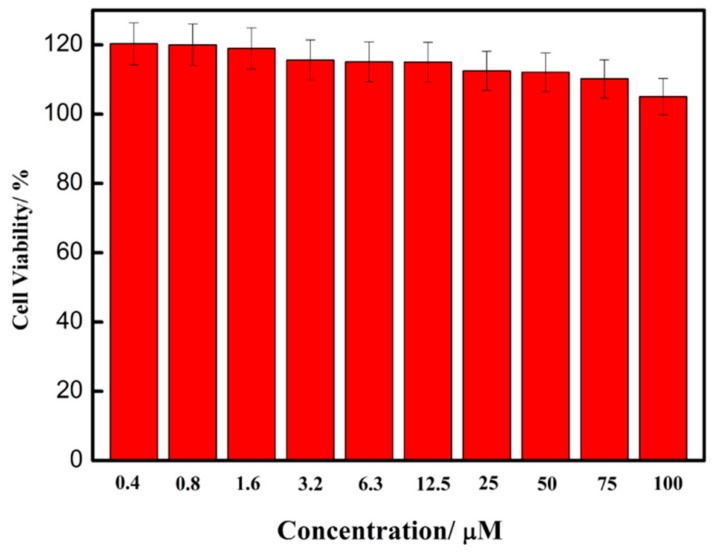
Cell toxicity of probe GP to MDA-MB-231 cells. Cells were incubated in cell culture fluid containing different concentrations (range from 0 μM to 100 μM) of probe GP at 37 °C for 24 h. The cell viability was tested via the MTT method.
Figure 6
Figure 6
Confocal Laser Scanning Microscopy (CLSM) images of MDA-MB-231 cells incubated in PBS (pH = 7.4) containing 10 μM GP (a1a3) for 30 min. MDA-MB-231 cells were pretreated with 100 μM GSH (b1b3) or 1 mM NEM (c1c3) for 30 min firstly and incubated in PBS containing 10 μM GP for 30 min. (a1,b1,c1): Fluorescent channel (570 nm ± 30 nm); (a2,b2,c2): Bright field; (a3,b3,c3): Overlay images of fluorescent channel and bright field. Ex = 405 nm; Scale bar = 10 μm.

References

    1. Rui H., Gang H., Fernández J.M., Byoung-Jin K., Forbes N.S., Rotello V.M. Glutathione-mediated delivery and release using monolayer protected nanoparticle carriers. J. Am. Chem. Soc. 2006;128:1078–1079. - PubMed
    1. Niu H., Ni B., Chen K., Yang X., Cao W., Ye Y., Zhao Y. A long-wavelength-emitting fluorescent probe for simultaneous discrimination of H2S/Cys/GSH and its bio-imaging applications. Talanta. 2019;196:145–152. doi: 10.1016/j.talanta.2018.12.031. - DOI - PubMed
    1. Ren X., Tian H., Yang L., He L., Geng Y., Liu X., Song X. Fluorescent probe for simultaneous discrimination of Cys/Hcy and GSH in pure aqueous media with a fast response under a single-wavelength excitation. Sens. Actuators B Chem. 2018;273:1170–1178. doi: 10.1016/j.snb.2018.04.163. - DOI
    1. Yang R., Tang Y., Zhu W. Ratiometric Fluorescent Probe for the Detection of Glutathione in Living Cells. Chem. J. Chin. Univ.-Chin. 2016;37:643–647. doi: 10.7503/cjcu20150725. - DOI
    1. Niu L.-Y., Guan Y.-S., Chen Y.-Z., Wu L.-Z., Tung C.-H., Yang Q.-Z. BODIPY-Based Ratiometric Fluorescent Sensor for Highly Selective Detection of Glutathione over Cysteine and Homocysteine. J. Am. Chem. Soc. 2012;134:18928–18931. doi: 10.1021/ja309079f. - DOI - PubMed

LinkOut - more resources