Review
. 2019 Dec 8;9(12):843.
doi: 10.3390/biom9120843.

Insights into the Chemical Biology of Childhood Embryonal Solid Tumors by NMR-Based Metabolomics

Affiliations
Review

Insights into the Chemical Biology of Childhood Embryonal Solid Tumors by NMR-Based Metabolomics

Melissa Quintero Escobar et al. Biomolecules. .

Abstract

Most childhood cancers occur as isolated cases and show very different biological behavior when compared with cancers in adults. There are some solid tumors that occur almost exclusively in children among which stand out the embryonal solid tumors. These cancers main types are neuroblastoma, nephroblastoma (Wilms tumors), retinoblastoma and hepatoblastomas and tumors of the central nervous system (CNS). Embryonal solid tumors represent a heterogeneous group of cancers supposedly derived from undifferentiated cells, with histological features that resemble tissues of origin during embryogenesis. This key observation suggests that tumorigenesis might begin during early fetal or child life due to the errors in growth or pathways differentiation. There are not many literature data on genomic, transcriptomic, epigenetic, proteomic, or metabolomic differences in these types of cancers when compared to the omics- used in adult cancer research. Still, metabolomics by nuclear magnetic resonance (NMR) in childhood embryonal solid tumors research can contribute greatly to understand better metabolic pathways alterations and biology of the embryonal solid tumors and potential to be used in clinical applications. Different types of samples, such as tissues, cells, biofluids, mostly blood plasma and serum, can be analyzed by NMR to detect and identify cancer metabolic signatures and validated biomarkers using enlarged group of samples. The literature search for biomarkers points to around 20-30 compounds that could be associated with pediatric cancer as well as metastasis.

Keywords: Wilms tumor; central nervous system tumors; embryonal solid tumors; hepatoblastoma; metabolomics.; neuroblastoma; retinoblastoma.


Conflict of interest statement

The authors declare no conflict of interest.

Figures
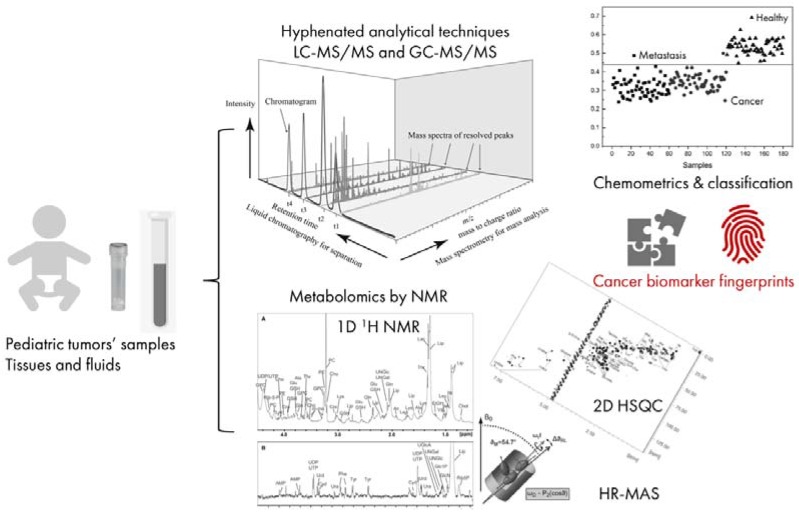
Figure 1
Figure 1
Graphical representation of metabolomics studies in childhood cancer research. Samples derived from patients can be tumor tissue or body fluids (at left). The analyses start with sample preparation for hyphenated analytical techniques, such as gas (GC) or liquid chromatography (LC), coupled with mass spectrometers (MS) as detectors as in tandem mass spectrometry (MS/MS); or with liquid or semisolid nuclear magnetic resonance (NMR) or high-resolution magic angle spinning (HR-MAS) NMR performed in one- and two-dimensional (1D and 2D). At upper right corner of the figure, an example of an ideal set of samples is depicted: a group of samples could be classified in three main classes, healthy/control, primary tumors, and metastasis, in accordance to the profile of their metabolites, which allows the characterization of a set of biomarkers that can be used as hallmarks of cancer or cancer fingerprints.
Figure 2
Figure 2
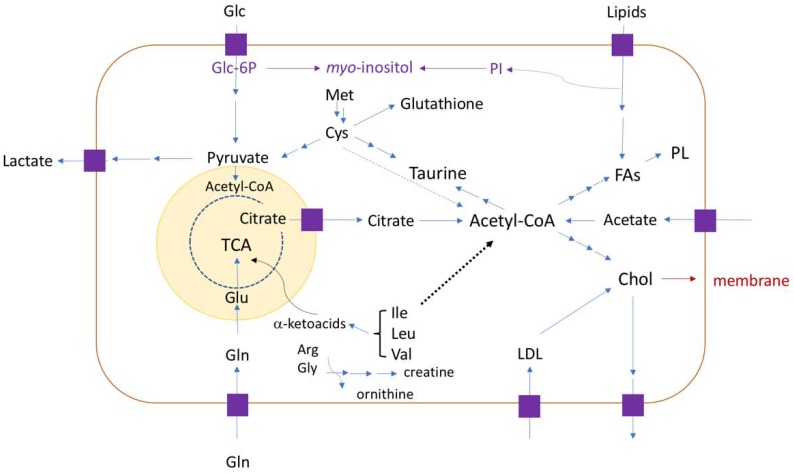
Illustration of the main metabolic pathways reported as altered in childhood solid tumors. Phospholipids (PL), cholesterol (Chol), Fatty Acids (FA), Phosphoinositol (PI), Acetyl-CoA, Branched-chain Amino Acids (BCAA, such as isoleucine (Ile), leucine (Leu), valine (Val)), Citrate, Taurine, Glycose (Glc), Lactate, Pyruvate, Glutamine (Gln), Glutamate (Glu), and creatine. For example, BCAA can provide alpha-ketoacids for TCA cycle or Acetyl-CoA. Cancer cells have high lactate concentration that is derived from pyruvate or cysteine (Cys), if Cys was used as precursor for lactate synthesis, then there would be decreases in the glutathione and taurine concentrations. Mitochondrion is shown in light yellow.
Figure 3
Figure 3
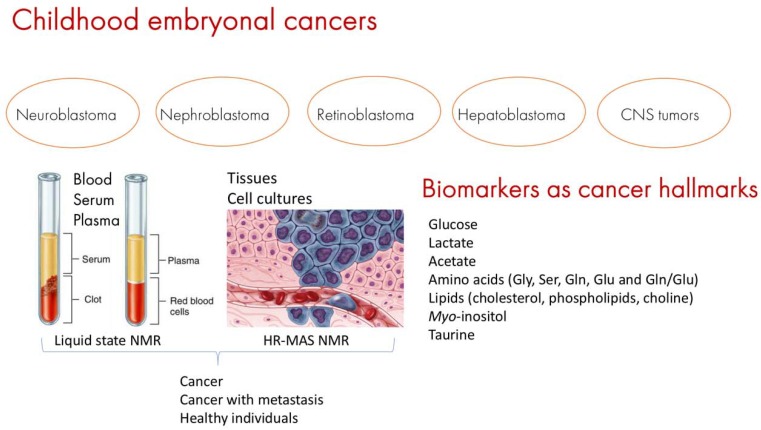
Discovering childhood embryonal cancer metabolic fingerprints by NMR. Ideally, samples should belong to three groups: (1) cancer samples, (2) cancer samples with metastatic behavior, and (3) healthy controls (for example tissue near the cancer zone which shows no histological alterations). Biofluids, tissues and cells must be handled in the same way—from sampling and storage to analyses. The most cited biomarkers are 20–30 compounds among which figure glucose, lactate, acetate, and some amino acids such as glycine, serine, glutamate, glutamine, leucine, isoleucine and valine, creatine and phosphocreatine, lipids (glycerophosphocholines, cholesterol, and some fatty acids), taurine and myo-inositol.

References

    1. Trivedi D.K., Hollywood K.A. Metabolomics for the masses: The future of metabolomics in a personalized world. New Horiz. Transl. Med. 2017;3:294–305. doi: 10.1016/j.nhtm.2017.06.001. - DOI - PMC - PubMed
    1. Fanos V., Van den Anker J., Noto A., Mussap M., Atzori L. Metabolomics in neonatology: Fact or fiction? Semin. Fetal Neonatal. Med. 2013;18:3–12. doi: 10.1016/j.siny.2012.10.014. - DOI - PubMed
    1. Hanna M.H., Brophy P.D. Metabolomics in pediatric nephrology: Emerging concepts. Pediatr. Nephrol. 2015;30:881–887. doi: 10.1007/s00467-014-2880-x. - DOI - PMC - PubMed
    1. Ramsden J.J. Bioinformatics: An Introduction. 2nd ed. Springer; London, UK: 2009. pp. 239–244.
    1. Čuperlović-Culf M. NMR Metabolomics in Cancer Research. 1st ed. Woodhead Publishing; Cambridge, UK: 2013. pp. 1–14.

Publication types

MeSH terms

Substances

LinkOut - more resources