Review
. 2020 Jun 12;13(1):45-65.
doi: 10.1146/annurev-anchem-091619-102649. Epub 2019 Dec 10.

3D Printed Microfluidics

Affiliations
Review

3D Printed Microfluidics

Anna V Nielsen et al. Annu Rev Anal Chem (Palo Alto Calif). .

Abstract

Traditional microfabrication techniques suffer from several disadvantages, including the inability to create truly three-dimensional (3D) architectures, expensive and time-consuming processes when changing device designs, and difficulty in transitioning from prototyping fabrication to bulk manufacturing. 3D printing is an emerging technique that could overcome these disadvantages. While most 3D printed fluidic devices and features to date have been on the millifluidic size scale, some truly microfluidic devices have been shown. Currently, stereolithography is the most promising approach for routine creation of microfluidic structures, but several approaches under development also have potential. Microfluidic 3D printing is still in an early stage, similar to where polydimethylsiloxane was two decades ago. With additional work to advance printer hardware and software control, expand and improve resin and printing material selections, and realize additional applications for 3D printed devices, we foresee 3D printing becoming the dominant microfluidic fabrication method.

Keywords: PDMS; PolyJet; additive manufacturing; fused deposition modeling; microdevice fabrication; polydimethylsiloxane; stereolithography.


Figures
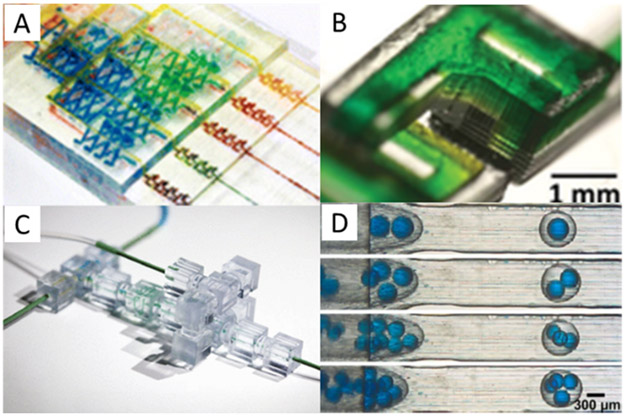
Figure 1.
Figure 1.
Fluidic features produced by 3D printing. A) Gradient mixing device consisting of several intersecting turbulent mixing sections used to measure nitrite concentrations. Reprinted with permission from ref. ; copyright 2014 American Chemical Society. B) Mixer consisting of several connected “F” shaped units that allow streams of fluid to pass and diffuse into each other. Reprinted with permission from ref. . C) 3D printed modular device consisting of several discrete elements produced in cubes which can be connected together to create larger functional devices with several purposes; adapted with permission from ref. . D) Droplet generators showing several different water/oil/water droplets containing multiple blue droplets within a single oil droplet; adapted with permission from ref. .
Figure 2.
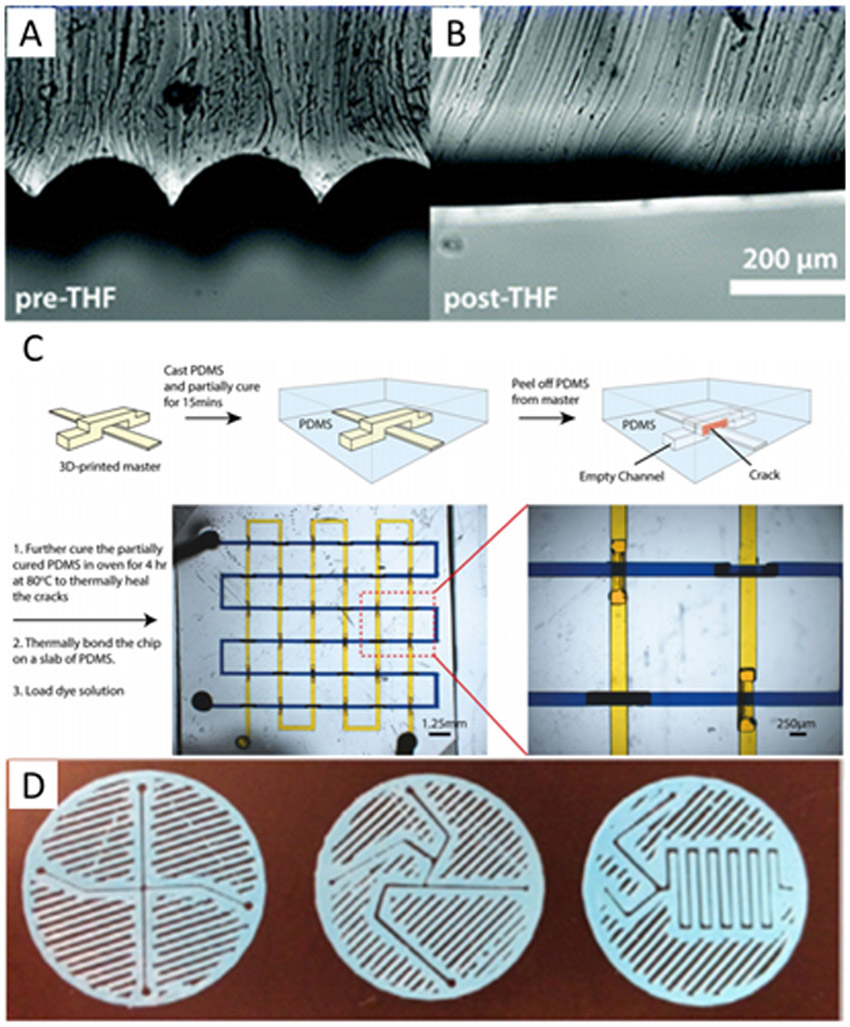
Figure 2.
Template and surface 3D printed microfluidic devices. A-B) Images showing the surface roughness of a polylactic acid FDM template before and after smoothing with tetrahydrofuran solvent. Republished with permission of the Royal Society of Chemistry, from ref. ; permission conveyed through Copyright Clearance Center. C) A method of casting a fully three-dimensional device. PDMS is cast over a 3D printed template and allowed to partially cure. The PDMS is cracked and peeled off the template then allowed to fully cure before filling with fluid for experiments. Reprinted by permission from ref. , copyright 2015 Springer Nature. D) Sandwich-style planar mixers printed using FDM then sandwiched between two surfaces with interface connections to form fluidic devices. Republished from ref. with permission of IOP Publishing; permission conveyed through Copyright Clearance Center.
Figure 3.
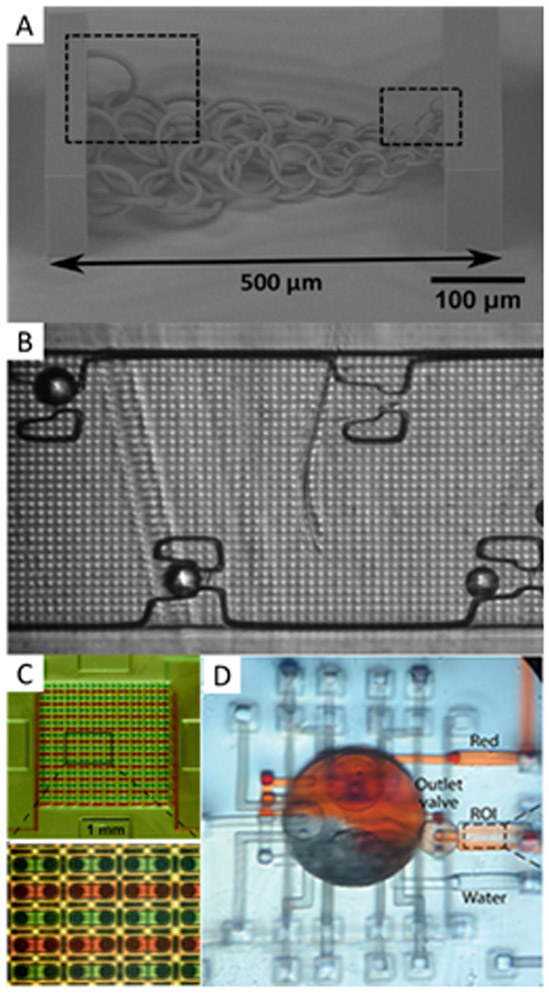
Figure 3.
SLA 3D printed microfluidic devices with ~50 μm features. A) Chain-links of varying sizes as small as 4 μm. Reproduced with permission from ref. . B) Microfluidic bead trapping device; 25 μm particles were captured in the traps, adapted with permission from ref. . C) Interlocking microgaskets used to make a 20 × 20 array of interconnected channels between two discrete devices to facilitate device-to-world interfacing without leaking. Republished from ref. with permission of the Royal Society of Chemistry; permission conveyed through Copyright Clearance Center. D) Mixing device consisting of 50 μm channels with valves and a large mixing chamber in the center. Reprinted from ref. , with the permission of AIP Publishing.
Figure 4.
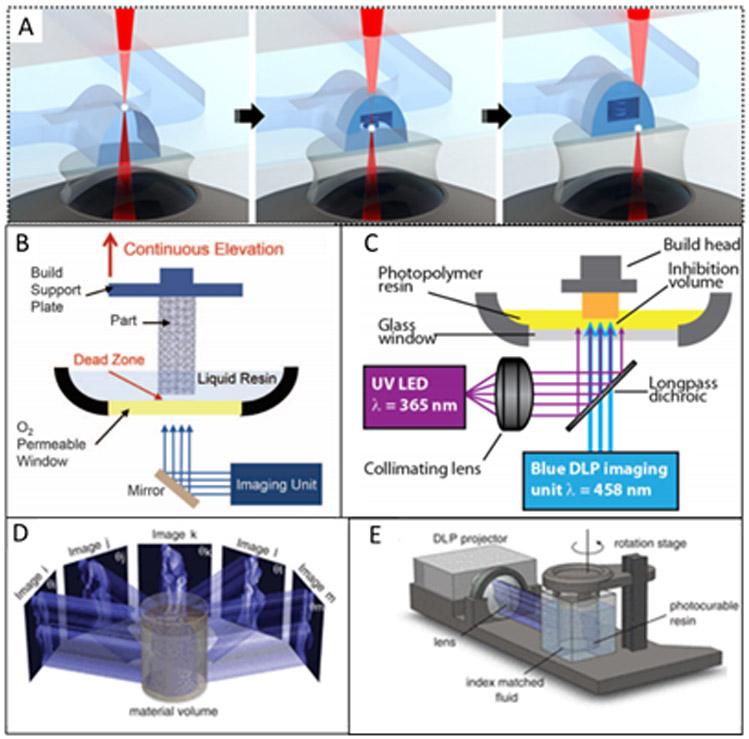
Figure 4.
New approaches for 3D printing of microfluidic devices and structures. A) Two-photon polymerization of a spring diode inside a microfluidic channel; adapted with permission from ref. . B) Instrumentation setup for CLIP; the build platform is continuously raised out of a resin vat and polymerization is enabled by an oxygen-inhibited “dead zone” above a permeable window. Reprinted from ref. with permission from AAAS. C) Instrumental setup for an alternate approach to CLIP. Polymerization is initiated by the blue light and inhibited by the UV light. Reproduced with permission from ref. . D-E) Image angle breakdown and instrumental setup for CAL 3D printing. Reprinted from ref. with permission from AAAS.

References

    1. Dixit CK, Kadimisetty K, Rusling J. 2018. 3D-printed miniaturized fluidic tools in chemistry and biology. Anal. Chem 10:37–52 - PMC - PubMed
    1. Layani M, Wang X, Magdassi S. 2018. Novel materials for 3D printing by photopolymerization. Adv. Mater 30:1706344 - PubMed
    1. Bhattacharjee N, Urrios A, Kang S, Folch A. 2016. The upcoming 3D-printing revolution in microfluidics. Lab Chip 16:1720–42 - PMC - PubMed
    1. Au AK, Huynh W, Horowitz LF, Folch A. 2016. 3D-printed microfluidics. Angew. Chem. Int. Ed 55:3862–81 - PMC - PubMed
    1. Waheed S, Cabot JM, Macdonald NP, Lewis T, Guijt RM, et al. 2016. 3D printed microfluidic device: enablers and barrier. Lab Chip 16:1993–2013 - PubMed

Publication types

MeSH terms

LinkOut - more resources