


Genomic Landscape of Intramedullary Spinal Cord Gliomas
- PMID: 31822682
- PMCID: PMC6904446
- DOI: 10.1038/s41598-019-54286-9
Genomic Landscape of Intramedullary Spinal Cord Gliomas
Abstract
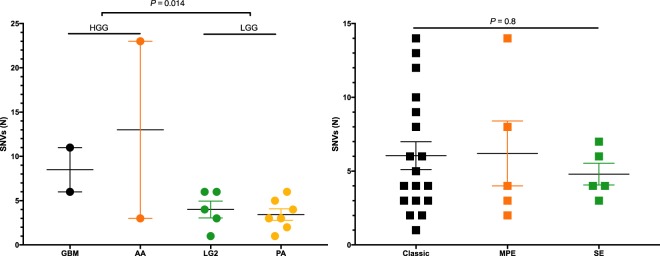
Intramedullary spinal cord tumors (IMSCTs) are rare neoplasms that have limited treatment options and are associated with high rates of morbidity and mortality. To better understand the genetic basis of these tumors we performed whole exome sequencing on 45 tumors and matched germline DNA, including twenty-nine spinal cord ependymomas and sixteen astrocytomas. Though recurrent somatic mutations in IMSCTs were rare, we identified NF2 mutations in 15.7% of tumors (ependymoma, N = 7; astrocytoma, N = 1), RP1 mutations in 5.9% of tumors (ependymoma, N = 3), and ESX1 mutations in 5.9% of tumors (ependymoma, N = 3). We further identified copy number amplifications in CTU1 in 25% of myxopapillary ependymomas. Given the paucity of somatic driver mutations, we further performed whole-genome sequencing of 12 tumors (ependymoma, N = 9; astrocytoma, N = 3). Overall, we observed that IMSCTs with intracranial histologic counterparts (e.g. glioblastoma) did not harbor the canonical mutations associated with their intracranial counterparts. Our findings suggest that the origin of IMSCTs may be distinct from tumors arising within other compartments of the central nervous system and provides the framework to begin more biologically based therapeutic strategies.
Conflict of interest statement
The authors declare no competing interests.
Figures


References
Publication types
MeSH terms
Substances
Supplementary concepts
Grants and funding
- U01 CA230691/CA/NCI NIH HHS/United States
- R37-CA230400/U.S. Department of Health & Human Services | National Institutes of Health (NIH)/International
- R21 CA208723/CA/NCI NIH HHS/United States
- R21-CA208723/U.S. Department of Health & Human Services | National Institutes of Health (NIH)/International
- R37 CA230400/CA/NCI NIH HHS/United States
LinkOut - more resources
Full Text Sources
Medical
Miscellaneous
