. 2019 Dec 10;7(1):156.
doi: 10.1186/s40168-019-0766-7.

Discordant transmission of bacteria and viruses from mothers to babies at birth

Affiliations

Discordant transmission of bacteria and viruses from mothers to babies at birth

Rabia Maqsood et al. Microbiome. .

Abstract

Background: The earliest microbial colonizers of the human gut can have life-long consequences for their hosts. Precisely how the neonatal gut bacterial microbiome and virome are initially populated is not well understood. To better understand how the maternal gut microbiome influences acquisition of the infant gut microbiome, we studied the early life bacterial microbiomes and viromes of 28 infant twin pairs and their mothers.

Results: Infant bacterial and viral communities more closely resemble those of their related co-twin than unrelated infants. We found that 63% of an infant's bacterial microbiome can be traced to their mother's gut microbiota. In contrast, only 15% of their viral communities are acquired from their mother. Delivery route did not determine how much of the bacterial microbiome or virome was shared from mother to infant. However, bacteria-bacteriophage interactions were altered by delivery route.

Conclusions: The maternal gut microbiome significantly influences infant gut microbiome acquisition. Vertical transmission of the bacterial microbiome is substantially higher compared to vertical transmission of the virome. However, the degree of similarity between the maternal and infant gut bacterial microbiome and virome did not vary by delivery route. The greater similarity of the bacterial microbiome and virome between twin pairs than unrelated twins may reflect a shared environmental exposure. Thus, differences of the inter-generation transmissibility at birth between the major kingdoms of microbes indicate that the foundation of these microbial communities are shaped by different rules. Video Abstract.

Keywords: Microbiome; Transmission; Virome.


Conflict of interest statement

P.I.T. is a consultant to Takeda Pharmaceuticals on childhood gastrointestinal diseases. The other authors declare that they have no competing interests.

Figures
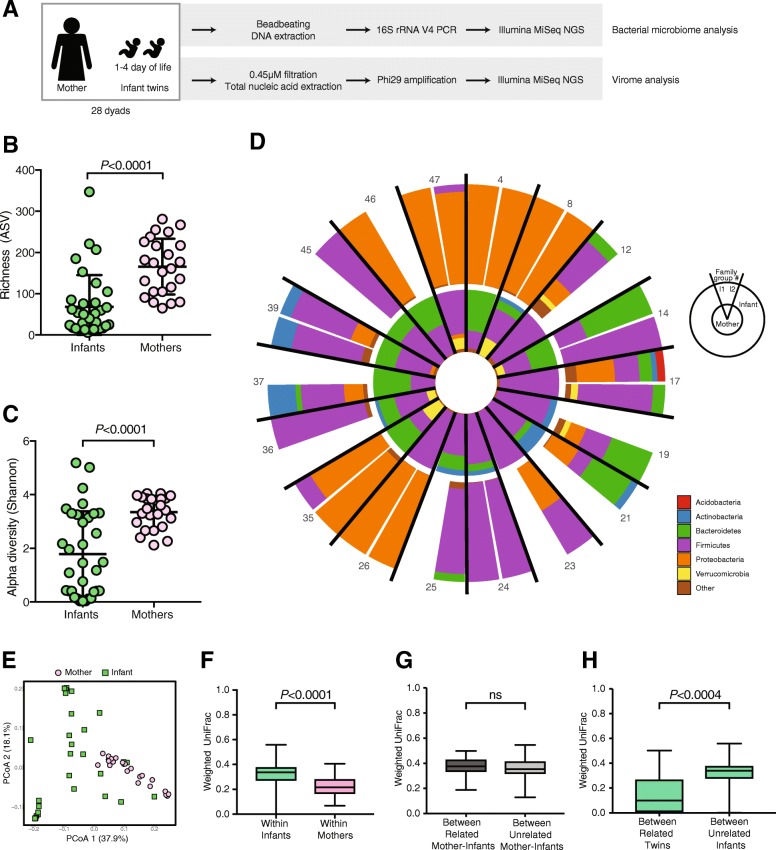
Fig. 1
Fig. 1
Bacterial microbiota analysis of mothers and infants. a Overview of study design. b Richness of bacterial amplicon sequence variants (ASV) in infants and mothers. Statistical significance assessed by Mann-Whitney test. c Alpha diversity of bacterial ASV in mothers and infants. Statistical significance assessed by Mann-Whitney test. d Relative abundance of bacteria at phylum level for mothers and infants; I1 (infant twin 1) and I2 (infant twin 2). e PCoA plot of weighted UniFrac distances. f Weighted UniFrac pairwise comparison within infants and within mothers. Statistical significance assessed by Mann-Whitney test. g Weighted UniFrac pairwise comparison between related mother-infant (n = 27 pairs) and between unrelated mother-infant (n = 765 pairs). Statistical significance assessed by Mann-Whitney test. h Weighted UniFrac pairwise comparison between co-twins (n = 11 twin pairs) and between unrelated infants (n = 517 pairs). Statistical significance assessed by Mann-Whitney test
Fig. 2
Fig. 2
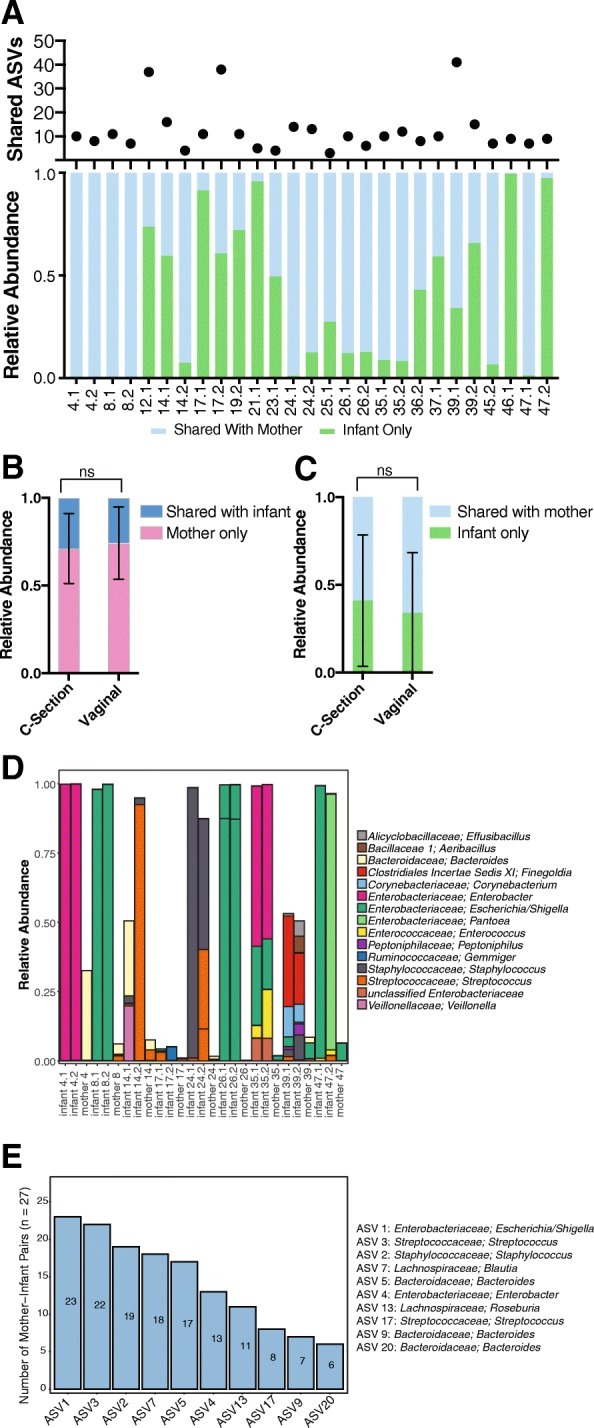
Bacterial ASV transmission analysis. a The number of ASVs shared between mother and infant and the relative abundance of the infant bacterial microbiome that is shared with mother. b Average relative abundance of maternal bacterial microbiome that is shared with infant by delivery route. Statistical significance assessed by Mann-Whitney test. c Average relative abundance of infant bacterial microbiome that is shared with mother by delivery route. Statistical significance assessed by Mann-Whitney test. d Relative abundance of ASVs present in both twin pairs (> 0.05). Taxonomy shown at the genus level. e Frequency plot of the 10 most commonly transmitted ASVs
Fig. 3
Fig. 3
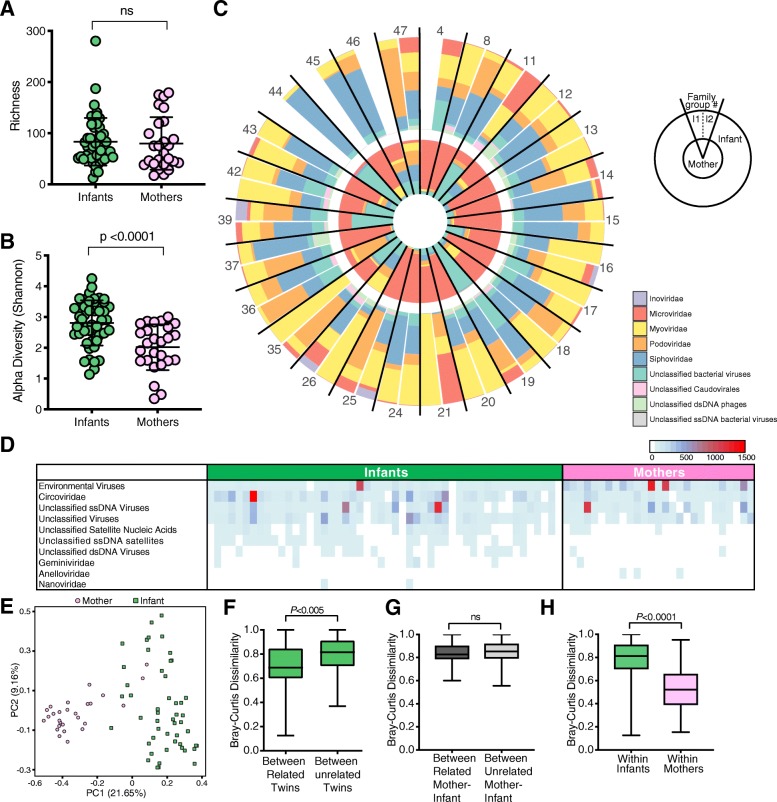
Virome analysis of mothers and infants. a Richness of viral species in infants and mothers. Statistical significance assessed by Mann-Whitney test. b Alpha diversity of viral species in mothers and infants using Shannon index. Statistical significance assessed by Mann-Whitney test. c Relative abundance of phages at family level for mothers and related infants within each family. I1 (infant twin 1) and I2 (infant twin 2). d Heatmap of eukaryotic families and unclassified categories for infants and mothers. e PCoA plot using Bray-Curtis distance. Color represent category of samples as infants or mothers. f Bray-Curtis distance for viral species between related twins and between unrelated twins. Statistical significance assessed by Mann-Whitney test. g Bray-Curtis distance for viral species between related mother-infant and between unrelated mother-infant. Statistical significance assessed by Mann-Whitney test. h Bray-Curtis distance for viral species within infants and within mothers. Statistical significance assessed by Mann-Whitney test
Fig. 4
Fig. 4
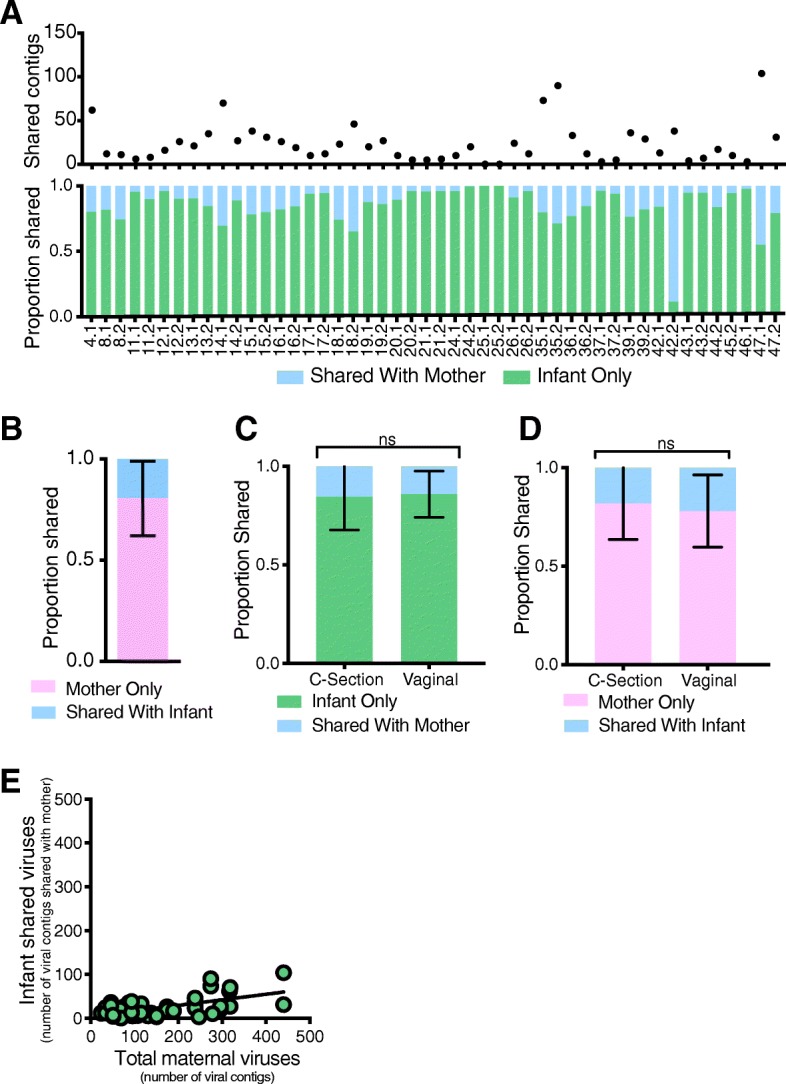
Viral contig transmission analysis. a The number of contigs shared between mother and infant and the proportion of infant virome that is shared with mother or is infant only. b Average contig proportion of mother virome that is shared with infant or is mother only. c Average contig proportion of infant virome that is shared with mother by delivery route. Statistical significance assessed by Mann-Whitney test. d Average contig proportion of maternal virome that is shared with infant by delivery route. Statistical significance assessed by Mann-Whitney test. e Plot of the number of infant shared viral contigs vs. the total number of maternal contigs. Linear regression line fit to data
Fig. 5
Fig. 5
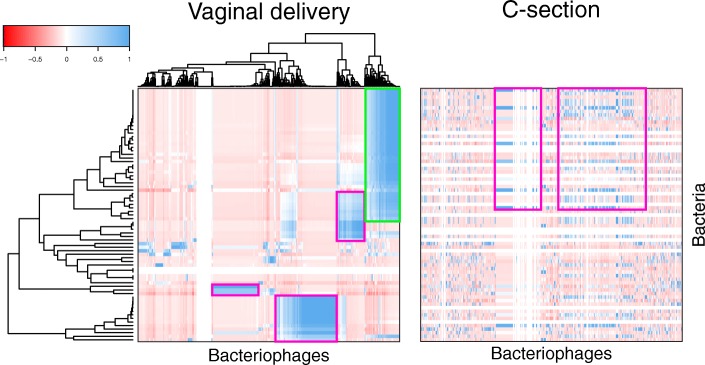
Transkingdom interaction between bacteria and bacteriophage. Correlation of bacterial ASVs and viral contigs shared between infants and mothers. Heatmap shows the Pearson correlation between bacterial ASVs and bacteriophage contigs in infants from vaginal delivery (left) clustered by hierarchical clustering. Correlations from infants delivered by C-section (right) were clustered in the same order as correlations from infants delivered vaginally. Examples of differences in transkingdom interactions between infant delivered vaginally vs. C-section are outlined in pink and green

References

    1. White RA, Bjornholt JV, Baird DD, Midtvedt T, Harris JR, Pagano M, Hide W, Rudi K, Moen B, Iszatt N, et al. Novel developmental analyses identify longitudinal patterns of early gut microbiota that affect infant growth. PLoS Comput Biol. 2013;9:e1003042. doi: 10.1371/journal.pcbi.1003042. - DOI - PMC - PubMed
    1. Britton RA, Young VB. Interaction between the intestinal microbiota and host in Clostridium difficile colonization resistance. Trends Microbiol. 2012;20:313–319. doi: 10.1016/j.tim.2012.04.001. - DOI - PMC - PubMed
    1. Frank DN, Robertson CE, Hamm CM, Kpadeh Z, Zhang T, Chen H, Zhu W, Sartor RB, Boedeker EC, Harpaz N, et al. Disease phenotype and genotype are associated with shifts in intestinal-associated microbiota in inflammatory bowel diseases. Inflamm Bowel Dis. 2011;17:179–184. doi: 10.1002/ibd.21339. - DOI - PMC - PubMed
    1. Olszak T, An D, Zeissig S, Vera MP, Richter J, Franke A, Glickman JN, Siebert R, Baron RM, Kasper DL, Blumberg RS. Microbial exposure during early life has persistent effects on natural killer T cell function. Science. 2012;336:489–493. doi: 10.1126/science.1219328. - DOI - PMC - PubMed
    1. Stout MJ, Conlon B, Landeau M, Lee I, Bower C, Zhao Q, Roehl KA, Nelson DM, Macones GA, Mysorekar IU. Identification of intracellular bacteria in the basal plate of the human placenta in term and preterm gestations. Am J Obstet Gynecol. 2013;208:226 e221–226 e227. - PMC - PubMed

Publication types