Review
. 2020 May 1;11(3):709-723.
doi: 10.1093/advances/nmz127.

Tryptophan Metabolism: A Link Between the Gut Microbiota and Brain

Affiliations
Review

Tryptophan Metabolism: A Link Between the Gut Microbiota and Brain

Kan Gao et al. Adv Nutr. .

Abstract

The gut-brain axis (GBA) is a bilateral communication network between the gastrointestinal (GI) tract and the central nervous system. The essential amino acid tryptophan contributes to the normal growth and health of both animals and humans and, importantly, exerts modulatory functions at multiple levels of the GBA. Tryptophan is the sole precursor of serotonin, which is a key monoamine neurotransmitter participating in the modulation of central neurotransmission and enteric physiological function. In addition, tryptophan can be metabolized into kynurenine, tryptamine, and indole, thereby modulating neuroendocrine and intestinal immune responses. The gut microbial influence on tryptophan metabolism emerges as an important driving force in modulating tryptophan metabolism. Here, we focus on the potential role of tryptophan metabolism in the modulation of brain function by the gut microbiota. We start by outlining existing knowledge on tryptophan metabolism, including serotonin synthesis and degradation pathways of the host, and summarize recent advances in demonstrating the influence of the gut microbiota on tryptophan metabolism. The latest evidence revealing those mechanisms by which the gut microbiota modulates tryptophan metabolism, with subsequent effects on brain function, is reviewed. Finally, the potential modulation of intestinal tryptophan metabolism as a therapeutic option for brain and GI functional disorders is also discussed.

Keywords: depression; gut microbiota; gut-brain axis; irritable bowel syndrome; kynurenine; microbial tryptophan metabolites; serotonin; tryptophan metabolism.


Figures

FIGURE 1
FIGURE 1
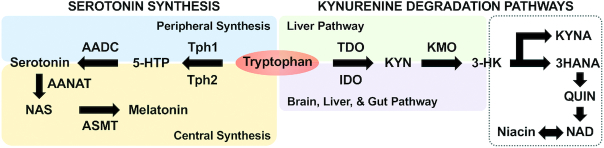
Overview of host tryptophan metabolism via serotonin synthesis and degradation pathway. The key metabolites and enzymes during tryptophan metabolism are presented. AADC, aromatic L-amino acid decarboxylase; AANAT, aralkylamine N-acetyltransfer; ASMT, acetylserotonin O-methyltransferase; IDO, indoleamine 2,3-dioxygenase; KMO, kynurenine 3-monooxygenase; KYN, kynurenine; KYNA, kynurenic acid; NAD, nicotinamide adenine dinucleotides; NAS, N-acetyl-serotonin; QUIN, quinolinic acid; TDO, tryptophan 2,3-dioxygenase; Tph1/2, tryptophan hydroxylase 1/2; 3HANA, 3-hydroxyanthranilic acid; 3-HK, 3-hydroxykynurenine; 5-HTP, 5-hydroxytryptophan.
FIGURE 2
FIGURE 2
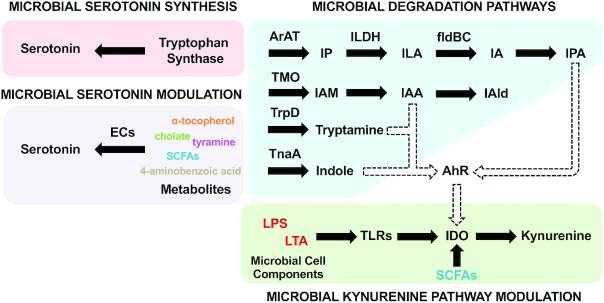
The modulation of tryptophan metabolism by gut microbiota. The key modulatory pathways in the microbial modulation of tryptophan metabolism are presented. AhR, aryl hydrocarbon receptor; ArAT, aromatic amino acid transaminase; ECs, enterochromaffin cells; fldBC, phenyllactate dehydratase; IA, indole acrylic acid; IAA, indole-3-acetic acid; IAld, indole-3-aldehyde; IAM, indole-3-acetamide; IDO, indoleamine 2,3-dioxygenase; ILA, indole-3-lactic acid; ILDH, indolelactic acid dehydrogenase; IP, indole-3-pyruvate; IPA, indolic-3-propionic acid; LPS, lipopolysaccharides; LTA, lipoteichoic acid; SCFA, short-chain fatty acid; TLR, toll-like receptor; TMO, tryptophan-2-monooxygenase; TnaA, tryptophanase; TrpD, tryptophan decarboxylase.
FIGURE 3
FIGURE 3
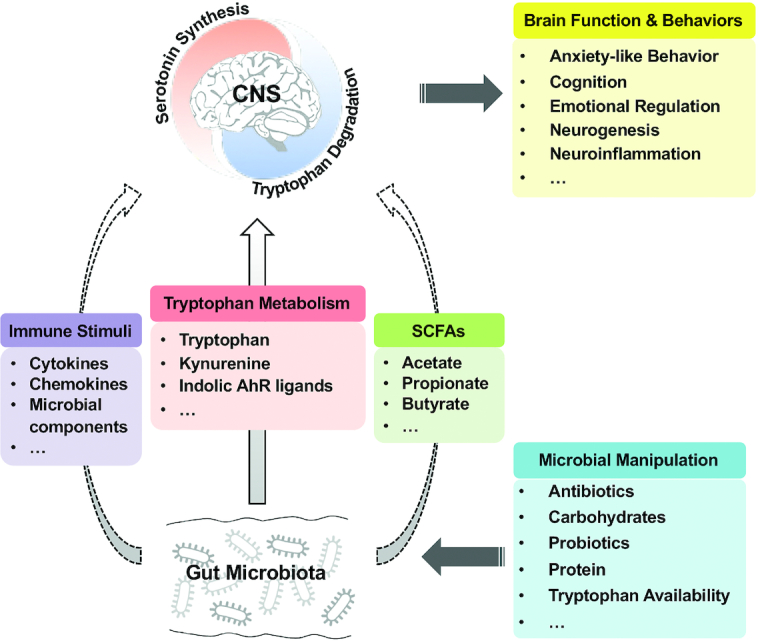
The potential role of tryptophan metabolism in the gut microbiota-brain axis. Manipulations of gut microbiota composition and metabolism by various ways (e.g., antibiotics and probiotics) contribute to the shifts in the central tryptophan metabolism between serotonin synthesis and tryptophan degradation pathways, which thereby influence the brain function and behaviors. The solid arrow indicates the tryptophan metabolism–dependent effects of alterations in gut microbiota on the central tryptophan metabolism; the dashed arrow indicates the tryptophan-independent effects on the central tryptophan metabolism. AhR, aryl hydrocarbon receptor; CNS, central nervous system; SCFA, short-chain fatty acid.

References

    1. Jaglin M, Rhimi M, Philippe C, Pons N, Bruneau A, Goustard B, Dauge V, Maguin E, Naudon L, Rabot S. Indole, a signaling molecule produced by the gut microbiota, negatively impacts emotional behaviors in rats. Front Neurosci. 2018;12:216. - PMC - PubMed
    1. Frohlich EE, Farzi A, Mayerhofer R, Reichmann F, Jacan A, Wagner B, Zinser E, Bordag N, Magnes C, Frohlich E et al. .. Cognitive impairment by antibiotic-induced gut dysbiosis: analysis of gut microbiota-brain communication. Brain Behav Immun. 2016;56:140–55. - PMC - PubMed
    1. De Vadder F, Kovatcheva-Datchary P, Goncalves D, Vinera J, Zitoun C, Duchampt A, Backhed F, Mithieux G. Microbiota-generated metabolites promote metabolic benefits via gut-brain neural circuits. Cell. 2014;156(1–2):84–96. - PubMed
    1. Labus JS, Hollister EB, Jacobs J, Kirbach K, Oezguen N, Gupta A, Acosta J, Luna RA, Aagaard K, Versalovic J et al. .. Differences in gut microbial composition correlate with regional brain volumes in irritable bowel syndrome. Microbiome. 2017;5(1):49. - PMC - PubMed
    1. Pinto-Sanchez MI, Hall GB, Ghajar K, Nardelli A, Bolino C, Lau JT, Martin FP, Cominetti O, Welsh C, Rieder A et al. .. Probiotic Bifidobacterium longum NCC3001 reduces depression scores and alters brain activity: a pilot study in patients with irritable bowel syndrome. Gastroenterology. 2017;153(2):448–59. - PubMed

Publication types