


Snow and Glacial Algae: A Review1
- PMID: 31825096
- PMCID: PMC7232433
- DOI: 10.1111/jpy.12952
Snow and Glacial Algae: A Review1
Abstract
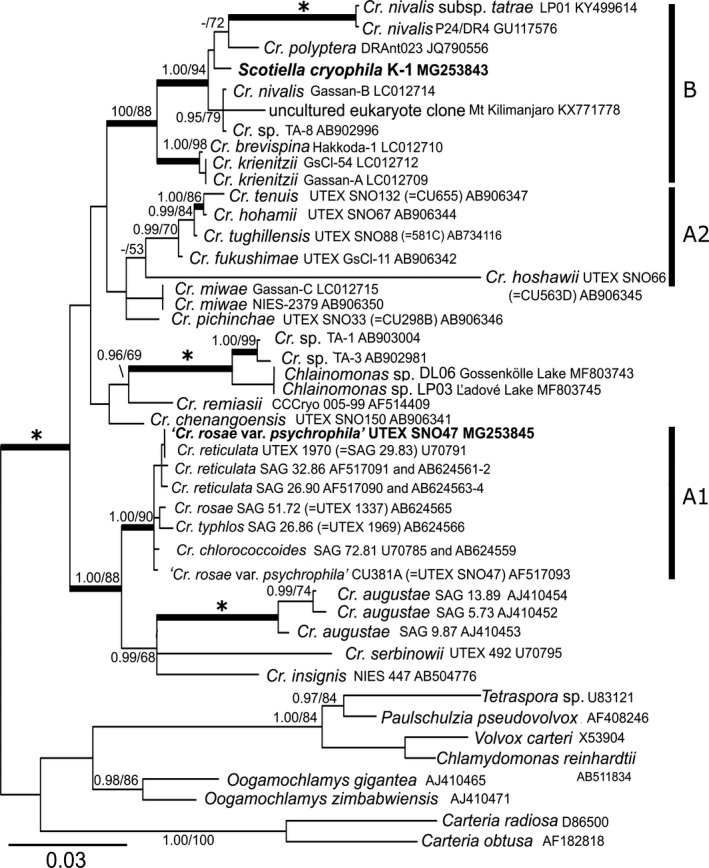
Snow or glacial algae are found on all continents, and most species are in the Chlamydomonadales (Chlorophyta) and Zygnematales (Streptophyta). Other algal groups include euglenoids, cryptomonads, chrysophytes, dinoflagellates, and cyanobacteria. They may live under extreme conditions of temperatures near 0°C, high irradiance levels in open exposures, low irradiance levels under tree canopies or deep in snow, acidic pH, low conductivity, and desiccation after snow melt. These primary producers may color snow green, golden-brown, red, pink, orange, or purple-grey, and they are part of communities that include other eukaryotes, bacteria, archaea, viruses, and fungi. They are an important component of the global biosphere and carbon and water cycles. Life cycles in the Chlamydomonas-Chloromonas-Chlainomonas complex include migration of flagellates in liquid water and formation of resistant cysts, many of which were identified previously as other algae. Species differentiation has been updated through the use of metagenomics, lipidomics, high-throughput sequencing (HTS), multi-gene analysis, and ITS. Secondary metabolites (astaxanthin in snow algae and purpurogallin in glacial algae) protect chloroplasts and nuclei from damaging PAR and UV, and ice binding proteins (IBPs) and polyunsaturated fatty acids (PUFAs) reduce cell damage in subfreezing temperatures. Molecular phylogenies reveal that snow algae in the Chlamydomonas-Chloromonas complex have invaded the snow habitat at least twice, and some species are polyphyletic. Snow and glacial algae reduce albedo, accelerate the melt of snowpacks and glaciers, and are used to monitor climate change. Selected strains of these algae have potential for producing food or fuel products.
Keywords: albedo; community structure; cryophilic; environmental parameters; genomics; glacial algae; life cycles; primary productivity; secondary metabolites; snow algae.
© 2019 The Authors. Journal of Phycology published by Wiley Periodicals, Inc. on behalf of Phycological Society of America.
Figures


References
-
- Aitchison, C. W. 2001. The effect of snow cover on small animals In Jones H. G., Pomeroy J. W., Walker D. A. & Hoham R. [Eds.] Snow Ecology. An Interdisciplinary Examination of Snow‐Covered Ecosystems. Cambridge University Press, Cambridge, pp. 229–65.
-
- Allison, I. , Hock, R. , King, M. A. & Mackintosh, A. N. 2018. Future Earth and cryopshere In Beer T., Jianping L. & Alverson K. [Eds.] Global Change and Future Earth: The Geoscience Perspective. Cambridge University Press, Cambridge, pp. 91–113.
-
- Aoki, T. , Kuchiki, K. , Niwano, M. , Matoba, S. , Uetake, J. , Masuda, K. & Ishimoto, H. 2013. Numerical simulation of spectral albedos of glacier surfaces covered with glacial microbes in Northwestern Greenland. AIP Conf. Proc. 1531:176–9.
-
- Barcyt≐, D. , Hodač, L. , Nedbalová, L. & Elster, J. 2018. Chloromonas arctica sp. nov., a psychrotolerant alga from snow in the High Arctic (Chlamydomonadales, Chlorophyta). Int. J. Syst. Evol. Microbiol. 68:851–9. - PubMed
Publication types
MeSH terms
Grants and funding
LinkOut - more resources
Full Text Sources
