


Myocardial Storage, Inflammation, and Cardiac Phenotype in Fabry Disease After One Year of Enzyme Replacement Therapy
- PMID: 31826677
- PMCID: PMC6924943
- DOI: 10.1161/CIRCIMAGING.119.009430
Myocardial Storage, Inflammation, and Cardiac Phenotype in Fabry Disease After One Year of Enzyme Replacement Therapy
Abstract
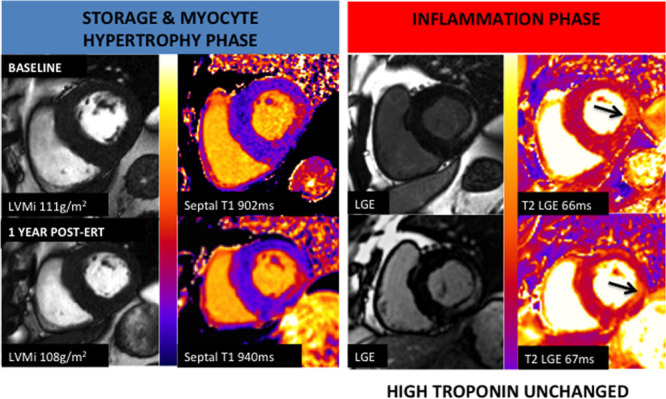
Background: Cardiac response to enzyme replacement therapy (ERT) in Fabry disease is typically assessed by measuring left ventricular mass index using echocardiography or cardiovascular magnetic resonance, but neither quantifies myocardial biology. Low native T1 in Fabry disease represents sphingolipid accumulation; late gadolinium enhancement with high T2 and troponin elevation reflects inflammation. We evaluated the effect of ERT on myocardial storage, inflammation, and hypertrophy.
Methods: Twenty patients starting ERT (60% left ventricular hypertrophy-positive) were compared with 18 patients with early disease and 18 with advanced disease over 1 year at 3 centers. Cardiovascular magnetic resonance (left ventricular mass index, T1, T2, global longitudinal strain, and late gadolinium enhancement) and biomarkers (high-sensitive troponin-T and NT-proBNP [N-terminal Pro-B-type natriuretic peptide]) at baseline (pre-ERT) and 12 months were performed. Early disease controls were stable, treatment-naïve patients (mainly left ventricular hypertrophy-negative); advanced disease controls were stable, established ERT patients (mainly left ventricular hypertrophy-positive).
Results: Over 1 year, early disease controls increased maximum wall thickness and left ventricular mass index (9.8±2.7 versus 10.2±2.6 mm; P=0.010; 65±15 versus 67±16 g/m2; P=0.005) and native T1 fell (981±58 versus 959±61 ms; P=0.002). Advanced disease controls increased T2 in the late gadolinium enhancement area (57±6 versus 60±7 ms; P=0.023) with worsening global longitudinal strain (-13.2±3.4 versus -12.1±4.8; P=0.039). Newly treated patients had a small reduction in maximum wall thickness (14.8±5.9 versus 14.4±5.7 mm; P=0.028), stable left ventricular mass index (93±42 versus 92±40 g/m2; P=0.186) and a reduction in T1 lowering (917±49 versus 931±54 ms; P=0.017).
Conclusions: Fabry myocardial phenotype development is different at different disease stages. After 1 year of ERT initiation, left ventricular hypertrophy-positive patients have a detectable, small reduction in left ventricular mass and storage.
Keywords: Fabry disease; inflammation; myocardium; sphingolipid; troponin.
Figures


Comment in
-
Cardiovascular Magnetic Resonance to Guide and Monitor the Myocardial Response to Treatment.Circ Cardiovasc Imaging. 2019 Dec;12(12):e010045. doi: 10.1161/CIRCIMAGING.119.010045. Epub 2019 Dec 12. Circ Cardiovasc Imaging. 2019. PMID: 31826674 No abstract available.
References
-
- Zarate YA, Hopkin RJ. Fabry’s disease. Lancet. 2008;372:1427–1435. doi: 10.1016/S0140-6736(08)61589-5. - PubMed
-
- Waldek S, Patel MR, Banikazemi M, Lemay R, Lee P. Life expectancy and cause of death in males and females with Fabry disease: findings from the Fabry Registry. Genet Med. 2009;11:790–796. doi: 10.1097/GIM.0b013e3181bb05bb. - PubMed
-
- Baig S, Edward NC, Kotecha D, Liu B, Nordin S, Kozor R, Moon JC, Geberhiwot T, Steeds RP. Ventricular arrhythmia and sudden cardiac death in Fabry disease: a systematic review of risk factors in clinical practice. Europace. 2018;20(FI2):f153–f161. doi: 10.1093/europace/eux261. - PubMed
-
- Weidemann F, Niemann M, Breunig F, Herrmann S, Beer M, Störk S, Voelker W, Ertl G, Wanner C, Strotmann J. Long-term effects of enzyme replacement therapy on fabry cardiomyopathy: evidence for a better outcome with early treatment. Circulation. 2009;119:524–529. doi: 10.1161/CIRCULATIONAHA.108.794529. - PubMed
-
- Strotmann J, Breunig F, Wanner C, Weidemann F. Progression of Fabry cardiomyopathy. Clin Ther. 2007;29(suppl A):S13–S14. doi: 10.1016/s0149-2918(07)80120-2. - PubMed
Publication types
MeSH terms
Substances
Supplementary concepts
Grants and funding
LinkOut - more resources
Full Text Sources
Medical
Research Materials
