. 2020 Mar;69(3):413-423.
doi: 10.2337/db19-0942. Epub 2019 Dec 11.

Insulin-Like Growth Factor Dysregulation Both Preceding and Following Type 1 Diabetes Diagnosis

Affiliations

Insulin-Like Growth Factor Dysregulation Both Preceding and Following Type 1 Diabetes Diagnosis

Melanie R Shapiro et al. Diabetes. 2020 Mar.

Abstract

Insulin-like growth factors (IGFs), specifically IGF1 and IGF2, promote glucose metabolism, with their availability regulated by IGF-binding proteins (IGFBPs). We hypothesized that IGF1 and IGF2 levels, or their bioavailability, are reduced during type 1 diabetes development. Total serum IGF1, IGF2, and IGFBP1-7 levels were measured in an age-matched, cross-sectional cohort at varying stages of progression to type 1 diabetes. IGF1 and IGF2 levels were significantly lower in autoantibody (AAb)+ compared with AAb- relatives of subjects with type 1 diabetes. Most high-affinity IGFBPs were unchanged in individuals with pre-type 1 diabetes, suggesting that total IGF levels may reflect bioactivity. We also measured serum IGFs from a cohort of fasted subjects with type 1 diabetes. IGF1 levels significantly decreased with disease duration, in parallel with declining β-cell function. Additionally, plasma IGF levels were assessed in an AAb+ cohort monthly for a year. IGF1 and IGF2 showed longitudinal stability in single AAb+ subjects, but IGF1 levels decreased over time in subjects with multiple AAb and those who progressed to type 1 diabetes, particularly postdiagnosis. In sum, IGFs are dysregulated both before and after the clinical diagnosis of type 1 diabetes and may serve as novel biomarkers to improve disease prediction.


Figures

Figure 1
Figure 1
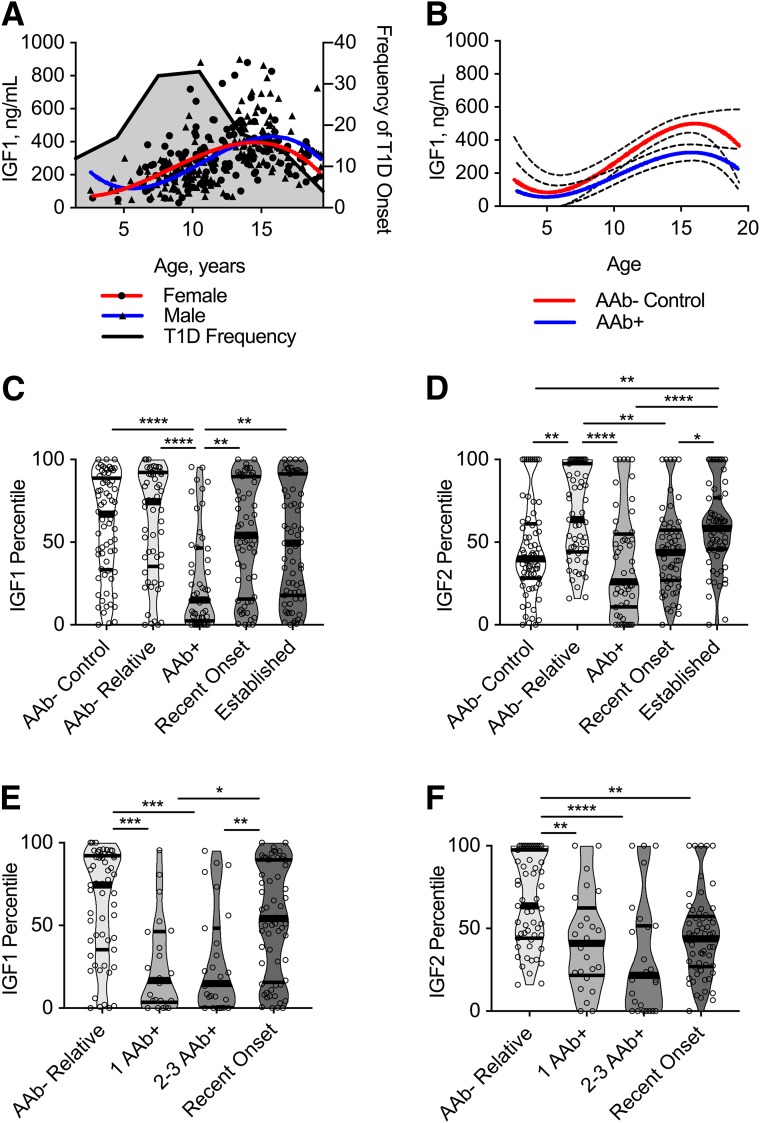
Total IGF1 and IGF2 levels are significantly decreased in serum of AAb+ subjects at high risk for type 1 diabetes onset. Subjects from UF cross-sectional cohort. A: IGF1 levels correlate with age for males (Spearman correlation: P < 0.0001, r = 0.60) and females (P < 0.0001, r = 0.38), with an earlier peak in females compared with males. Ages at onset of type 1 diabetes in this cohort (includes subjects with recent onset and established disease) were binned based on frequency and are overlaid in gray. B: Best fit curves were significantly different for AAb control vs. AAb+ subjects (P = 0.0002, extra sum of squares F test). Data are shown as mean (solid line) with 95% CI (dashed lines). C: Violin plots showing IGF1 levels normalized for age and sex are decreased in AAb+ subjects compared with AAb control subjects, AAb relatives, and subjects with recent-onset and established type 1 diabetes. D: IGF2 levels normalized for age and sex decreased in AAb+ subjects and subjects with recent-onset disease compared with AAb relatives and those with established type 1 diabetes. E and F: Upon stratification of the AAb+ group by number of AAb, decreases in IGF1 (E) and IGF2 (F) percentiles remain significant for those with any number of AAb. Kruskal-Wallis with Dunn multiple comparisons test: *P < 0.05, **P < 0.01, ***P < 0.001, ****P < 0.0001.
Figure 2
Figure 2
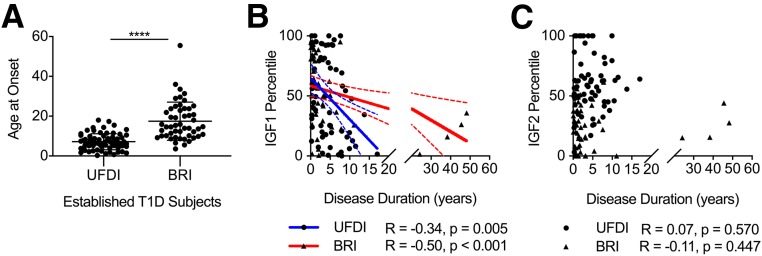
IGF1 decreases with increased duration of type 1 diabetes. A: Disease onset for the BRI cohort was at significantly older age than for the UFDI cohort with established type 1 diabetes (Mann-Whitney U test). B: IGF1 percentile for age and sex decreases with increasing disease duration in cross-sectional established type 1 diabetes cohorts from UFDI and BRI. C: IGF2 percentile is not associated with disease duration in either cohort. Data are overlaid with best fit lines (solid) and 95% CI (dashed lines). Spearman correlation: *P < 0.05, **P < 0.01, ***P < 0.001, ****P < 0.0001.
Figure 3
Figure 3
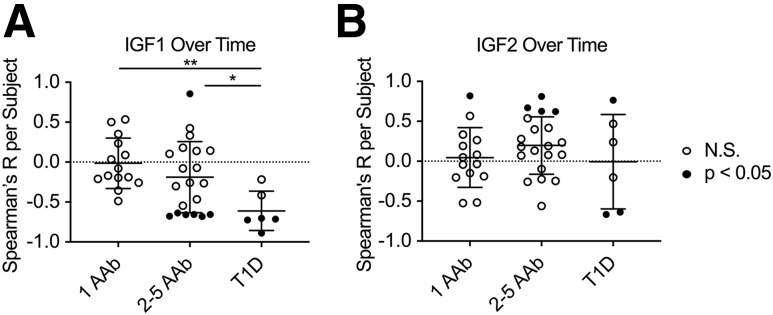
Longitudinal IGF1 levels were stable in subjects with 1AAb+ at enrollment and decreased over time in those with multiple AAb+ at enrollment and subjects who progressed to type 1 diabetes. Subjects from longitudinal T1DBIT cohort. A: IGF1 does not show any correlation with time of longitudinal follow-up in 1AAb+ subjects, while a subset of those with multiple AAb+ and who developed type 1 diabetes show significantly decreasing IGF1 over time. B: IGF2 does not show any correlation with time of longitudinal follow-up in 1AAb+ subjects, while a subset of those with multiple AAb+ show significantly increasing IGF2 levels and those who developed type 1 diabetes show variable IGF2 levels over time. ●, subjects with significant slopes; ○, subjects with nonsignificant slopes in IGF over the course of the study. N.S., not significant. Kruskal-Wallis with Dunn multiple comparisons test: *P < 0.05, **P < 0.01.
Figure 4
Figure 4
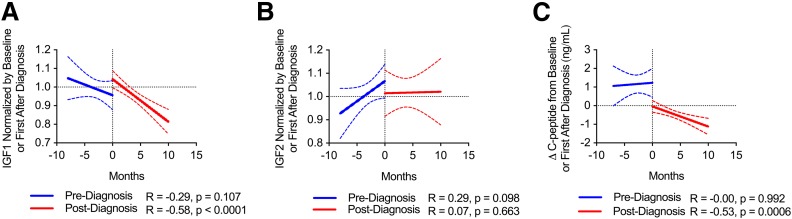
Subjects who progressed to type 1 diabetes showed reduction in IGF1 postdiagnosis. Subjects from longitudinal T1DBIT cohort. Grouped IGF trajectory data for subjects progressing to type 1 diabetes during the study reveal that IGF1 remains stable prediagnosis and decreases with time postdiagnosis in the same subjects (A) and that IGF2 levels were not significantly different in comparison of pre- and postdiagnosis trajectories (B). C: Random C-peptide levels are stable prediagnosis and decrease with time postdiagnosis. Data were normalized by baseline levels before or immediately after diagnosis. Best fit lines (solid) shown with 95% CI (dashed). Spearman correlation.

Comment in

References

    1. Raab J, Haupt F, Scholz M, et al. .; Fr1da Study Group . Capillary blood islet autoantibody screening for identifying pre-type 1 diabetes in the general population: design and initial results of the Fr1da study. BMJ Open 2016;6:e011144 - PMC - PubMed
    1. Hommel A, Haupt F, Delivani P, et al. .; The Freder1k Study Group . Screening for type 1 diabetes risk in newborns: the Freder1k Pilot Study in Saxony. Horm Metab Res 2018;50:44–49 - PubMed
    1. Winkler C, Haupt F, Heigermoser M, et al. .; GPPAD Study Group . Identification of infants with increased type 1 diabetes genetic risk for enrollment into Primary Prevention Trials-GPPAD-02 study design and first results. Pediatr Diabetes 2019;20:720–727 - PMC - PubMed
    1. Insel RA, Dunne JL, Atkinson MA, et al. . Staging presymptomatic type 1 diabetes: a scientific statement of JDRF, the Endocrine Society, and the American Diabetes Association. Diabetes Care 2015;38:1964–1974 - PMC - PubMed
    1. Knip M, Korhonen S, Kulmala P, et al. . Prediction of type 1 diabetes in the general population. Diabetes Care 2010;33:1206–1212 - PMC - PubMed

Publication types

MeSH terms

Substances