


Host-microbiota interactions in rheumatoid arthritis
- PMID: 31827063
- PMCID: PMC6906371
- DOI: 10.1038/s12276-019-0283-6
Host-microbiota interactions in rheumatoid arthritis
Abstract
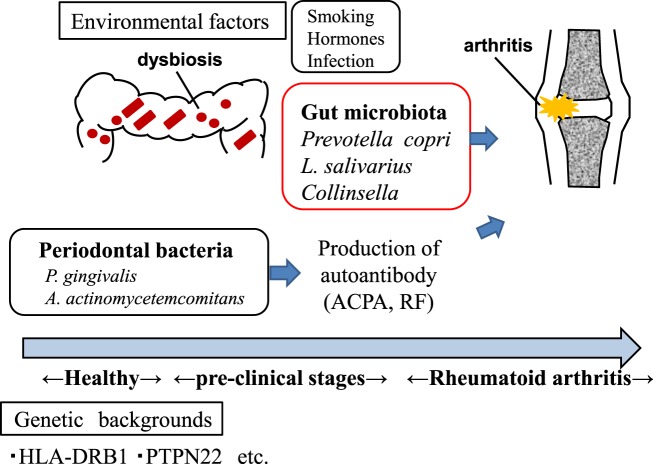
The gut microbiota has been proposed to be an important environmental factor in the development of rheumatoid arthritis (RA). Here, we review a growing body of evidence from human and animal studies that supports the hypothesis that intestinal microbiota play a role in RA. Previous studies from we and others showed an altered composition of the microbiota in early RA patients. A recent study demonstrated that Prevotella species are dominant in the intestine of patients in the preclinical stages of RA. In addition, Prevotella-dominated microbiota isolated from RA patients contributes to the development of Th17 cell-dependent arthritis in SKG mice. Moreover, it was reported that periodontal bacteria correlates with the pathogenesis of RA. In this review, we discuss the link between oral bacteria and the development of arthritis. However, many questions remain to be elucidated in terms of molecular mechanisms for the involvement of intestinal and oral microbiota in RA pathogenesis.
Conflict of interest statement
The authors declare that they have no conflict of interest.
Figures
References
Publication types
MeSH terms
LinkOut - more resources
Full Text Sources
Other Literature Sources
Medical
