Review
. 2019 Dec 11;51(12):1-13.
doi: 10.1038/s12276-019-0299-y.

Intracellular sensing of viral genomes and viral evasion

Affiliations
Review

Intracellular sensing of viral genomes and viral evasion

Hyun-Cheol Lee et al. Exp Mol Med. .

Abstract

During viral infection, virus-derived cytosolic nucleic acids are recognized by host intracellular specific sensors. The efficacy of this recognition system is crucial for triggering innate host defenses, which then stimulate more specific adaptive immune responses against the virus. Recent studies show that signal transduction pathways activated by sensing proteins are positively or negatively regulated by many modulators to maintain host immune homeostasis. However, viruses have evolved several strategies to counteract/evade host immune reactions. These systems involve viral proteins that interact with host sensor proteins and prevent them from detecting the viral genome or from initiating immune signaling. In this review, we discuss key regulators of cytosolic sensor proteins and viral proteins based on experimental evidence.


Conflict of interest statement

The authors declare that they have no conflict of interest.

Figures
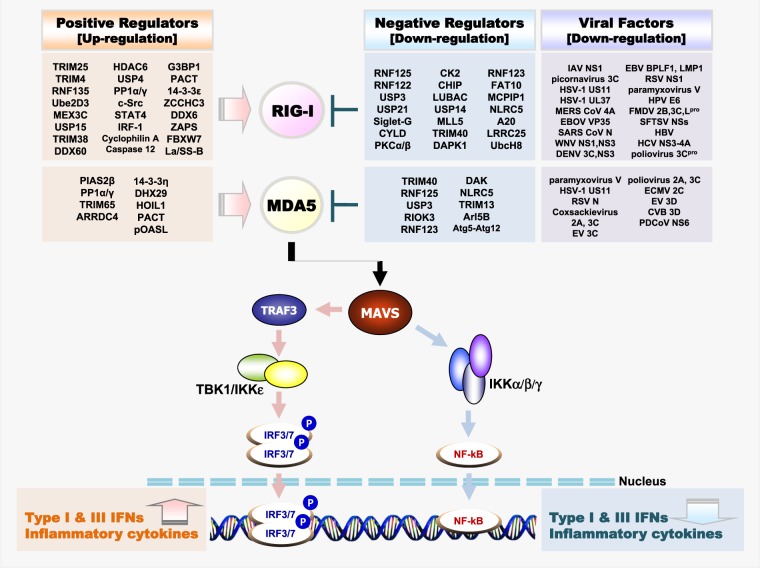
Fig. 1
Fig. 1. Regulators and interacting viral proteins of the RLR–MAVS antiviral signaling pathway.
Schematic presentation of positive and negative regulators of RLRs (Top) and melanoma differentiation-associated protein-5 (MDA5) (Bottom) through PTMs or non-PTMs and immune invasion viral proteins interacting with RIG-I (Top) and MDA5 (Bottom). The RLR-MAVS pathway includes the key cytosolic sensors RIG-I and MDA5, which detect viral RNA. These sensors subsequently interact with the central antiviral signaling protein MAVS, which in turn activates the transcription factors NF-κB and IRF3/IRF7 via the cytosolic kinases IKK and TBK1/IKKε, respectively. Activated transcription factors NF-κB, IRF7 and IRF3 translocate to the nucleus and induce transcription of type I IFN and pro-inflammatory genes
Fig. 2
Fig. 2. Regulators and interacting viral proteins of the cGAS–STING antiviral signaling pathway.
Schematic presentation of positive and negative regulators of cGAS through PTMs or non-PTMs and immune invasion viral proteins interacting with cGAS. cGAS induces signaling through the adapter protein STING, resulting in dimerization of STING and activation of the transcription factors NF-κB and IRF3/IRF7 via cytosolic kinases IKK and TBK1, respectively. Activated transcription factors NF-κB, IRF7, and IRF3 translocate to the nucleus and induce transcription of type I IFN and pro-inflammatory genes

References

    1. Goubau D, Deddouche S, Reis e Sousa C. Cytosolic sensing of viruses. Immunity. 2013;38:855–869. doi: 10.1016/j.immuni.2013.05.007. - DOI - PMC - PubMed
    1. Takeuchi O, Akira S. Pattern recognition receptors and inflammation. Cell. 2010;140:805–820. doi: 10.1016/j.cell.2010.01.022. - DOI - PubMed
    1. Ivashkiv LB, Donlin LT. Regulation of type I interferon responses. Nat. Rev. Immunol. 2014;14:36–49. doi: 10.1038/nri3581. - DOI - PMC - PubMed
    1. Mogensen TH. Pathogen recognition and inflammatory signaling in innate immune defenses. Clin. Microbiol Rev. 2009;22:240–273. doi: 10.1128/CMR.00046-08. - DOI - PMC - PubMed
    1. Chiang C, Gack MU. Post-translational control of intracellular pathogen sensing pathways. Trends Immunol. 2017;38:39–52. doi: 10.1016/j.it.2016.10.008. - DOI - PMC - PubMed

Publication types

MeSH terms
