


Should MASP-2 Deficiency Be Considered a Primary Immunodeficiency? Relevance of the Lectin Pathway
- PMID: 31828694
- PMCID: PMC7223972
- DOI: 10.1007/s10875-019-00714-4
Should MASP-2 Deficiency Be Considered a Primary Immunodeficiency? Relevance of the Lectin Pathway
Abstract
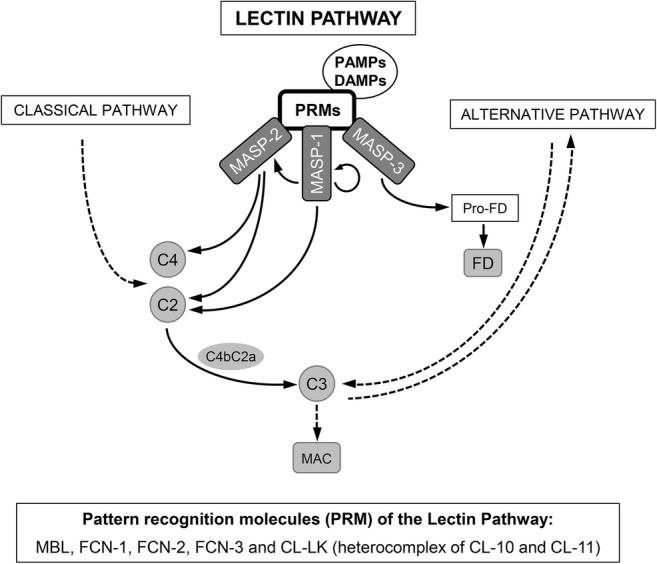
Mannose-binding lectin (MBL)-associated serine protease-2 (MASP-2) is an indispensable enzyme for the activation of the lectin pathway of complement. Its deficiency is classified as a primary immunodeficiency associated to pyogenic bacterial infections, inflammatory lung disease, and autoimmunity. In Europeans, MASP-2 deficiency, due to homozygosity for c.359A > G (p.D120G), occurs in 7 to 14/10,000 individuals. We analyzed the presence of the p.D120G mutation in adults (increasing the sample size of our previous studies) and children. Different groups of patients (1495 adults hospitalized with community-acquired pneumonia, 186 adults with systemic lupus erythematosus, 103 pediatric patients with invasive pneumococcal disease) and control individuals (1119 healthy adult volunteers, 520 adult patients without history of relevant infectious diseases, and a pediatric control group of 311 individuals) were studied. Besides our previously reported MASP-2-deficient healthy adults, we found a new p.D120G homozygous individual from the pediatric control group. We also reviewed p.D120G homozygous individuals reported so far: a total of eleven patients with a highly heterogeneous range of disorders and nine healthy controls (including our four MASP-2-deficient individuals) have been identified by chance in association studies. Individuals with complete deficiencies of several pattern recognition molecules of the lectin pathway (MBL, collectin-10 and collectin-11, and ficolin-3) as well as of MASP-1 and MASP-3 have also been reviewed. Cumulative evidence suggests that MASP-2, and even other components of the LP, are largely redundant in human defenses and that individuals with MASP-2 deficiency do not seem to be particularly prone to infectious or autoimmune diseases.
Keywords: MASP-2; MBL; collectin; complement; ficolin-3; lectin pathway; primary immunodeficiency.
Conflict of interest statement
The authors declare that they have no conflicts of interest.
Figures
References
-
- Garred P, Genster N, Pilely K, Bayarri-Olmos R, Rosbjerg A, et al. A journey through the lectin pathway of complement-MBL and beyond. Immunol Rev. 2016. 10.1111/imr.12468. - PubMed
-
- Oroszlán G, Dani R, Szilágyi A, Závodszky P, Thiel S, Gál P, et al. Extensive basal level activation of complement mannose-binding lectin-associated serine protease-3: kinetic modeling of lectin pathway activation provides possible mechanism. Front Immunol. 2017. 10.3389/fimmu.2017.01821. - PMC - PubMed
Publication types
MeSH terms
Substances
LinkOut - more resources
Full Text Sources
Miscellaneous
