. 2019 Dec 12;14(12):e0225309.
doi: 10.1371/journal.pone.0225309. eCollection 2019.

Diversity and distribution of microbial communities in floral nectar of two night-blooming plants of the Sonoran Desert

Affiliations

Diversity and distribution of microbial communities in floral nectar of two night-blooming plants of the Sonoran Desert

Martin von Arx et al. PLoS One. .

Abstract

Nectar-inhabiting microbes are increasingly appreciated as important components of plant-pollinator interactions. We quantified the incidence, abundance, diversity, and composition of bacterial and fungal communities in floral nectar of two night-blooming plants of the Sonoran Desert over the course of a flowering season: Datura wrightii (Solanaceae), which is pollinated by hawkmoths, and Agave palmeri (Agavaceae), which is pollinated by bats but visited by hawkmoths that forage for nectar. We examined the relevance of growing environment (greenhouse vs. field), time (before and after anthesis), season (from early to late in the flowering season), and flower visitors (excluded via mesh sleeves or allowed to visit flowers naturally) in shaping microbial assemblages in nectar. We isolated and identified bacteria and fungi from >300 nectar samples to estimate richness and taxonomic composition. Our results show that microbes were common in D. wrightii and A. palmeri nectar in the greenhouse but more so in field environments, both before and especially after anthesis. Bacteria were isolated more frequently than fungi. The abundance of microbes in nectar of D. wrightii peaked near the middle of the flowering season. Microbes generally were more abundant as time for floral visitation increased. The composition of bacterial and especially fungal communities differed significantly between nectars of D. wrightii and A. palmeri, opening the door to future studies examining their functional roles in shaping nectar chemistry, attractiveness, and pollinator specialization.


Conflict of interest statement

The authors have declared that no competing interests exist.

Figures
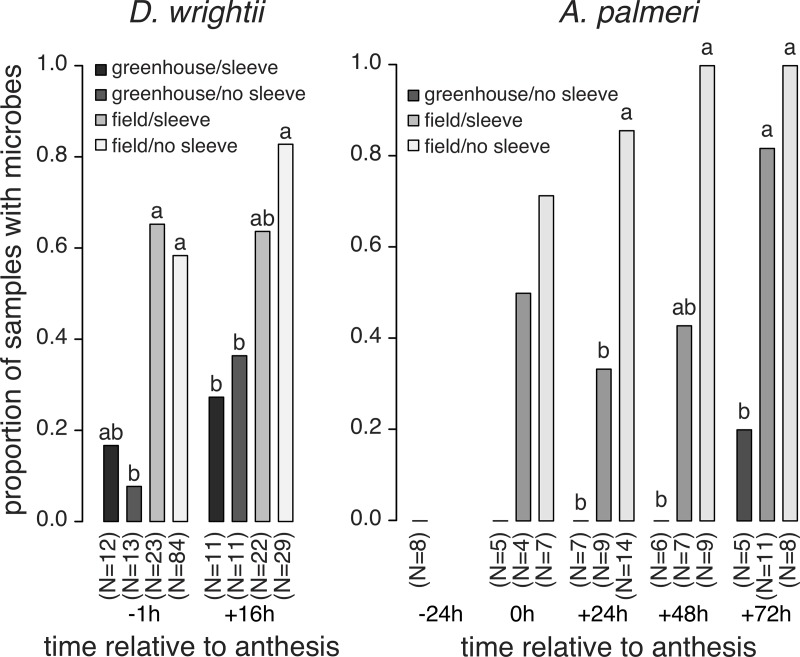
Fig 1
Fig 1. Proportion of D. wrightii and A. palmeri flowers containing nectar microbes (bacteria and fungi; one nectar sample per flower).
Nectar was collected from plants in field or greenhouse environments, at different time points relative to anthesis, and with or without exclusion of flower visitors ("sleeve", "no sleeve"). Different letters assigned within a time category indicate statistically significant differences (Tukey HSD, p < 0.05).
Fig 2
Fig 2. Concentration of colony forming units (CFU) in D. wrightii nectar collected before and after anthesis from plants with and without flower visitor exclusion (N = 14, 47, 12, 24 for -1 h/sleeve, -1 h/no sleeve, +16 h/sleeve and +16 h/no sleeve, respectively).
Different letters indicate significant differences (Tukey HSD, p < 0.05).
Fig 3
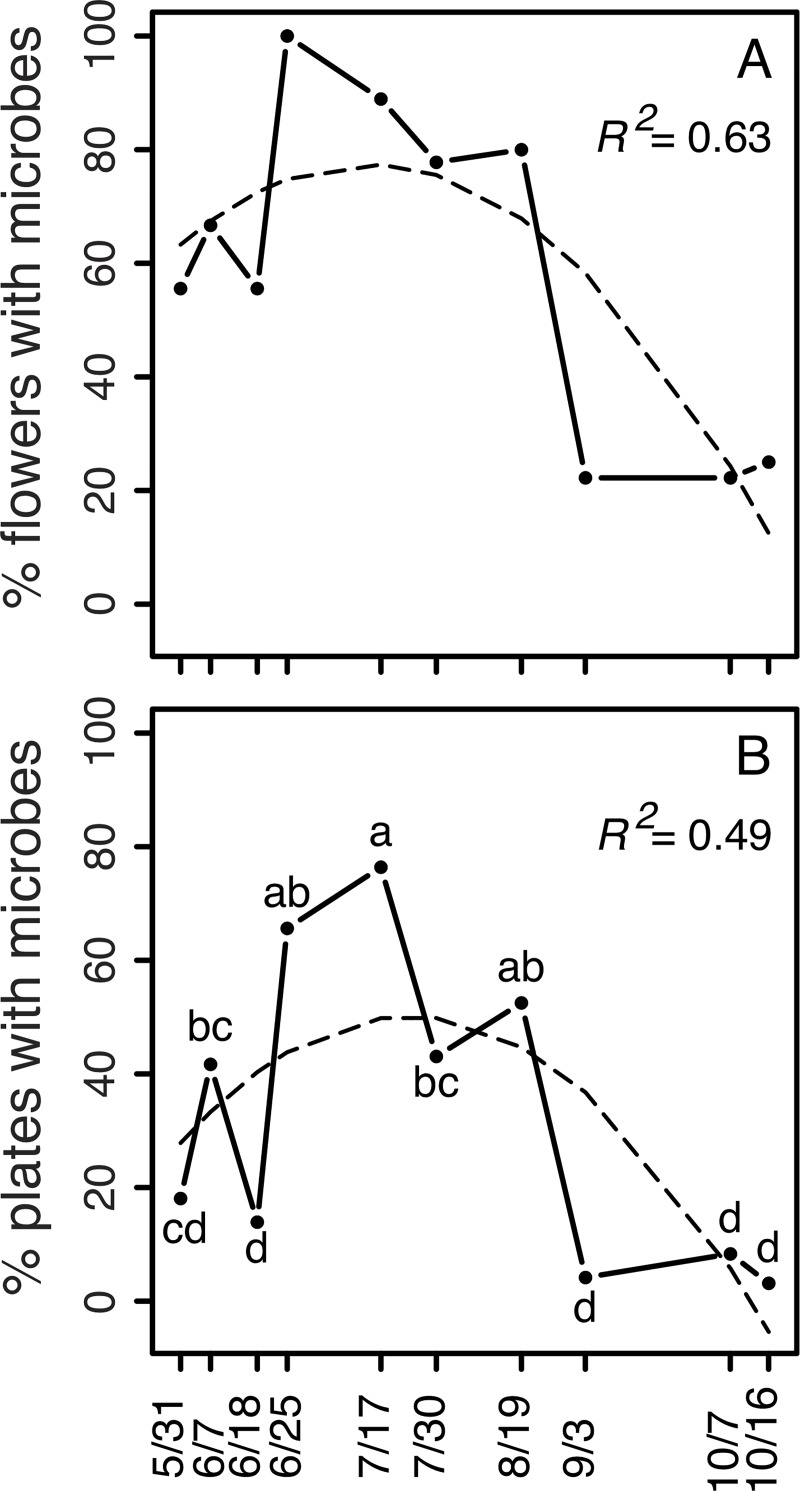
Fig 3. Change in abundance of nectar microbes in D. wrightii flowers during one flowering season (31 May (5/31)– 16 October (10/16), 2013).
Nectar was collected from plants in the field 1 h before anthesis and without exclusion of flower visitors. (A) Proportion of D. wrightii nectar samples with microbes (N = 9 each, except for 25 June, 19 August and 16 October, with N = 8, 5, and 8, respectively). (B) Proportion of agar plates showing microbe growth (N = 72 each, except for 25 June, 19 August and 16 October, with N = 64, 40, and 64, respectively). Dashed lines describe second-order polynomial regressions. Different letters indicate significant differences between collection dates (GLM, p < 0.05).
Fig 4
Fig 4. Concentration of colony forming units in A. palmeri nectar.
(A) CFU concentration in the nectar of 0, 1, 2, and 3 d old A. palmeri flowers with flower visitor exclusion (N = 2, 3, 3, and 7, respectively). (B) CFU concentration in the nectar of 0, 1, 2, and 3 d old A. palmeri flowers without flower visitor exclusion (N = 5, 12, 8, and 8, respectively).
Fig 5
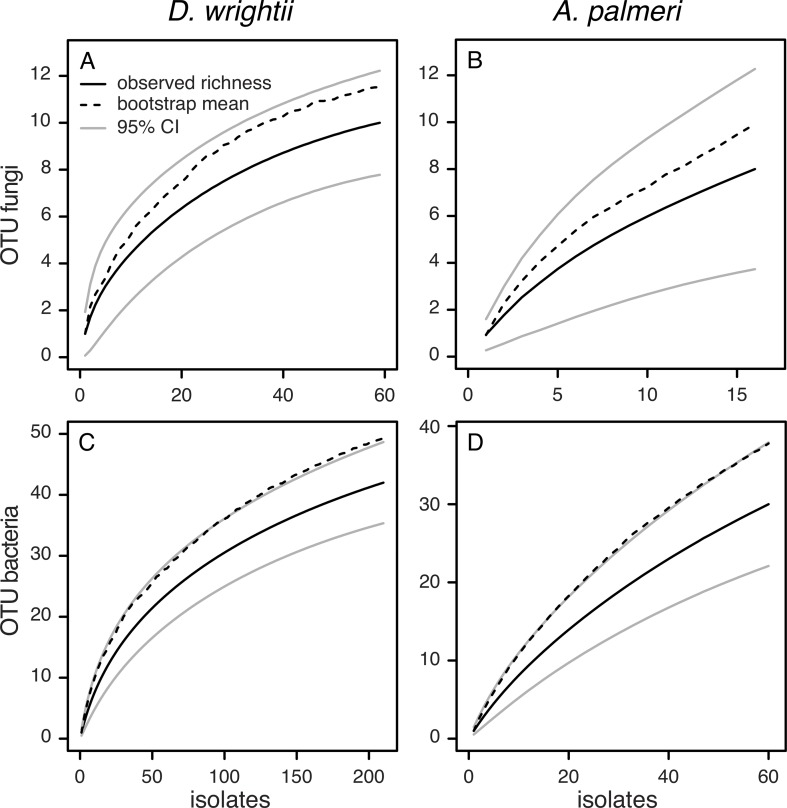
Fig 5. Richness of nectar microbes in D. wrightii and A. palmeri flowers.
(A) Species accumulation curve for fungi in D. wrightii nectar samples (N = 59 isolates). (B) Species accumulation curve for fungi in A. palmeri nectar samples (N = 16 isolates). (C) Species accumulation curve for bacteria in D. wrightii nectar samples (N = 210 isolates). (D) Species accumulation curve for bacteria in A. palmeri nectar samples (N = 60 isolates). Figures show the number of fungi and bacteria species observed (here estimated as OTU) (Mao Tau; black lines), lower and upper 95% confidence intervals (light gray lines), and bootstrap estimate of richness (dashed lines).
Fig 6
Fig 6. Community analysis of nectar microbe communities for D. wrightii and A. palmeri.
Figure shows the results of non-metric multidimensional scaling based on Jaccard's index computed with non-singleton OTU only, and ANOSIM results for (A) bacterial (N = 31 and 47 for A. palmeri and D. wrightii, respectively) and (B) for fungal communities (N = 8 and 39 for A. palmeri and D. wrightii, respectively).

References

    1. Vannette RL, Gauthier M-PL, Fukami T. Nectar bacteria, but not yeast, weaken a plant-pollinator mutualism. Proc R Soc London B Biol Sci. 2013;280: 20122601. - PMC - PubMed
    1. Vannette RL, Fukami T. Contrasting effects of yeasts and bacteria on floral nectar traits. Ann Bot. 2018;121: 1343–1349. 10.1093/aob/mcy032 - DOI - PMC - PubMed
    1. Herrera CM, De Vega C, Canto A, Pozo MI. Yeasts in floral nectar: a quantitative survey. Ann Bot. 2009;103: 1415–1423. 10.1093/aob/mcp026 - DOI - PMC - PubMed
    1. Álvarez-Pérez S, Herrera CM, De Vega C. Zooming in on nectar: a first exploration of nectar-associated bacteria in wild plant communities. FEMS Microbiol Ecol. 2012;80: 591–602. 10.1111/j.1574-6941.2012.01329.x - DOI - PubMed
    1. Eisikowitch D, Kevan PG, Lachance MA. The nectar-inhabiting yeasts and their effect on pollen germination in common milkweed, Asclepias syriaca L. Isr J Bot. 1990;39: 217–225.

Publication types