Review
. 2020 Feb 1;20(1):foz084.
doi: 10.1093/femsyr/foz084.

Tasting the terroir of wine yeast innovation

Affiliations
Review

Tasting the terroir of wine yeast innovation

I S Pretorius. FEMS Yeast Res. .

Abstract

Wine is an archetypal traditional fermented beverage with strong territorial and socio-cultural connotations. Its 7000 year history is patterned by a tradition of innovation. Every value-adding innovation - whether in the vineyard, winery, supply chain or marketplace - that led to the invention of a new tradition spurred progress and created a brighter future from past developments. In a way, wine traditions can be defined as remembered innovations from the distant past - inherited knowledge and wisdom that withstood the test of time. Therefore, it should not be assumed a priori that tradition and innovation are polar opposites. The relations between the forces driven by the anchors of tradition and the wings of innovation do not necessarily involve displacement, conflict or exclusiveness. Innovation can strengthen wine tradition, and the reinvention of a tradition-bound practice, approach or concept can foster innovation. In cases where a paradigm-shifting innovation disrupts a tradition, the process of such an innovation transitioning into a radically new tradition can become protracted while proponents of divergent opinions duke it out. Sometimes these conflicting opinions are based on fact, and sometimes not. The imperfections of such a debate between the 'ancients' and the 'moderns' can, from time to time, obscure the line between myth and reality. Therefore, finding the right balance between traditions worth keeping and innovations worth implementing can be complex. The intent here is to harness the creative tension between science fiction and science fact when innovation's first-principles challenge the status quo by re-examining the foundational principles about a core traditional concept, such as terroir. Poignant questions are raised about the importance of the terroir (biogeography) of yeasts and the value of the microbiome of grapes to wine quality. This article imagines a metaphorical terroir free from cognitive biases where diverse perspectives can converge to uncork the effervescent power of territorial yeast populations as well as 'nomadic' yeast starter cultures. At the same time, this paper also engages in mental time-travel. A future scenario is imagined, explored, tested and debated where terroir-less yeast avatars are equipped with designer genomes to safely and consistently produce, individually or in combination with region-specific wild yeasts and or other starter cultures, high-quality wine according to the preferences of consumers in a range of markets. The purpose of this review is to look beyond the horizon and to synthesize a link between what we know now and what could be. This article informs readers where to look without suggesting what they must see as a way forward. In the context of one of the world's oldest fermentation industries - steeped in a rich history of tradition and innovation - the mantra here is: respect the past, lead the present and secure the future of wine.

Keywords: Saccharomyces cerevisiae; avatar yeast; biogeography; microbial terroir; microbiome; non-Saccharomyces; synthetic genomics; wine yeast; yeastome.


Figures

Figure 1.
Figure 1.
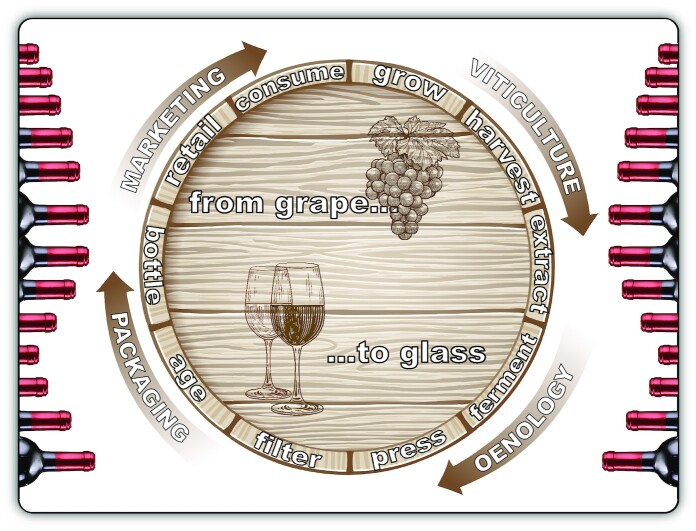
The from-grapes-to-glass value chain in wine production. The traditional production-driven view of the supply chain has been largely replaced by a more innovative market-driven approach. This new mindset among contemporary vintners has placed their products in the high-tension field between the forces of market-pull and technology-push, where tradition and innovation must co-exist.
Figure 2.
Figure 2.
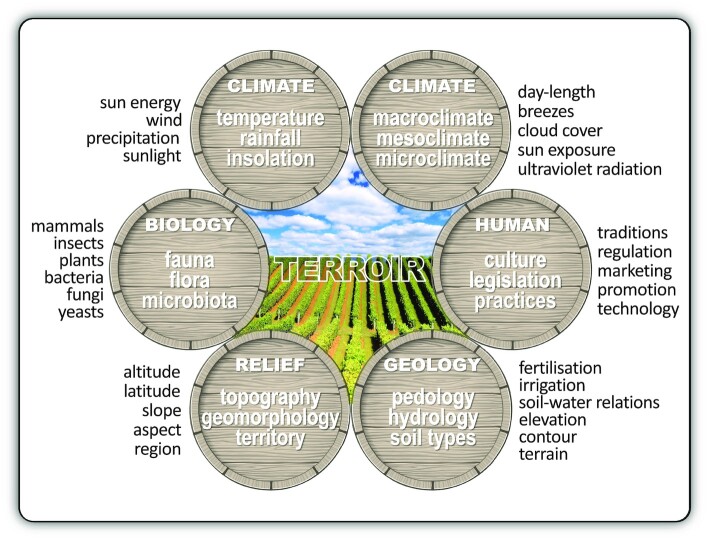
The concept of terroir in wine production. Terroir entails the total natural environment for specific viticultural sites, including climate as measured by temperature and rainfall; sunlight energy (or insolation) received per unit of land surface area; relief (topography or geomorphology) comprising altitude, slope and aspect; geology and pedology, determining the basic physical and chemical characteristics of various soil types; and hydrology or soil-water relations.
Figure 3.
Figure 3.
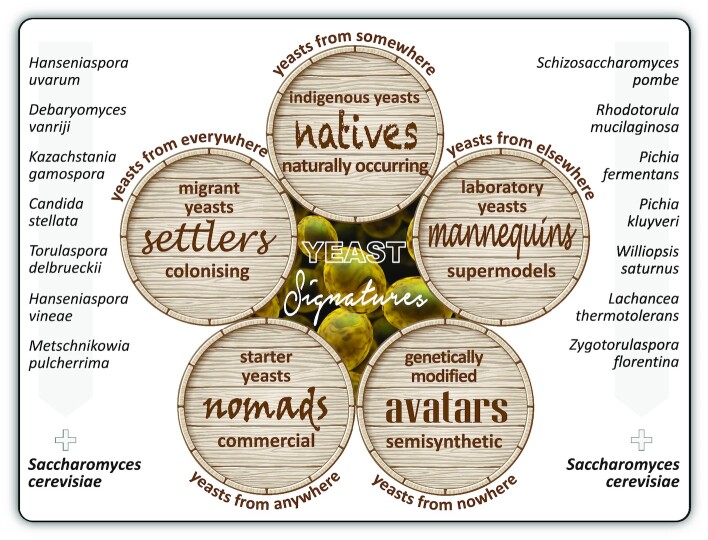
Yeast imprints on the sensory profile of wine. A diverse range of flavour-active yeasts can contribute to the overall quality of a wine. Flavour-active yeast types that might constitute a specific yeastome relevant to wine quality can include the following kinds of yeasts: The indigenous Saccharomyces and non-Saccharomyces yeasts inhabiting a niche vineyard are referred to as natives and yeasts that migrated and accumulated in a winery are referred to as settlers. Commercial active-dried yeast starter strains used in many wineries across the world are referred to as nomads. Laboratory-bred strains of S. cerevisiae are termed supermodel mannequins while genetically engineered and semisynthetic yeasts with reinvented or edited genomes are called avatars. The following sections explore the importance of residential natives (indigenous yeasts from somewhere), colonising settlers (migrant yeasts from everywhere), imported nomads (commercial starter yeasts from anywhere), prototypical mannequins (quintessential model yeasts from elsewhere) and alien avatars (genetically modified yeasts from nowhere) in terms of our understanding of their role in current wine ferments or potential role in future winemaking practices.
Figure 4.
Figure 4.
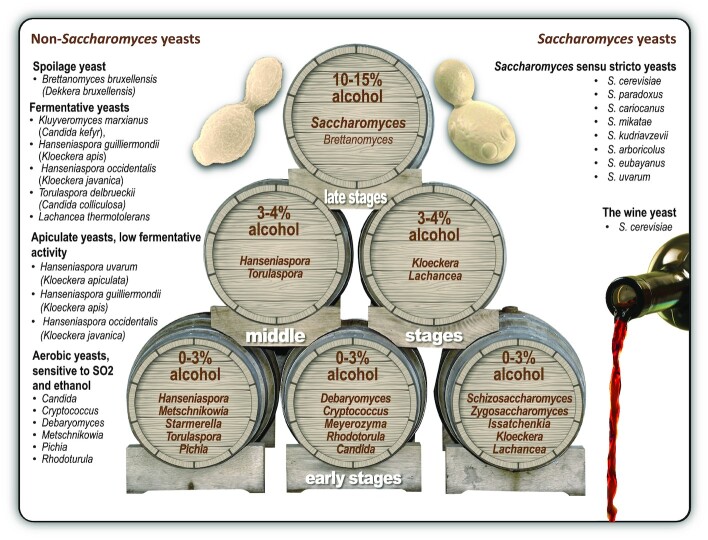
The sequential participation of various yeast species during wine fermentation. The selective pressures prevailing in fermenting grape must (e.g. sugar-induced osmotic pressure), fermentation conditions (e.g. temperature and pH) and winemaking practices (e.g. sulfite additions) inhibit and/or eliminate non-Saccharomyces yeast species during the course of fermentation. The selective nature of grape must becomes more pronounced once anaerobic conditions are established, nutrients become depleted and rising alcohol levels start to constrain the survival of ethanol-sensitive yeasts. This diagram is adapted from Pretorius (2017b).
Figure 5.
Figure 5.
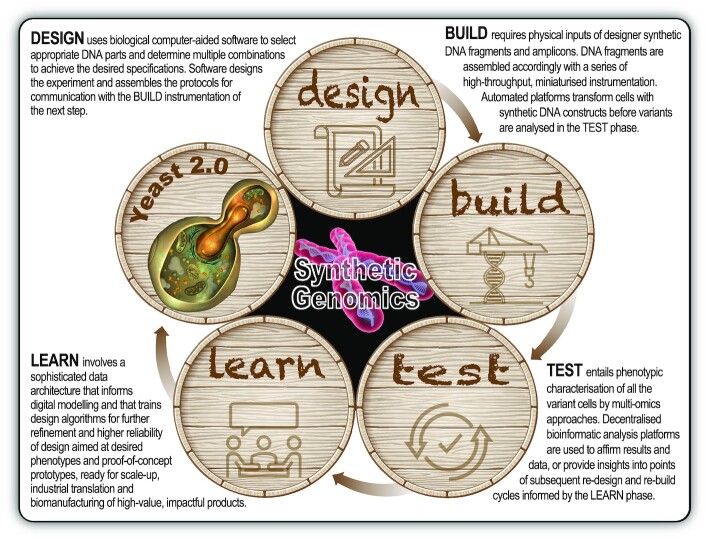
The design-build-test-learn (DBTL) biological engineering cycle. Application of the DBTL cycle can be accelerated in high-throughput, automated biofoundries with robotic workflows and technology platforms in Synthetic Biology. Recent rapid advances in high-throughput DNA sequencing (reading) and DNA synthesis (writing and editing) techniques are enabling the design and construction of new biological parts (genes), devices (gene networks) and modules (biosynthetic pathways), and the redesign of biological systems (cells and organisms) for useful purposes.
Figure 6.
Figure 6.
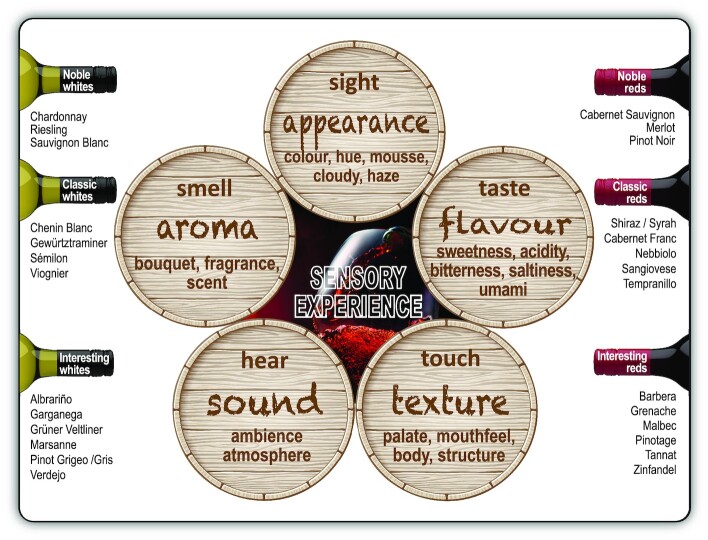
The sensorial quality of wine involves all five senses sight, smell, taste, touch and sound. The appearance of wine can be affected by cloudiness, haziness, a deposit in the bottom of the glass, and the depth of colour, hue, mousse). The smell of wine refers to both the aroma and the bouquet. A wine's palate, taste and touch refer to its flavour and mouth-feel.

References

    1. Alfred J, Baldwin IT. New opportunities at the wild frontier. eLife. 2015;4;06956. - PMC - PubMed
    1. Almeida P, Barbosa R, Zalar Pet al. .. A population genomics insight into Mediterranean origins of wine yeast domestication. Mol Ecol. 2015;24:5412–27. - PubMed
    1. Anfang N, Brajkovich M, Goddard MR. Co-fermentation with Pichia kluyveri increases varietal thiol concentrations in Sauvignon Blanc. Aust J Grape Wine Res. 2009;15:1–8.
    1. Annaluru N, Muller H, Mitchell LAet al. .. Total synthesis of a functional designer eukaryotic chromosome. Science. 2014;344:55–8. - PMC - PubMed
    1. Belda I, Ruiz J, Alastruey-Izquierdo Aet al. .. Unraveling the enzymatic basis of wine “flavorome”: A phylo-functional study of wine related yeast species. Frontier Microbiol. 2016a;7;1–13. - PMC - PubMed

Publication types