Relationships between addictive Facebook use, depressiveness, insomnia, and positive mental health in an inpatient sample: A German longitudinal study
- PMID: 31830811
- PMCID: PMC7044577
- DOI: 10.1556/2006.8.2019.63
Relationships between addictive Facebook use, depressiveness, insomnia, and positive mental health in an inpatient sample: A German longitudinal study
Abstract
Background and aims: Individuals with high level of negative mental health often tend to use the social platform Facebook to escape from daily stress. They are at risk to develop an emotional bond to Facebook linked to a need to stay permanently online. The current work investigated addictive use of Facebook and its conceptual framework in clinical context.
Methods: In a longitudinal study design, duration of daily use of Facebook, addictive Facebook use, depressiveness, insomnia, and positive mental health (PMH) were assessed in a sample of 349 inpatients [Mage (SDage) = 50.13 (9.41)] of a psychosomatic rehabilitation clinic in Germany over a period of on average 6 weeks.
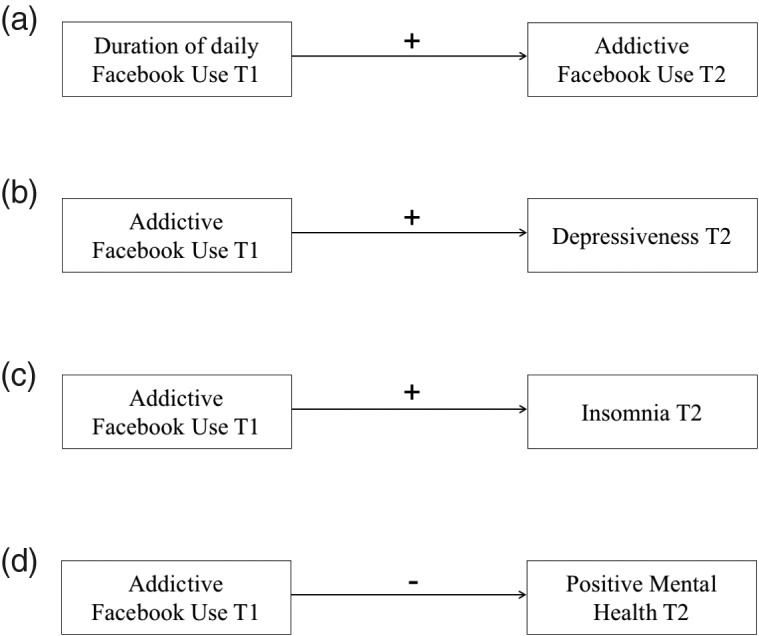
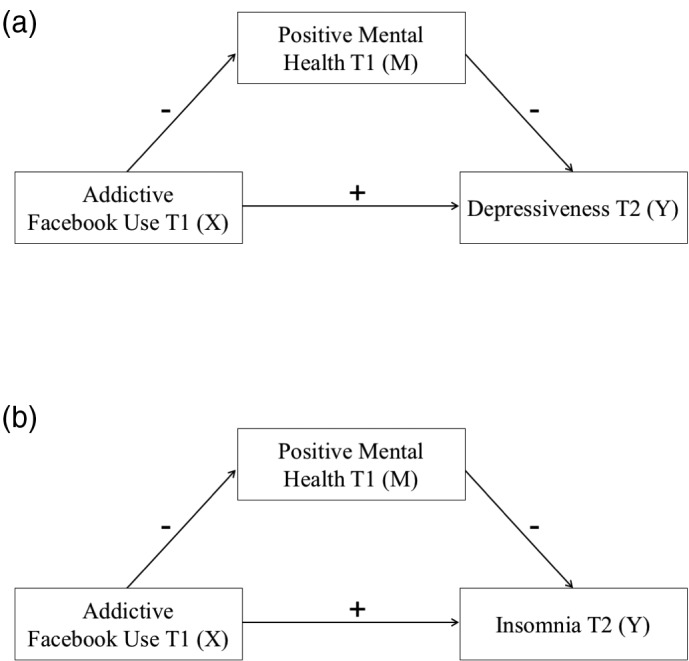
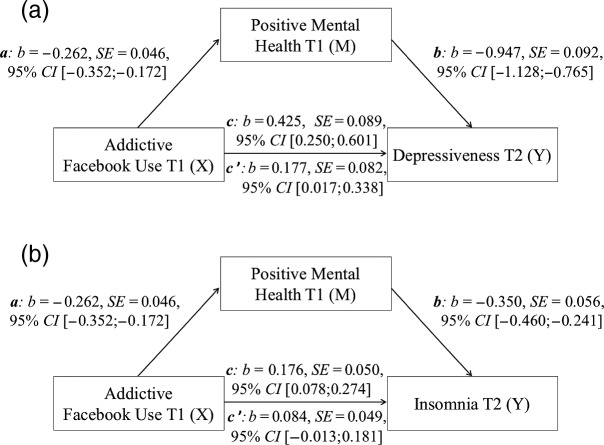
Results: Regression analyses revealed that duration of daily Facebook use at the first measurement time point (T1) served as significant positive predictor of addictive Facebook use at the second measurement time point (T2). Addictive Facebook use (T1) significantly positively predicted depressiveness and insomnia (T2). Its prediction of PMH (T2) was significantly negative. Mediation analyses showed that PMH (T1) partially mediated the association between addictive Facebook use (T1) and depressiveness (T2), and fully mediated the relationship between addictive Facebook use (T1) and insomnia (T2).
Discussion and conclusions: Current longitudinal results indicate that addictive Facebook use might negatively impact the recovery process of inpatients. Thus, it might be relevant to assess and consider addictive Facebook use in the clinical context. Therapeutic interventions are suggested to focus on the enhancement of inpatients' PMH level, which may buffer the negative effect of problematic Facebook use.
Keywords: addictive Facebook use; depressiveness; duration of daily Facebook use; insomnia; longitudinal study; positive mental health.
Figures
References
-
- Alhabash S., Ma M. (2017). A tale of four platforms: Motivations and uses of Facebook, Twitter, Instagram, and Snapchat among college students? Social Media + Society, 3(1), 1–13. doi:10.1177/2056305117691544 - DOI
-
- American Psychiatric Association. (2013). Diagnostic and statistical manual of mental disorders (5th ed.). Washington, DC: American Psychiatric Association.
-
- Andreassen C. S., Billieux J., Griffiths M. D., Kuss D. J., Demetrovics Z., Mazzoni E., Pallesen S. (2016). The relationship between addictive use of social media and video games and symptoms of psychiatric disorders: A large-scale cross-sectional study. Psychology of Addictive Behaviors, 30(2), 252–262. doi:10.1037/adb0000160 - DOI - PubMed
MeSH terms
LinkOut - more resources
Full Text Sources
Medical