Review
. 2019 Dec 13;18(1):184.
doi: 10.1186/s12943-019-1117-9.

The reciprocal regulation between host tissue and immune cells in pancreatic ductal adenocarcinoma: new insights and therapeutic implications

Affiliations
Review

The reciprocal regulation between host tissue and immune cells in pancreatic ductal adenocarcinoma: new insights and therapeutic implications

Xiaomeng Liu et al. Mol Cancer. .

Abstract

Pancreatic ductal adenocarcinoma (PDAC) is the fourth leading cause of cancer-related death and is one of the most difficult-to-treat cancers. Surgical resection and adjuvant therapy have limited effects on the overall survival of PDAC patients. PDAC exhibits an immunosuppressive microenvironment, the immune response predicts survival, and activation of immune system has the potential to produce an efficacious PDAC therapy. However, chimeric antigen receptor T (CAR-T) cell immunotherapy and immune checkpoint blockade (ICB), which have produced unprecedented clinical benefits in a variety of different cancers, produce promising results in only some highly selected patients with PDAC. This lack of efficacy may be because existing immunotherapies mainly target the interactions between cancer cells and immune cells. However, PDAC is characterized by an abundant tumor stroma that includes a heterogeneous mixture of immune cells, fibroblasts, endothelial cells, neurons and some molecular events. Immune cells engage in extensive and dynamic crosstalk with stromal components in the tumor tissue in addition to tumor cells, which subsequently impacts tumor suppression or promotion to a large extent. Therefore, exploration of the interactions between the stroma and immune cells may offer new therapeutic opportunities for PDAC. In this review, we discuss how infiltrating immune cells influence PDAC development and explore the contributions of complex components to the immune landscape of tumor tissue. The roles of stromal constituents in immune modulation are emphasized. We also predict potential therapeutic strategies to target signals in the immune network in the abundant stromal microenvironment of PDAC.

Keywords: Immune infiltrate; Immunotherapy; Pancreatic ductal adenocarcinoma; Stromal cells.


Conflict of interest statement

The authors declare that they have no competing interests.

Figures
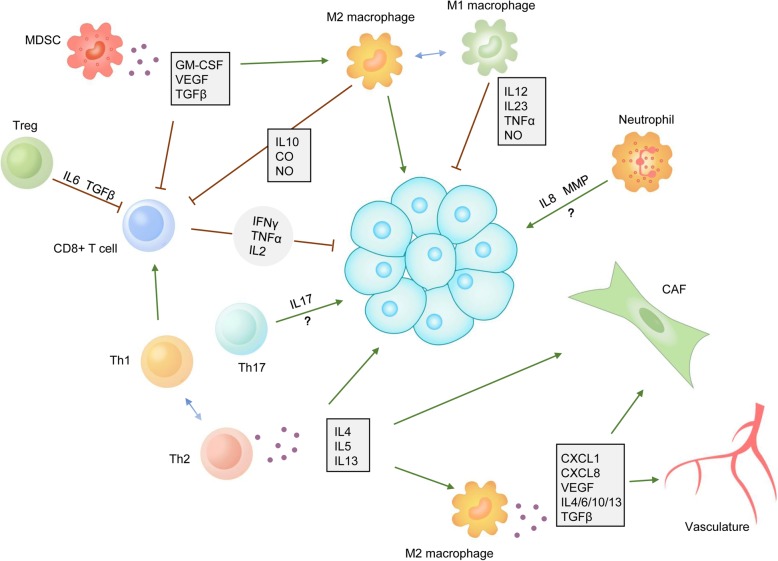
Fig. 1
Fig. 1
Immune infiltration contributes to PDAC outcomes. PDAC tumor tissue has complex interactions with multiple immune cells, mainly T cells, MDSCs, macrophages and neutrophils. CD8+ T cells eliminate cancer cells by releasing IFNγ and TNFα. CD4+ T cells can be divided into Th1, Th2, and Th17 cells and Tregs. Th1 cells assist CD8+ T cells in antitumor immunity. Th2 cells, which can be reversed into Th1 cells, can drive cancer cell growth and fibroblast activation and can promote the transition of the M1 macrophage into the M2 phenotype. The function of Th17 cells is still not clear, but the functions of these cells mainly depend on IL-17. Tregs inhibit the cytotoxic function of CD8+ T cells via IL-6 and TGFβ. Both MDSCs and M2 macrophages suppress CD8+ T cell functions through the secretion of cytokines. M1 macrophages have antitumor functions that are mediated by releasing IL-12, IL-23, TNFα and NO. M2 macrophages promote tumor progression by secreting cytokines to affect tumor cells, fibroblasts and the vasculature. The role of neutrophils is not clear, but it is known that these cells can exert effects through IL-6 and MMP
Fig. 2
Fig. 2
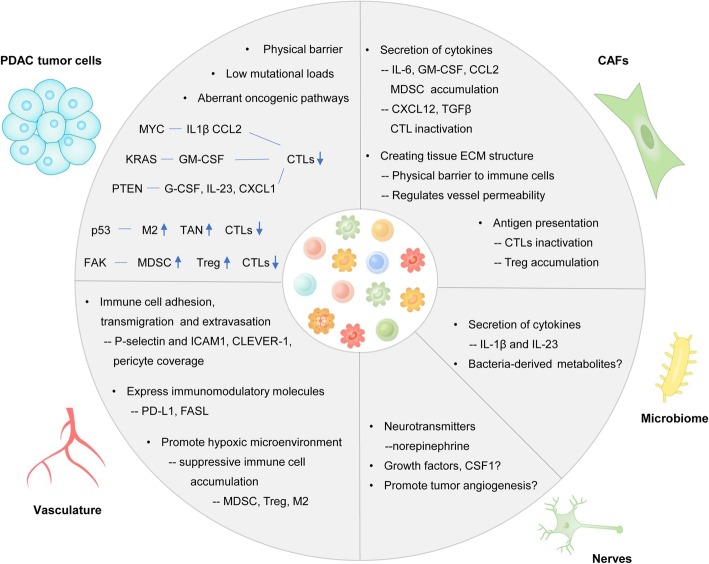
Immune landscape is shaped by tumor tissue components. PDAC tumor cells exert influence on immune infiltration in three ways: establishment of a physical barrier by cellular adhesion and the basal lamina; development of mutational loads; and activation of aberrant oncogenic pathways. Blood vessels control the immune cell composition by affecting immune cell adhesion, transmigration and extravasation. The vascular system also expresses immunomodulatory molecules and provides a hypoxic microenvironment to suppress immune cell accumulation. CAFs mainly modulate the immune microenvironment via cytokine secretion, impacting the ECM structure of the tissue and antigen presentation. The microbiome and nerve fibers can secrete cytokines and neurotransmitters to affect the immune landscape. However, their mechanisms require further exploration
Fig. 3
Fig. 3
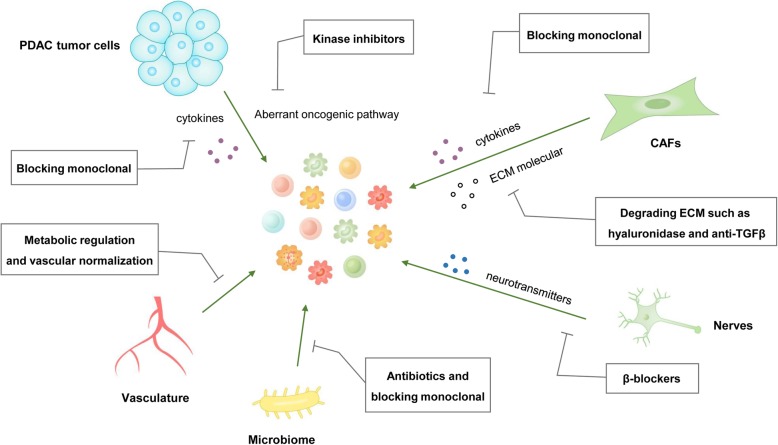
Therapeutic implications of targeting host tissue to activate immune cell infiltration. Implications of therapies that target host tissue, including signaling pathway inhibition, cytokine neutralization, ECM degradation, vascular normalization, antibiotics and β-blockers

References

    1. Siegel RL, Miller KD, Jemal A. Cancer statistics, 2018. CA Cancer J Clin. 2018;68:7–30. doi: 10.3322/caac.21442. - DOI - PubMed
    1. Bray Freddie, Ferlay Jacques, Soerjomataram Isabelle, Siegel Rebecca L., Torre Lindsey A., Jemal Ahmedin. Global cancer statistics 2018: GLOBOCAN estimates of incidence and mortality worldwide for 36 cancers in 185 countries. CA: A Cancer Journal for Clinicians. 2018;68(6):394–424. - PubMed
    1. Ryan DP, Hong TS, Bardeesy N. Pancreatic adenocarcinoma. N Engl J Med. 2014;371:1039–1049. doi: 10.1056/NEJMra1404198. - DOI - PubMed
    1. Garrido-Laguna I, Hidalgo M. Pancreatic cancer: from state-of-the-art treatments to promising novel therapies. Nat Rev Clin Oncol. 2015;12:319–334. doi: 10.1038/nrclinonc.2015.53. - DOI - PubMed
    1. Ribas A, Wolchok JD. Cancer immunotherapy using checkpoint blockade. Science. 2018;359:1350–1355. doi: 10.1126/science.aar4060. - DOI - PMC - PubMed

Publication types

MeSH terms