


Localized Dielectric Loss Heating in Dielectrophoresis Devices
- PMID: 31831755
- PMCID: PMC6908616
- DOI: 10.1038/s41598-019-55031-y
Localized Dielectric Loss Heating in Dielectrophoresis Devices
Abstract
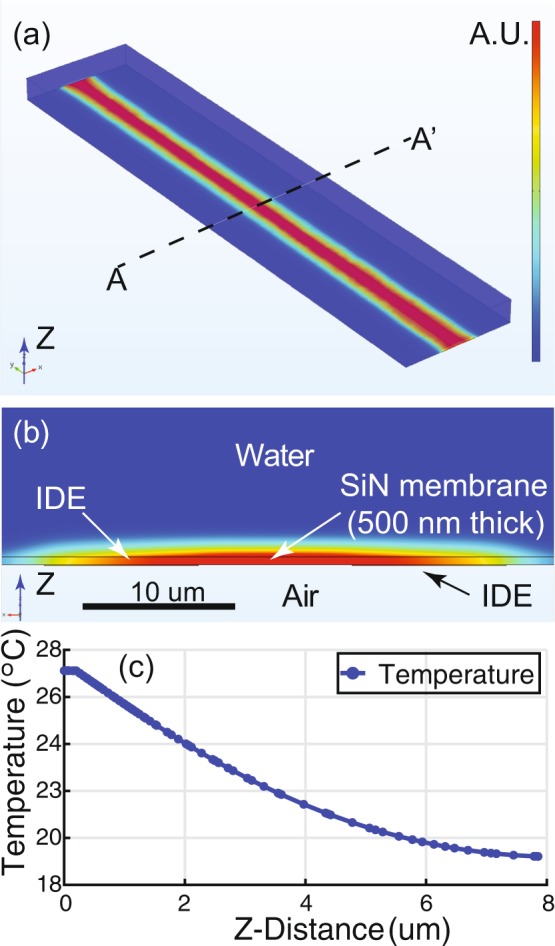
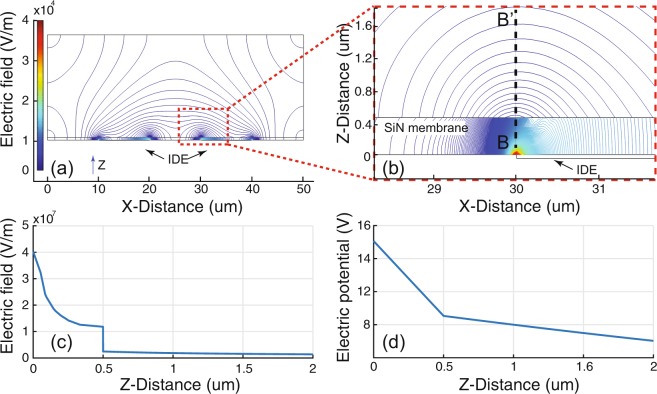
Temperature increases during dielectrophoresis (DEP) can affect the response of biological entities, and ignoring the effect can result in misleading analysis. The heating mechanism of a DEP device is typically considered to be the result of Joule heating and is overlooked without an appropriate analysis. Our experiment and analysis indicate that the heating mechanism is due to the dielectric loss (Debye relaxation). A temperature increase between interdigitated electrodes (IDEs) has been measured with an integrated micro temperature sensor between IDEs to be as high as 70 °C at 1.5 MHz with a 30 Vpp applied voltage to our ultra-low thermal mass DEP device. Analytical and numerical analysis of the power dissipation due to the dielectric loss are in good agreement with the experiment data.
Conflict of interest statement
The authors declare no competing interests.
Figures
References
-
- Van Rijn J, Van den Berg J, Souren J, Van Wijk R, Joenje H. Hepatoma cells adapted to proliferate under normally lethal hyperthermic stress conditions show rapid decay of thermoresistance and heat shock protein synthesis when returned to 37 c. Int. journal hyperthermia. 1995;11:697–708. doi: 10.3109/02656739509022501. - DOI - PubMed
Publication types
LinkOut - more resources
Full Text Sources
Miscellaneous
