


Bioinformatics Strategies, Challenges, and Opportunities for Next Generation Sequencing-Based HLA Genotyping
- PMID: 31832057
- PMCID: PMC6876610
- DOI: 10.1159/000502487
Bioinformatics Strategies, Challenges, and Opportunities for Next Generation Sequencing-Based HLA Genotyping
Abstract
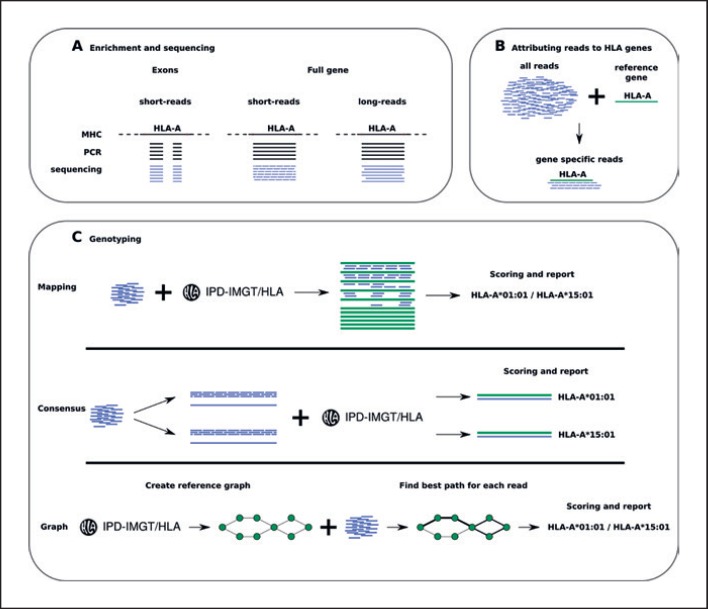
The advent of next generation sequencing (NGS) has altered the face of genotyping the human leukocyte antigen (HLA) system in clinical, stem cell donor registry, and research contexts. NGS has led to a dramatically increased sequencing throughput at high accuracy, while being more time and cost efficient than precursor technologies. This has led to a broader and deeper profiling of the key genes in the human immunogenetic make-up. The rapid evolution of sequencing technologies is evidenced by the development of varied short-read sequencing platforms with differing read lengths and sequencing capacities to long-read sequencing platforms capable of profiling full genes without fragmentation. Concomitantly, there has been development of a diverse set of computational analyses and software tools developed to deal with the various strengths and limitations of the sequencing data generated by the different sequencing platforms. This review surveys the different modalities involved in generating NGS HLA profiling sequence data. It systematically describes various computational approaches that have been developed to achieve HLA genotyping to different degrees of resolution. At each stage, this review enumerates the drawbacks and advantages of each of the platforms and analysis approaches, thus providing a comprehensive picture of the current state of HLA genotyping technologies.
Keywords: Genotyping; Human leukocyte antigen; Next generation sequencing.
Copyright © 2019 by S. Karger AG, Basel.
Conflict of interest statement
The authors have no conflicts of interest to declare.
Figures
References
-
- Lee SJ, Klein J, Haagenson M, Baxter-Lowe LA, Confer DL, Eapen M, et al. High-resolution donor-recipient HLA matching contributes to the success of unrelated donor marrow transplantation. Blood. 2007 Dec;110((13)):4576–83. - PubMed
-
- Loiseau P, Busson M, Balere ML, Dormoy A, Bignon JD, Gagne K, et al. HLA Association with hematopoietic stem cell transplantation outcome: the number of mismatches at HLA-A, -B, -C, -DRB1, or -DQB1 is strongly associated with overall survival. Biol Blood Marrow Transplant. 2007 Aug;13((8)):965–74. - PubMed
Publication types
LinkOut - more resources
Full Text Sources
Other Literature Sources
Research Materials
