Biomechanical and Morphologic Effects of Collagen Cross-Linking in Human Tarsus
- PMID: 31832279
- PMCID: PMC6900964
- DOI: 10.1167/tvst.8.6.25
Biomechanical and Morphologic Effects of Collagen Cross-Linking in Human Tarsus
Abstract
Purpose: To investigate the feasibility of increasing the stiffness of human tarsal tissue following treatment with riboflavin and ultraviolet A (UVA) to induce cross-linking of collagen fibers.
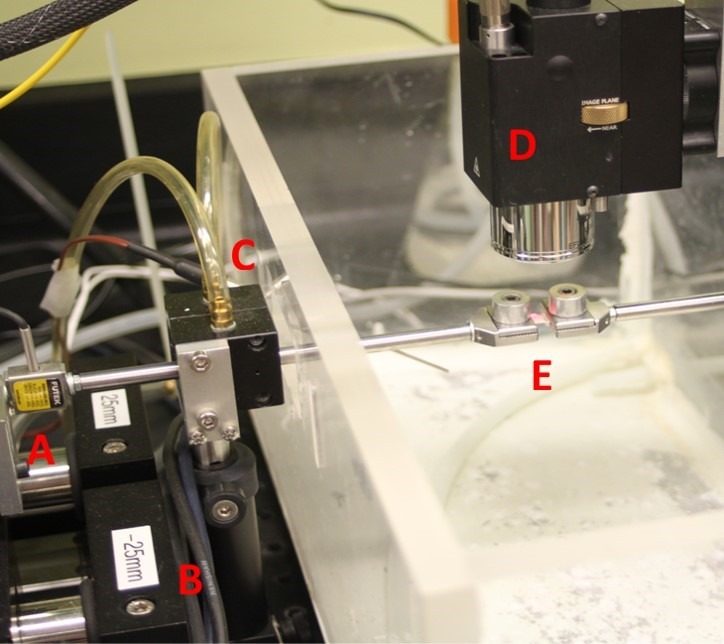
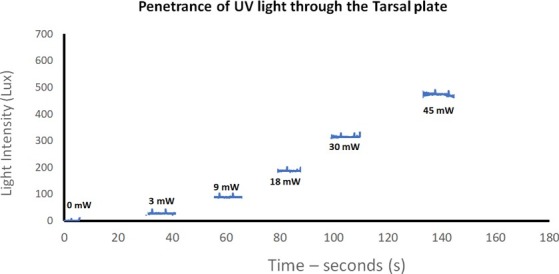
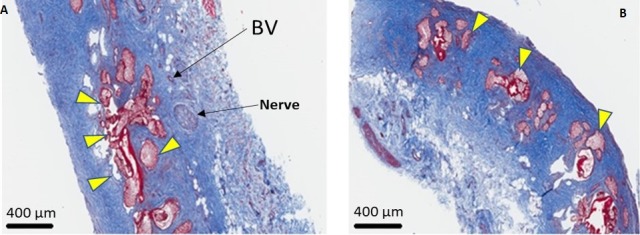
Methods: In this case control study, 18 right and left upper eyelids were excised en bloc from 18 fresh-frozen cadavers. One side served as the control while the samples from the opposite side were cross-linked. Four 2 × 6-mm vertical strips of central tarsus were cut from the superior to inferior border of each tarsal plate. Sample tissue was irradiated with UVA at 6 mW/cm2 for 18 minutes. A microtensile load cell and an optical coherence tomography scanner allowed calculation of stiffness (Young's modulus). Six cross-linked samples and corresponding controls were stained with hematoxylin and eosin (H&E) and Masson trichrome stains. Four controls and four cross-linked samples were also reviewed with a transmission electron microscope.
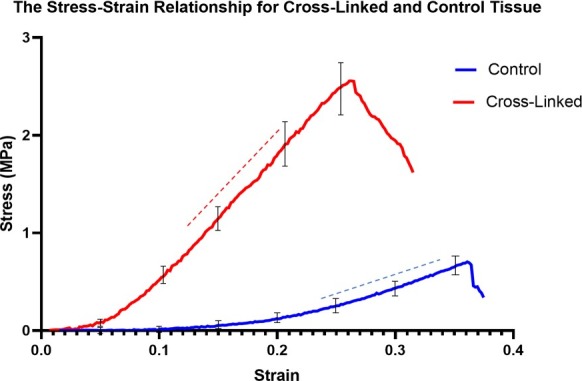
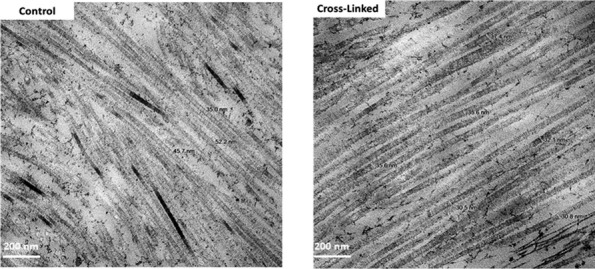
Results: Mean Young's modulus in the linear region for controls was 28 ± 9 MPa and was much higher at 138 ± 8 MPa for cross-linked samples (P < 0.001), yielding a 493% mean stiffness increase. Staining with H&E and Masson did not reveal any histologic changes. Transmission electron microscopy showed a decrease in average diameter of 50 randomly selected collagen fibers from 47.2 ± 1.9 nm prior to cross-linking to 34.2 ± 1.1 nm post cross-linking (P < 0.001). Qualitatively, the collagen fibers appeared more closely packed following cross-linking.
Conclusions: The findings of this study suggest that collagen cross-linking is a viable and effective modality for increasing the stiffness of human tarsal plates.
Translational relevance: This work provides proof that collagen cross-linking produces stiffening of the human tarsal plate and may be used in disorders that cause eyelid laxity.
Keywords: cross-linking; floppy eyelids; tarsus.
Copyright 2019 The Authors.
Figures
References
-
- Sisler HA, Labay GR, Finlay JR. Senile ectropion and entropion: a comparative histopathological study. Ann Ophthalmol. 1976;8:319–322. - PubMed
-
- Marshall JA, Valenzuela AA, Strutton GM, Sullivan TJ. Anterior lamella actinic changes as a factor in involutional eyelid malposition. Ophthalmic Plast Reconstr Surg. 2006;22:192–194. - PubMed
-
- Netland PA, Sugrue SP, Albert DM, Shore JW. Histopathologic features of the floppy eyelid syndrome: involvement of tarsal elastin. Ophthalmology. 1994;101:174–181. - PubMed
-
- Ezra DG, Beaconsfield M, Collin R. Floppy eyelid syndrome: stretching the limits. Surv Ophthalmol. 2010;55:35–46. - PubMed
-
- Schlötzer-Schrehardt U, Stojkovic M, Hofmann-Rummelt C, Cursiefen C, Kruse FE, Holbach LM. The pathogenesis of floppy eyelid syndrome: involvement of matrix metalloproteinases in elastic fiber degradation. Ophthalmology. 2005;112:694–704. - PubMed
Grants and funding
LinkOut - more resources
Full Text Sources
Research Materials