


Celiomesenteric trunk: New classification based on multidetector computed tomography angiographic findings and probable embryological mechanisms
- PMID: 31832400
- PMCID: PMC6906573
- DOI: 10.12998/wjcc.v7.i23.3980
Celiomesenteric trunk: New classification based on multidetector computed tomography angiographic findings and probable embryological mechanisms
Abstract
Background: In previous studies, celiomesenteric trunk (CMT) was narrowly defined as a hepato-gastro-spleno-mesenteric (HGSM) trunk, but other possible types were ignored. With the widespread use of multidetector computed tomography (MDCT) angiography, it is easy to collect a large sampling of data on arterial anatomy of the abdomen in daily radiological practice. A new classification system for CMT may be created based on its MDCT angiographic findings and variation patterns.
Aim: To identify the spectrum and prevalence of CMT according to a new classification based on MDCT angiographic findings, and discuss the probable embryological mechanisms to explain the CMT variants.
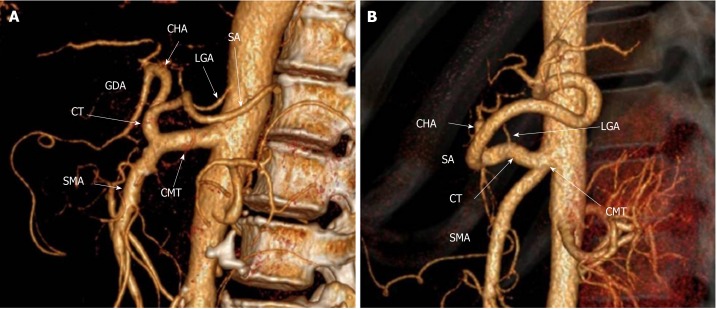
Methods: A retrospective study was carried out on 5580 abdominal MDCT angiography images. CMT was defined as a single common trunk arising from the aorta and its branches including the superior mesenteric artery and at least two major branches of the celiac trunk. Various types of CMT were investigated.
Results: Of the 5580 patients, 171 (3.06%) were identified as having CMT. According to the new definitions and classification, the CMT variants included five types: I, II, III, IV and V, which were found in 96 (56.14%), 57 (33.33%), 4 (2.34%), 3 (1.75%) and 8 (4.68%) patients, respectively. The CMT variants also were classified as long type (106 patients, 61.99%) and short type (65 patients, 38.01%) based on the length of single common trunk. Further CMT classification was based on the origin of the left gastric artery: Type a (92 patients, 53.80%), type b (57 patients, 33.33%), type c (11 patients, 6.43%) and type d (8 patients, 4.68%).
Conclusion: We systematically classified CMT variants according to our new classification system based on MDCT angiographic findings. Dislocation interruption, incomplete interruption and persistence of the longitudinal anastomosis could all be embryological mechanisms of various types of CMT variants.
Keywords: Anatomic variation; Celiac artery; Classification; Computed tomography angiography; Mesenteric artery; superior.
©The Author(s) 2019. Published by Baishideng Publishing Group Inc. All rights reserved.
Conflict of interest statement
Conflict-of-interest statement: None of the authors have conflicts of interest that are related to the work submitted for consideration for publication. There are no commercial, personal, intellectual, political or religious interests by any of the authors.
Figures


References
-
- Wang Y, Cheng C, Wang L, Li R, Chen JH, Gong SG. Anatomical variations in the origins of the celiac axis and the superior mesenteric artery: MDCT angiographic findings and their probable embryological mechanisms. Eur Radiol. 2014;24:1777–1784. - PubMed
-
- Song SY, Chung JW, Yin YH, Jae HJ, Kim HC, Jeon UB, Cho BH, So YH, Park JH. Celiac axis and common hepatic artery variations in 5002 patients: systematic analysis with spiral CT and DSA. Radiology. 2010;255:278–288. - PubMed
-
- Alakkam A, Hill RV, Saggio G. Superior mesenteric origin of the proper hepatic artery: embryological and clinical implications. Surg Radiol Anat. 2016;38:747–750. - PubMed
-
- Yan J, Nagasawa Y, Nakano M, Hitomi J. Origin of the celiac and superior mesenteric arteries in a common trunk: description of a rare vessel variation of the celiacomesenteric trunk with a literature review. Okajimas Folia Anat Jpn. 2014;91:45–48. - PubMed
-
- Iezzi R, Cotroneo AR, Giancristofaro D, Santoro M, Storto ML. Multidetector-row CT angiographic imaging of the celiac trunk: anatomy and normal variants. Surg Radiol Anat. 2008;30:303–310. - PubMed
LinkOut - more resources
Full Text Sources
