


Sulfur dioxide resistance in Saccharomyces cerevisiae: beyond SSU1
- PMID: 31832424
- PMCID: PMC6883346
- DOI: 10.15698/mic2019.12.699
Sulfur dioxide resistance in Saccharomyces cerevisiae: beyond SSU1
Abstract
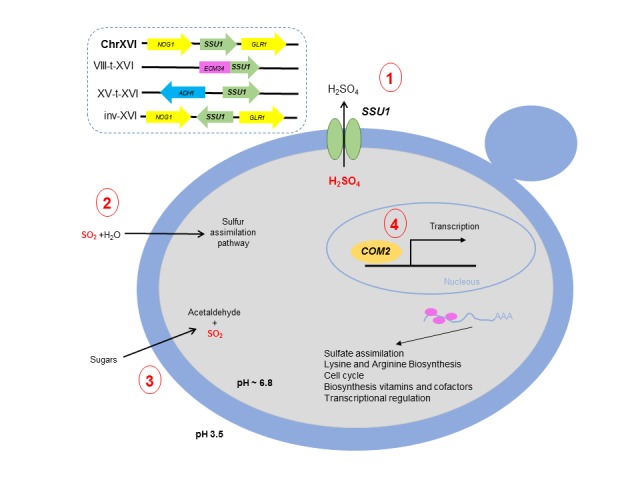
Sulfite resistance is an important oenological trait for wine yeasts because this compound is used during winemaking as a microbial inhibitor and antioxidant. The molecular mechanisms by which Saccharomyces cerevisiae responds and tolerates SO2 have been mainly focused on the sulfite efflux pump encoded by SSU1. Different chromosomal rearrangements in the regulatory region of this gene have been correlated with improved sulfite tolerance. However, other molecular factors must contribute to this trait because the SSU1 gene activity does not always fit with sulfite tolerance. An interesting approach to shed light onto this issue could be found by Lage et al. (2019). These authors have combined transcriptomic and genome-wide analysis to describe how the poorly characterized transcription factor Com2 controls, directly or indirectly, the expression of more than 80% of the genes activated by SO2. Additionally, large-scale phenotyping revealed the identification of 50 Com2-targets contributing to the protection against SO2. This information is very interesting for gaining knowledge regarding this important industrial trait.
Keywords: Com2; Saccharomyces cerevisiae; sulfur dioxide; wine.
Conflict of interest statement
Conflict of interest: The authors declare no conflict of interest.
Figures
Comment on
-
Transcriptomic and chemogenomic analyses unveil the essential role of Com2-regulon in response and tolerance of Saccharomyces cerevisiae to stress induced by sulfur dioxide.Microb Cell. 2019 Sep 30;6(11):509-523. doi: 10.15698/mic2019.11.697. Microb Cell. 2019. PMID: 31799324 Free PMC article.
References
-
- Legras J, Galeote V, Bigey F, Camarasa C, Marsit S, Nidelet T, Sanchez I, Couloux A, Guy J, Franco-duarte R, Marcet-houben M, Gabaldon T, Schuller D, Sampaio JP. Adaptation of S. cerevisiae to fermented food environments reveals remarkable genome plasticity and the footprints of domestication. Mol Biol Evol. 2018;35(May):1712–1727. doi: 10.1093/molbev/msy066. - DOI - PMC - PubMed
-
- Liti G, Carter DM, Moses AM, Warringer J, Parts L, James SA, Davey RP, Roberts IN, Burt A, Koufopanou V, Tsai IJ, Bergman CM, Bensasson D, O 'kelly MJT, Van Oudenaarden A, Barton DBH, Bailes E, Nguyen Ba AN, Jones M, Quail MA, Goodhead I, Sims S, Smith F, Blomberg A, Durbin R, Louis EJ. Population genomics of domestic and wild yeasts. Nature. 2009;458:337–341. doi: 10.1038/nature07743. - DOI - PMC - PubMed
-
- Almeida P, Barbosa R, Zalar P, Imanishi Y, Shimizu K, Turchetti B, Legras JL, Serra M, Dequin S, Couloux A, Guy J, Bensasson D, Gonçalves P, Sampaio JP. A population genomics insight into the Mediterranean origins of wine yeast domestication. Mol Ecol. 2015;24(21):5412–5427. doi: 10.1111/mec.13341. - DOI - PubMed
Publication types
LinkOut - more resources
Full Text Sources
Molecular Biology Databases