


Evaluation of factors associated with complications in amoebic liver abscess in a predominantly toddy-drinking population: A retrospective study of 198 cases
- PMID: 31832547
- PMCID: PMC6891022
- DOI: 10.1002/jgh3.12183
Evaluation of factors associated with complications in amoebic liver abscess in a predominantly toddy-drinking population: A retrospective study of 198 cases
Abstract
Background and aim: Although the mortality rate has declined in recent years, amoebic liver abscesses (ALAs) still carry a substantial risk of morbidity. Studies regarding the indicators of severity, complication, or prognosis of ALA are limited in number and heterogeneous in methodology and results.
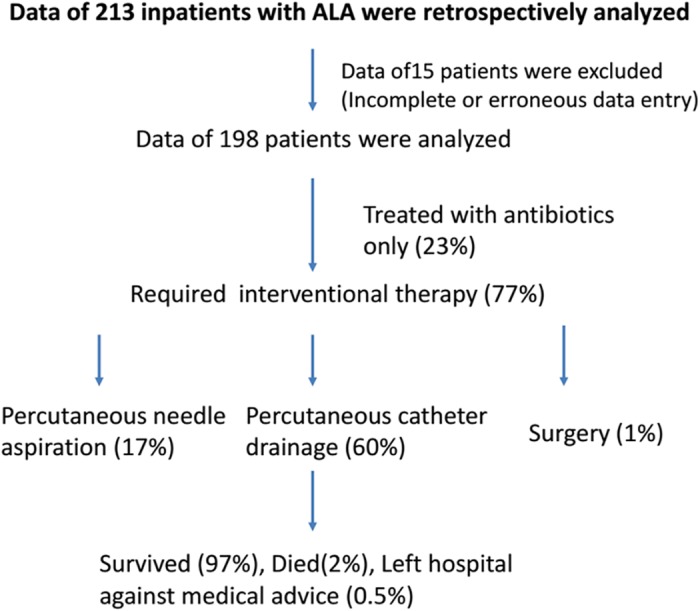
Methods: Clinicodemographic profile, therapeutic modalities, and outcomes of indoor ALA patients admitted between January 2016 and October 2017 were analyzed. An analysis of possible prognostic factors associated with complications and interventional therapy in patients with ALA was performed retrospectively.
Results: Data of 198 patients with ALA (mean age: 45 ± 12.1; M:F ratio: 193:5) were analyzed. The volume of abscess (503.1 ± 391.2: 300.2 ± 305.8 mL), elevated liver enzymes, and duration of hospital stay (11.98 ± 5.75): 10.23 ± 4.1 days) were significantly (P < 0.05) higher in alcoholic, compared to nonalcoholic, individuals. On univariate analysis, older age, duration of alcohol consumption, smoking, leukocytosis, hyperbilirubinemia, hypoalbuminemia, hyponatremia, and a larger volume of abscess were found to be significantly (P < 0.05) associated with complications. On multivariate analysis, older age, duration of alcohol consumption, smoking, leukocytosis, hyperbilirubinemia, hypoalbuminemia, and hyponatremia were found to be significantly (P < 0.05) associated with complications. Male gender, hypoalbuminemia, and larger volume of abscess were significantly (P < 0.05) associated with interventional treatment.
Conclusion: Older age, leukocytosis, hyperbilirubinemia, hypoalbuminemia, hyponatremia, chronic alcoholism, and smoking are independent factors significantly associated with complications in patients with ALA. Hypoalbuminemia, larger volume of abscess, and male gender are independent variables associated with the requirement of interventional therapy.
Keywords: Entamoeba histolytica; amoebic liver abscess; complication; interventional therapy; palm wine; prognosis; tari; toddy.
© 2019 The Authors. JGH Open: An open access journal of gastroenterology and hepatology published by Journal of Gastroenterology and Hepatology Foundation and John Wiley & Sons Australia, Ltd.
Figures
References
-
- World Health Organization . World Health Organization Pan American health organization/UNESCO report of a consultation of expert on amoebiasis. Wkly. Epidemiol. Rec. 1997; 72: 97–100.
-
- Peters RS, Gitlin N, Libke RD. Amebic liver diseases. Annu. Rev. Med. 1982; 32: 161–74. - PubMed
-
- Sharma MP, Dasarathy S, Verma N, Saksena S, Shukla DK. Prognostic markers in amebic liver abscess: a prospective study. Am. J. Gastroenterol. 1996; 91: 2584–8. - PubMed
-
- Meng XY, Wu JX. Perforated amebic liver abscess: clinical analysis of 110 cases. South. Med. J. 1994; 87: 985–90. - PubMed
LinkOut - more resources
Full Text Sources
